Sterile Technique NCLEX Questions With Rationales
What it is
Sterile technique, also called surgical asepsis, is a method of preventing the introduction of microorganisms into sterile tissues, body cavities, or invasive procedure sites. Medical asepsis, also called clean technique, reduces the number and spread of microorganisms but does not eliminate all microorganisms. Medical asepsis is used for routine activities such as bathing, oral care, handling clean equipment, and emptying drainage bags. Surgical asepsis is required for invasive procedures such as urinary catheter insertion, central venous catheter insertion, and surgical procedures.
What the NCLEX focuses on
- A sterile field contains only sterile supplies and must be protected from contamination throughout the procedure.
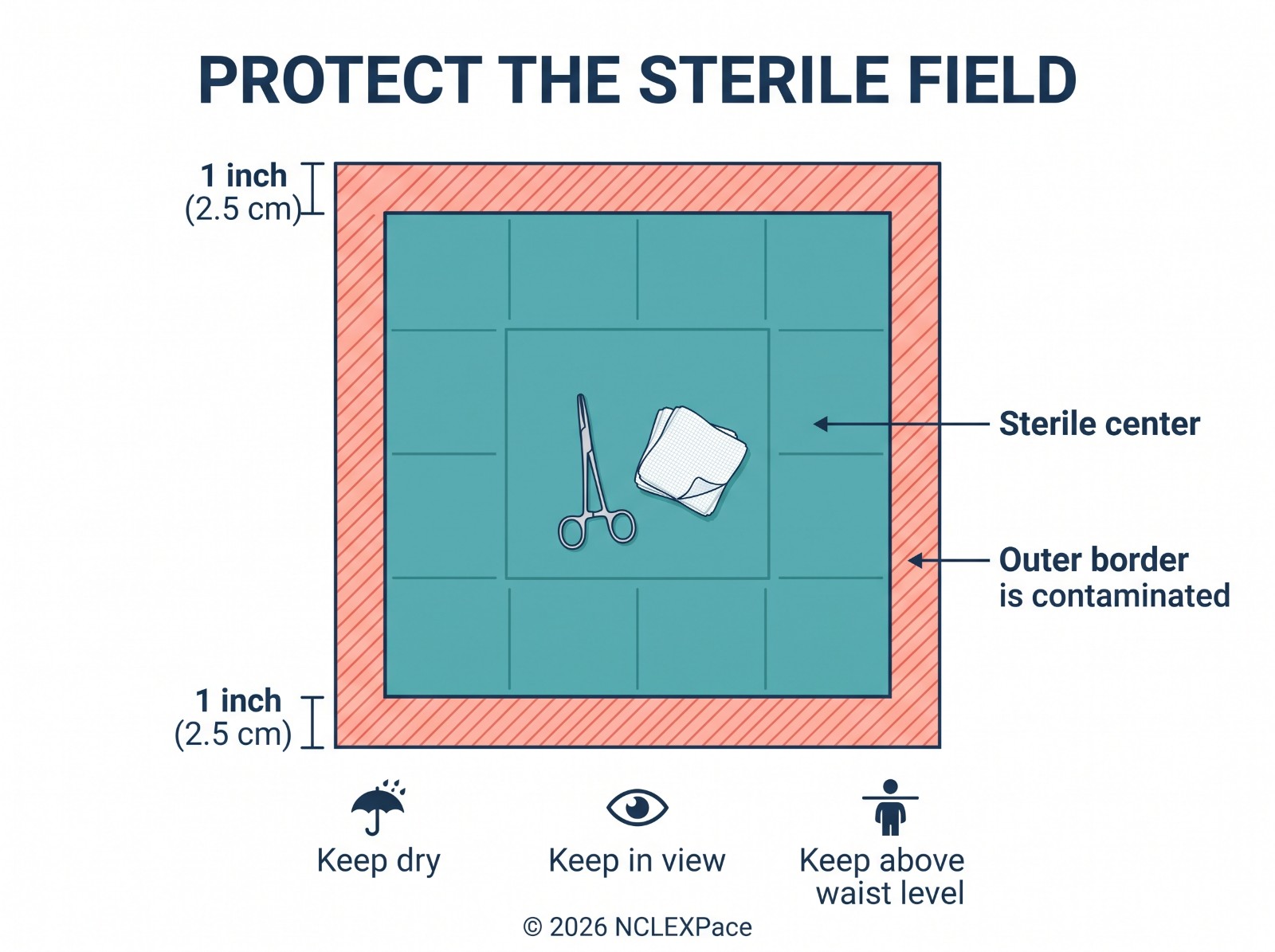
- The outer 1-inch border of a sterile drape is considered contaminated and must not be used as a sterile working surface.
- Any sterile item that falls below waist level or below the sterile field is considered contaminated.
- The nurse must maintain the sterile field within direct observation and must never turn away from an established sterile field or leave it unattended.
- Moisture causes strike-through contamination because microorganisms can travel through a wet barrier from a contaminated surface to a sterile surface.
- The nurse must never reach over a sterile field because clothing, arms, and other nonsterile objects can contaminate the supplies.
- Sterile packages must be inspected for expiration dates, moisture, tears, punctures, and appropriate sterilization indicators before use.
- Wrapped sterile packages are opened by unfolding the flap away from the body first, opening the side flaps next, and opening the flap closest to the body last.
- Sterile solution is poured into a sterile basin without reaching over the sterile field, splashing, or allowing the bottle to touch the basin.
Priority nursing actions
- Perform hand hygiene and prepare a clean, dry work surface before establishing the sterile field.
- Inspect all sterile packages and discard any package that is wet, damaged, expired, or has an inappropriate sterilization indicator.
- Open the sterile package away from the body first, followed by the side flaps and the flap closest to the body.
- Pour sterile solution carefully into the sterile basin from the side of the field, holding the container about 6 inches above it, without touching the sterile basin or splashing the field.
- Apply sterile gloves using the closed or open gloving technique appropriate to the procedure, touching only the appropriate glove surfaces.
- If contamination occurs, stop the procedure, identify the contaminated item or area, replace contaminated supplies, and reestablish the sterile field before continuing.
Common exam traps
- Choosing the outer 1-inch border as sterile: wrong because the border is considered contaminated.
- Choosing to continue after a sterile glove touches a nonsterile surface: wrong because the contaminated glove must be replaced.
- Choosing to use a wet sterile drape: wrong because moisture permits microorganisms to pass through the sterile barrier.
- Choosing to turn away briefly from the sterile field: wrong because the nurse must maintain continuous observation of the field.
- Choosing to reach across the sterile field to obtain equipment: wrong because the arm or clothing may contaminate the sterile supplies.
What to teach
- Explain that sterile technique prevents microorganisms from entering normally sterile body sites.
- Teach clients not to touch sterile equipment or supplies during invasive procedures.
- Explain that sterile supplies must remain dry, intact, and within the nurse's observation.
- Teach that contamination requires replacement of affected supplies rather than attempting to clean or reuse them.
- Explain that hand hygiene is essential before and after procedures, even when sterile gloves are worn.
2 NCLEX questions with rationales on this topic
From the NCLEXPace question bank. Choose your answer first, then open the correct answer and the full rationale under each question.
A nurse must add sterile normal saline to a basin that is already sitting on an established sterile field. Which action is correct?
Select the best answer.
- A. Place the opened bottle on an unused corner of the sterile field
- B. Reach across the field and pour into the basin from the far side
- C. Rest the bottle opening against the basin rim to steady the stream
- D. Pour slowly from 6 inches above, avoiding splashes
Show the correct answer and rationale
Correct answer:
- D. Pour slowly from 6 inches above, avoiding splashes
Rationale
Overview
- Definition: Pouring sterile solutions is an aseptic procedure that transfers sterile fluid into a sterile container without contaminating the established sterile field.
- Technique: Hold the bottle with its label against the palm. Pour slowly from approximately 6 inches (15 cm) above the basin without touching its rim or splashing.
- What contaminates the field: Nonsterile bottle surfaces, reaching across sterile supplies, and moisture penetrating a permeable drape compromise sterility through direct contact or strike-through contamination.
Nursing key points
- Hold the bottle with its label against the palm to protect the label from moisture.
- Pour from approximately 6 inches (15 cm) above the basin without touching its rim.
- Pour slowly from the near side to prevent splashing onto the sterile drape.
- Keep the nonsterile bottle exterior outside the sterile field.
- Never reach across the sterile field while pouring.
- Follow facility policy for previously opened solutions, including discarding an initial small amount when required; replace the field after strike-through contamination.
Answer analysis
| Nursing action | Rationale |
|---|---|
| Place the opened bottle on an unused corner of the sterile field | Not correct. The nonsterile bottle exterior contaminates the field on contact. |
| Reach across the field and pour into the basin from the far side | Not correct. Reaching across exposes sterile supplies to the nonsterile arm and clothing. |
| Rest the bottle opening against the basin rim to steady the stream | Not correct. Contact between the bottle and basin rim contaminates the sterile container. |
| Pour slowly from 6 inches above, avoiding splashes | Correct. A slow pour maintains separation and reduces moisture contamination. |
A nurse sets up a sterile field on the overbed table for a wound dressing change. For each observation, indicate whether the field remains sterile or is contaminated.
For each observation, identify whether the field remains sterile or is contaminated.
| Field remains sterile | Field is contaminated | |
|---|---|---|
| A sterile syringe is dropped onto the field from 6 inches above | ||
| The nurse reaches across the field for the antiseptic swab | ||
| The nurse turns toward the door to answer a knock | ||
| Sterile gauze is placed 3 inches inside the edge of the drape | ||
| A wet spot spreads through the drape from the table underneath |
Show the correct answer and rationale
Correct answers:
- A sterile syringe is dropped onto the field from 6 inches above: Field remains sterile
- The nurse reaches across the field for the antiseptic swab: Field is contaminated
- The nurse turns toward the door to answer a knock: Field is contaminated
- Sterile gauze is placed 3 inches inside the edge of the drape: Field remains sterile
- A wet spot spreads through the drape from the table underneath: Field is contaminated
Rationale
Overview
- Definition: Maintaining a sterile field preserves asepsis by preventing contact with nonsterile surfaces, microorganisms, and contaminated moisture.
- Sterile technique: Place sterile supplies within the sterile working area, beyond the outer 1-inch (2.5-cm) border. Keep the field continuously visible.
- Contamination: Turning away, reaching across the field with nonsterile clothing, or moisture passing through the drape compromises sterility.
Nursing key points
- Keep the sterile field above waist level and continuously within sight.
- Treat the outer 1 inch (2.5 cm) of the sterile drape as contaminated.
- Add sterile supplies from approximately 6 inches above the field without touching the field with nonsterile packaging.
- Prevent moisture from passing through the sterile drape from a nonsterile surface.
- Never reach across a sterile field with nonsterile hands, arms, or clothing.
- Discard a contaminated field and establish a new sterile field before continuing.
Answer analysis
| Observation during the setup | Field status | Why |
|---|---|---|
| A sterile syringe is dropped onto the field from 6 inches above | Field remains sterile. | The sterile syringe enters the field without contact with nonsterile hands or packaging. |
| The nurse reaches across the field for the antiseptic swab | Field is contaminated. | Nonsterile clothing passes over the sterile working area. |
| The nurse turns toward the door to answer a knock | Field is contaminated. | The nurse loses continuous observation and cannot verify continued sterility. |
| Sterile gauze is placed 3 inches inside the edge of the drape | Field remains sterile. | The gauze rests beyond the contaminated outer 1-inch border. |
| A wet spot spreads through the drape from the table underneath | Field is contaminated. | Moisture produces strike-through contamination from the nonsterile table. |
The NCLEXPace bank has 3,200+ NCLEX questions with full rationales, sorted by topic, with your progress tracked as you practice. Create your account to start.
Create Account →More topics in Fundamentals
Postmortem Care NCLEX Questions With RationalesCovers respectful care of the body after death, legal pronouncement, organ donation referral, preservation of evidence, family support, and documentation.Carbon Monoxide Poisoning NCLEX Questions With RationalesCovers carbon monoxide exposure, clinical manifestations, diagnostic testing, emergency oxygen therapy, complications, and prevention.Scabies and Head Lice NCLEX Questions With RationalesReviews scabies and head lice transmission, clinical findings, treatment, infection control, prevention, and nursing interventions.Sources
- National Library of Medicine. Sterile Technique. 2022.
- National Library of Medicine. Chapter 4: Aseptic Technique. 2021.
3,200+ NCLEX questions with think-like-a-nurse rationales, unfolding case studies and adaptive readiness exams. Start with free practice questions, then choose a plan when you are ready.
Create Account →