Safe Sleep and SIDS NCLEX Questions With Rationales
What it is
Sudden infant death syndrome (SIDS) is the sudden, unexplained death of an infant younger than 1 year of age that remains unexplained after a complete investigation. SIDS is one type of sudden unexpected infant death (SUID), which also includes explained sleep-related deaths such as accidental suffocation and strangulation. Safe sleep practices reduce the risk of sleep-related infant deaths but cannot eliminate SIDS completely.
What the NCLEX focuses on
- Always place infants on their backs for every sleep, including naps and nighttime, until their first birthday.
- Use a firm, flat, level, noninclined sleep surface, such as a safety-approved crib, bassinet, or portable crib with a fitted sheet.
- Room sharing without bed sharing is recommended, ideally for at least the first 6 months of life.
- Keep pillows, blankets, quilts, stuffed toys, bumper pads, and other soft objects out of the infant's sleep area.
- Prevent overheating by dressing infants appropriately and avoiding excessive clothing, blankets, and head coverings.
- Offer a pacifier at naps and bedtime, waiting until breastfeeding is well established before introducing one when breastfeeding.
- Breastfeeding or feeding human milk is associated with a reduced risk of SIDS.
- Routine immunizations according to CDC and AAP recommendations are recommended because immunization is associated with reduced SIDS risk.
- Avoid prenatal and postnatal exposure to tobacco smoke, nicotine, alcohol, marijuana, opioids, and illicit drugs.
- Never use weighted blankets, weighted sleep sacks, or weighted swaddles for infants.
Priority nursing actions
- Assess the infant's sleeping environment and identify unsafe positioning, bedding, and sleep products.
- Teach caregivers to place the infant supine on a separate, firm, flat, noninclined sleep surface for every sleep.
- Demonstrate safe swaddling when appropriate, keeping the hips and legs able to move freely and avoiding overheating. Stop swaddling as soon as the infant shows signs of attempting to roll.
- Encourage supervised tummy time while the infant is awake to support motor development and prevent positional plagiocephaly.
- Instruct caregivers to transfer an infant who falls asleep in a car seat, stroller, swing, or carrier to a firm, flat sleep surface as soon as possible.
- Assess caregiver understanding and reinforce consistent safe sleep practices with every caregiver.
Numbers to know
| Value | Number | Why it matters |
|---|---|---|
| Peak SIDS age | 1 to 4 months | This is the period of greatest SIDS incidence. |
| SIDS deaths before 6 months | 90% | Most SIDS deaths occur during the first 6 months. |
| Room sharing | At least 6 months | Keep the infant's separate sleep space in the caregiver's room. |
| Safe sleep positioning | Until 1 year | Continue placing the infant on the back for every sleep. |
| Daily tummy time goal | 15 to 30 minutes by 7 weeks | Build up supervised awake tummy time gradually. |
Common exam traps
- Choosing side sleeping: wrong because the infant can roll onto the stomach, increasing sleep-related death risk.
- Choosing prone sleeping to prevent aspiration: wrong because back sleeping is recommended even for infants with gastroesophageal reflux.
- Choosing a soft mattress or crib bumper: wrong because soft materials increase suffocation, entrapment, and strangulation risks.
- Choosing bed sharing instead of room sharing: wrong because sharing an adult sleep surface increases the risk of suffocation and sleep-related death.
- Choosing continued swaddling after rolling begins: wrong because restricted movement increases the risk of an unsafe position and suffocation.
What to teach
- Place the infant on the back for every nap and nighttime sleep, even when the infant can roll independently. Once the infant can roll in both directions, the infant can remain in the position independently assumed after being placed on the back.
- Use only an approved crib, bassinet, or portable crib with a firm mattress and fitted sheet.
- Never use a car seat, swing, inclined sleeper, or infant carrier as a routine sleep location.
- Keep the infant's environment smoke-free and avoid alcohol and drug exposure during pregnancy and after birth.
- Encourage breastfeeding when possible, routine immunizations, and pacifier use once breastfeeding is established.
2 NCLEX questions with rationales on this topic
From the NCLEXPace question bank. Choose your answer first, then open the correct answer and the full rationale under each question.
Which infant sleep arrangement best reflects current safe-sleep recommendations for the first 6 months?
Select the best answer.
- A. The infant sleeps on the stomach in a separate crib with a rolled blanket
- B. The infant sleeps on the back in a separate nursery across the hall
- C. The infant sleeps on the back in the parents' bed between feedings
- D. The infant sleeps on the back, in their own crib, in the parents' room
Show the correct answer and rationale
Correct answer:
- D. The infant sleeps on the back, in their own crib, in the parents' room
Rationale
Overview
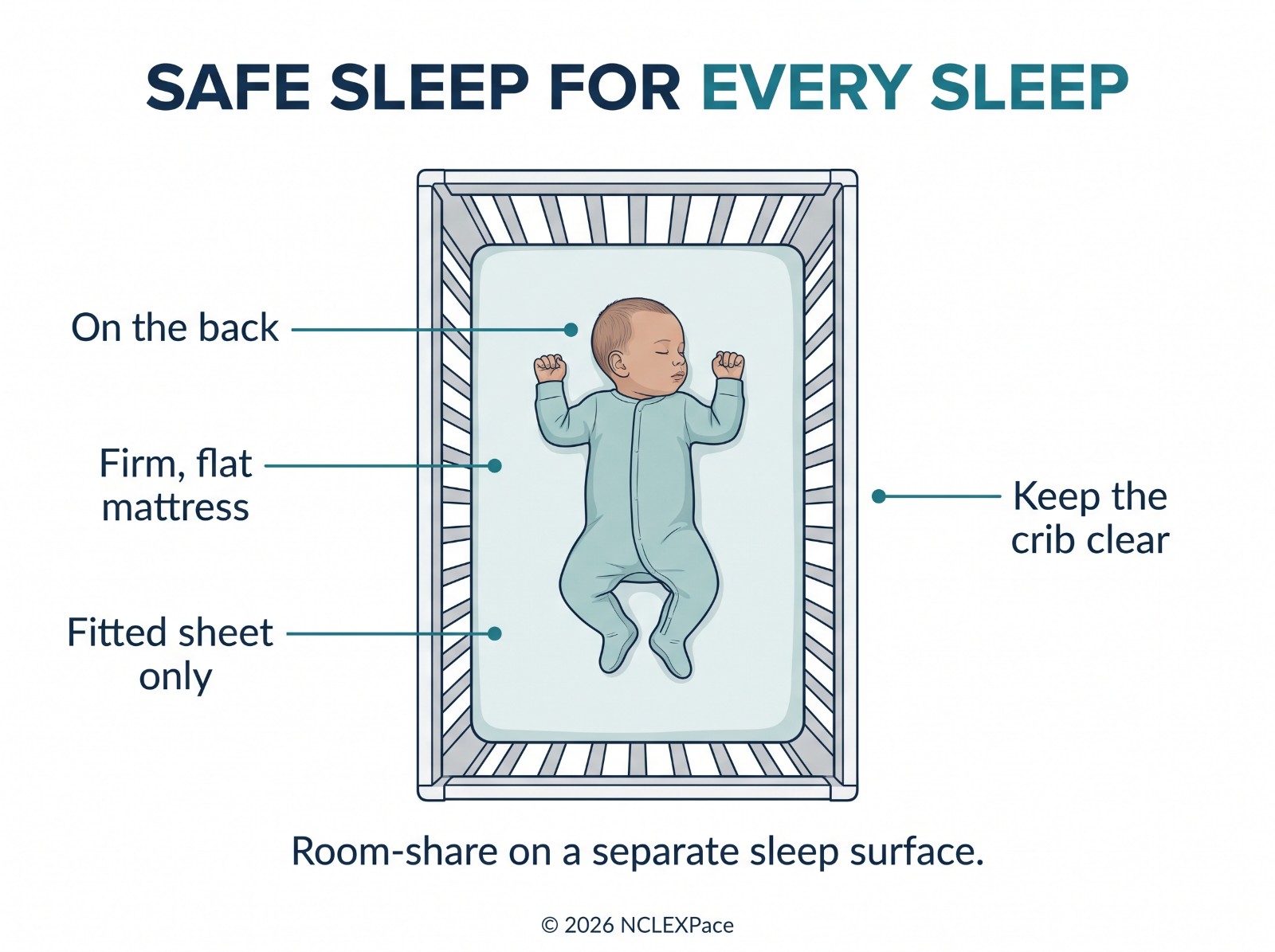
- Definition: Room-sharing without bed-sharing means the infant sleeps on a separate, approved sleep surface in the caregivers' bedroom.
- Prevention: Room-sharing is associated with a reduction in sudden infant death syndrome risk of up to 50%. It is recommended for at least the first 6 months.
- Teaching: Place the infant supine on a firm, flat, noninclined mattress with a fitted sheet. Remove pillows, blankets, toys, and positioning devices.
Nursing key points
- Place the infant supine for every sleep throughout the first year.
- Maintain room-sharing without bed-sharing for at least 6 months.
- Use a firm, flat crib or bassinet mattress with a fitted sheet.
- Keep blankets, pillows, toys, and sleep positioners outside the crib.
- Return the infant to the separate sleep surface after feeding.
- Avoid smoke exposure and overheating during sleep.
Answer analysis
| Sleep arrangement | Rationale |
|---|---|
| The infant sleeps on the stomach in a separate crib with a rolled blanket | Not correct. Prone positioning and loose bedding increase sleep-related death risk. |
| The infant sleeps on the back in a separate nursery across the hall | Not correct. A separate nursery lacks the protective benefit of recommended room-sharing. |
| The infant sleeps on the back in the parents' bed between feedings | Not correct. Adult beds create suffocation, entrapment, and overlay hazards. |
| The infant sleeps on the back, in their own crib, in the parents' room | Correct. Supine positioning and room-sharing without bed-sharing meet recommended safe-sleep practices. |
A new parent asks if it's okay to let their 2-month-old sleep on their stomach since the baby seems to sleep more soundly that way. Which response is most appropriate?
Select the best answer.
- A. "Stomach sleeping can be used if the mattress is firm, the crib is empty, and you check the baby's position regularly during the night."
- B. "Use back sleeping for daytime naps, but stomach sleeping at night is acceptable when an adult is nearby and checking frequently."
- C. "Always place your baby on the back to sleep, for every sleep, to reduce SIDS risk."
- D. "Place the baby on the side with the back supported by a rolled blanket so the infant does not turn fully onto the stomach."
Show the correct answer and rationale
Correct answer:
- C. "Always place your baby on the back to sleep, for every sleep, to reduce SIDS risk."
Rationale
Overview
- Definition: Back-to-sleep positioning is the practice of placing every infant supine at the beginning of every sleep throughout the first year to reduce sudden infant death syndrome (SIDS).
- Physiology: Prone sleeping reduces arousability and increases the risk of rebreathing exhaled air, contributing to SIDS risk.
- Prevention: The Back to Sleep campaign began in 1994, and U.S. SIDS rates subsequently decreased by more than half.
- Safe positioning: Supine sleep is recommended for naps and nighttime sleep. Side and prone positioning increase risk.
Nursing key points
- Place the infant supine at the beginning of every sleep until 1 year of age.
- Use a firm, flat mattress with a fitted sheet and no loose bedding.
- Explain that sounder prone sleep reflects reduced arousability rather than increased safety.
- Provide supervised prone tummy time only while the infant is awake.
- Once the infant independently rolls both ways, continue supine placement but do not repeatedly reposition the infant.
- Teach caregivers that frequent checking does not make prone or side sleeping safe.
Answer analysis
| Nurse's response to the parent | Rationale |
|---|---|
| "Stomach sleeping can be used if the mattress is firm, the crib is empty, and you check the baby's position regularly during the night." | Not correct. Frequent checking and an empty crib do not eliminate the increased SIDS risk of prone positioning. |
| "Use back sleeping for daytime naps, but stomach sleeping at night is acceptable when an adult is nearby and checking frequently." | Not correct. Supine positioning is required at the start of every nap and nighttime sleep. |
| "Always place your baby on the back to sleep, for every sleep, to reduce SIDS risk." | Correct. Placing the infant supine for every sleep reduces SIDS risk throughout infancy. |
| "Place the baby on the side with the back supported by a rolled blanket so the infant does not turn fully onto the stomach." | Not correct. Side positioning is unstable, and rolled blankets create additional sleep hazards. |
The NCLEXPace bank has 3,200+ NCLEX questions with full rationales, sorted by topic, with your progress tracked as you practice. Create your account to start.
Create Account →More topics in Pediatrics
Measles and Varicella NCLEX Questions With RationalesReviews measles and chickenpox symptoms, transmission, isolation, complications, treatment, vaccination, and nursing interventions.Pertussis (Whooping Cough) NCLEX Questions With RationalesCovers pertussis stages, transmission, diagnosis, antibiotic treatment, isolation, infant complications, nursing interventions, and vaccination.Wilms Tumor NCLEX Questions With RationalesCovers Wilms tumor manifestations, prevention of tumor rupture, surgical treatment, postoperative nursing care, and long-term kidney protection.Sources
- CDC. Providing Care for Babies to Sleep Safely. 2024.
- National Institute of Child Health and Human Development. Frequently Asked Questions. Current edition.
- National Institute of Child Health and Human Development. Safe Sleep Environment for Baby. Current edition.
- American Academy of Pediatrics. How to Keep Your Sleeping Baby Safe: AAP Policy Explained. Current edition.
3,200+ NCLEX questions with think-like-a-nurse rationales, unfolding case studies and adaptive readiness exams. Start with free practice questions, then choose a plan when you are ready.
Create Account →