Rheumatoid Arthritis NCLEX Questions With Rationales
What it is
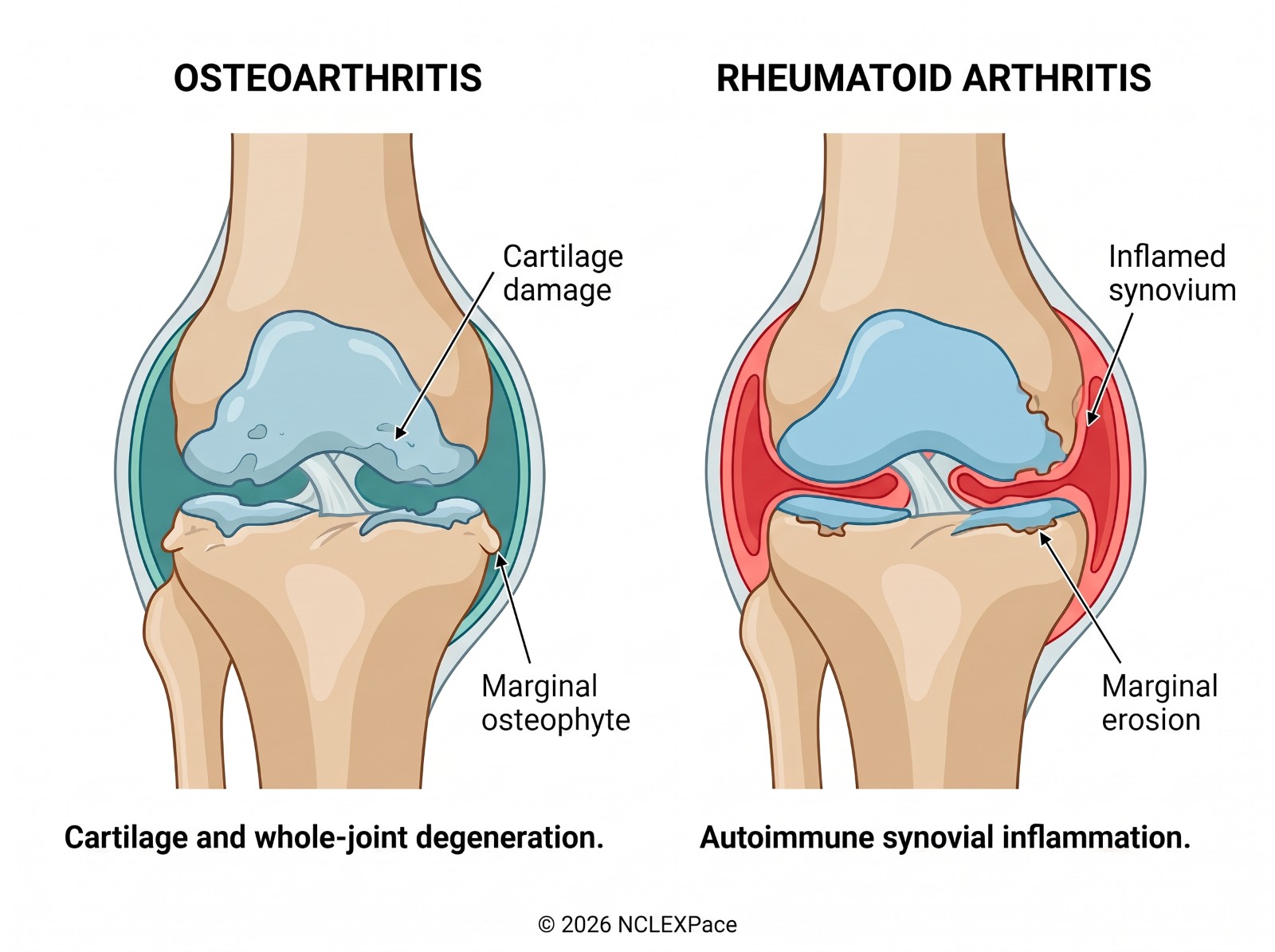
Rheumatoid arthritis (RA) is a chronic systemic autoimmune disease that causes inflammation of the synovial lining of joints. It commonly produces symmetric joint swelling, tenderness, pain, and prolonged morning stiffness, especially in the hands, wrists, and feet. Unlike osteoarthritis, which involves changes in joint cartilage and other joint tissues, RA is primarily an inflammatory autoimmune condition that can cause progressive joint destruction. Early treatment with disease-modifying antirheumatic drugs (DMARDs) helps prevent irreversible damage.
What the NCLEX focuses on
- RA commonly affects corresponding joints on both sides of the body in a symmetric pattern.
- Morning stiffness in RA typically lasts longer than 30 minutes and often improves with movement.
- Osteoarthritis stiffness is generally shorter and mechanical joint pain commonly worsens with activity.
- RA can cause systemic findings such as fatigue, low-grade fever, anemia, and inflammation outside the joints.
- Methotrexate is a conventional synthetic DMARD that slows inflammatory joint damage.
- Methotrexate for RA is generally administered once weekly, never routinely every day.
- Folic acid is commonly prescribed with methotrexate to reduce adverse effects.
- Methotrexate requires regular monitoring of blood counts, liver function, and kidney function.
- Other treatments include hydroxychloroquine, sulfasalazine, leflunomide, biologic DMARDs, and targeted synthetic DMARDs; NSAIDs and corticosteroids may provide symptom relief.
Priority nursing actions
- Assess joint swelling, pain, stiffness, movement limitations, functional ability, and systemic symptoms.
- Monitor for fever or other infection symptoms in clients receiving immunosuppressive medications and promptly report concerning findings.
- Verify the prescribed weekly methotrexate schedule and report any suspected dosing error immediately.
- Review prescribed laboratory monitoring, including complete blood count, liver enzymes, and kidney function, and report abnormal results.
- Administer prescribed medications, assess for adverse effects, and reinforce joint protection and balanced activity.
Numbers to know
| Value | Number | Why it matters |
|---|---|---|
| Typical RA morning stiffness | More than 30 minutes | Prolonged stiffness supports an inflammatory arthritis pattern. |
| Typical methotrexate dosing frequency | Once every 7 days | Daily administration for RA can cause serious toxicity. |
| Common oral methotrexate starting dose | 10 to 15 mg once weekly | The provider individualizes dosing according to response and tolerance. |
| Folic acid supplementation | At least 5 mg per week | Prescribed supplementation reduces methotrexate adverse effects. |
| Initial methotrexate laboratory monitoring | About monthly for the first 3 months | Early monitoring helps identify blood, liver, and kidney toxicity. |
| Initial methotrexate symptom improvement | 3 to 6 weeks | Clinical improvement may develop gradually rather than immediately. |
Common exam traps
- Choosing daily methotrexate for RA: wrong because standard RA treatment uses weekly dosing.
- Choosing NSAIDs as the only long-term disease-controlling treatment: wrong because NSAIDs relieve symptoms without preventing progressive joint destruction.
- Choosing complete bed rest throughout treatment: wrong because appropriate activity maintains strength and joint mobility.
- Choosing to ignore fever during methotrexate treatment: wrong because immunosuppression increases concern for serious infection.
- Choosing to discontinue methotrexate when pain persists initially: wrong because its therapeutic benefit develops over several weeks.
What to teach
- Take methotrexate only on the prescribed weekly schedule and take folic acid as directed.
- Avoid alcohol during methotrexate treatment because of the risk of liver injury.
- Report fever, mouth sores, unusual bruising, bleeding, or new shortness of breath promptly.
- Avoid pregnancy and breastfeeding during methotrexate therapy and discuss pregnancy planning with the prescribing provider.
- Balance rest during inflammatory flares with appropriate low-impact exercise and regular movement.
- Protect painful joints with assistive devices, energy conservation, and occupational therapy techniques when recommended.
2 NCLEX questions with rationales on this topic
From the NCLEXPace question bank. Choose your answer first, then open the correct answer and the full rationale under each question.
A client is being evaluated for rheumatoid arthritis. Which assessment finding does the nurse expect?
Select the best answer.
- A. Unilateral knee pain that worsens with prolonged walking, improves with rest, and is accompanied by crepitus during movement
- B. Firm painless bony enlargements at several distal finger joints that have gradually increased in size over several years
- C. Hip and knee stiffness that improves within about 15 minutes after getting up but returns after prolonged sitting or inactivity
- D. Warm, swollen, tender joints of both wrists with stiffness lasting more than an hour each morning
Show the correct answer and rationale
Correct answer:
- D. Warm, swollen, tender joints of both wrists with stiffness lasting more than an hour each morning
Rationale
Overview
- Definition: Rheumatoid arthritis is a systemic autoimmune disease that produces chronic inflammatory synovitis and progressive joint damage.
- Signs and symptoms: Symmetric warmth, swelling, and tenderness affect the wrists and small joints of the hands and feet. Morning stiffness commonly lasts more than 1 hour.
- Systemic manifestations: Fatigue, low-grade fever, and weight loss accompany active inflammatory disease.
Nursing key points
- Assess bilateral wrists, metacarpophalangeal joints, and proximal interphalangeal joints for synovitis.
- Record morning stiffness duration; stiffness exceeding 1 hour indicates an inflammatory pattern.
- Assess fatigue, low-grade fever, weight changes, and limitations in daily activities.
- Review prescribed rheumatoid factor, anti-CCP antibodies, ESR, and CRP results.
- Report persistent swelling, reduced range of motion, and progressive functional impairment.
Answer analysis
| Assessment finding | Rationale |
|---|---|
| Unilateral knee pain that worsens with prolonged walking, improves with rest, and is accompanied by crepitus during movement | Not correct. Mechanical pain and crepitus characterize osteoarthritis. |
| Firm painless bony enlargements at several distal finger joints that have gradually increased in size over several years | Not correct. Heberden nodes are characteristic of osteoarthritis. |
| Hip and knee stiffness that improves within about 15 minutes after getting up but returns after prolonged sitting or inactivity | Not correct. Brief stiffness following inactivity characterizes osteoarthritis. |
| Warm, swollen, tender joints of both wrists with stiffness lasting more than an hour each morning | Correct. Symmetric synovitis and prolonged morning stiffness characterize rheumatoid arthritis. |
A client with rheumatoid arthritis is starting methotrexate. Which client statements indicate correct understanding? Select all that apply.
- A. “I will use reliable contraception while I take this medication.”
- B. “I will keep taking it even on weeks when my joints feel fine.”
- C. “I take methotrexate once a week, not every day, and folic acid as prescribed.”
- D. “I can stop the medication once the swelling goes down.”
- E. “I will avoid alcohol and have my blood tests done on schedule.”
- F. “I will call if I get a fever, a sore throat, mouth sores, or unusual bruising.”
Show the correct answer and rationale
Correct answers:
- A. “I will use reliable contraception while I take this medication.”
- B. “I will keep taking it even on weeks when my joints feel fine.”
- C. “I take methotrexate once a week, not every day, and folic acid as prescribed.”
- E. “I will avoid alcohol and have my blood tests done on schedule.”
- F. “I will call if I get a fever, a sore throat, mouth sores, or unusual bruising.”
Rationale
Overview
- Definition: Methotrexate is a disease-modifying antirheumatic drug (DMARD) that suppresses rheumatoid inflammation and prevents progressive joint damage.
- Treatment: Methotrexate is administered once weekly with prescribed folic acid. Treatment continues during symptom improvement.
- Safety: Methotrexate causes hepatotoxicity, bone marrow suppression, and fetal harm. Accidental daily dosing causes severe or fatal toxicity.
Nursing key points
- Verify the prescribed weekly dose and administration day. Never administer methotrexate daily for rheumatoid arthritis.
- Administer folic acid as prescribed to reduce adverse effects.
- Monitor CBC, liver enzymes, and renal function every 1 to 3 months according to the treatment plan.
- Teach pregnancy prevention during treatment and for the prescribed interval after discontinuation.
- Instruct the client to avoid alcohol and report fever, sore throat, mouth ulcers, unusual bruising, or persistent cough immediately.
Answer analysis
| Client statement | Rationale |
|---|---|
| “I will use reliable contraception while I take this medication.” | Include. Methotrexate is teratogenic. |
| “I will keep taking it even on weeks when my joints feel fine.” | Include. Continuous treatment prevents inflammatory progression. |
| “I take methotrexate once a week, not every day, and folic acid as prescribed.” | Include. Weekly dosing prevents fatal dosing errors; folic acid reduces toxicity. |
| “I can stop the medication once the swelling goes down.” | Do not include. Symptom improvement does not justify stopping therapy. |
| “I will avoid alcohol and have my blood tests done on schedule.” | Include. Alcohol increases hepatotoxicity; laboratory monitoring identifies toxicity. |
| “I will call if I get a fever, a sore throat, mouth sores, or unusual bruising.” | Include. These findings indicate potential myelosuppression or mucosal toxicity. |
The NCLEXPace bank has 3,200+ NCLEX questions with full rationales, sorted by topic, with your progress tracked as you practice. Create your account to start.
Create Account →More topics in Medical-Surgical
Lyme Disease NCLEX Questions With RationalesCovers Lyme disease stages, clinical manifestations, doxycycline treatment, tick removal, nursing priorities, and prevention.Influenza NCLEX Questions With RationalesReviews seasonal influenza symptoms, high-risk groups, antiviral treatment, isolation, vaccination, complications, and nursing care.Atopic Dermatitis (Eczema) NCLEX Questions With RationalesReviews childhood eczema manifestations, age-related distribution, triggers, skin care, topical medications, infection prevention, and parent education.Sources
- National Institute of Arthritis and Musculoskeletal and Skin Diseases. Rheumatoid Arthritis Symptoms, Causes, and Risk Factors. 2022.
- National Institute of Arthritis and Musculoskeletal and Skin Diseases. Rheumatoid Arthritis: Diagnosis, Treatment, and Steps to Take. 2022.
- American College of Rheumatology. Methotrexate. 2026.
- Merck Manual Professional Edition. Rheumatoid Arthritis. 2026.
3,200+ NCLEX questions with think-like-a-nurse rationales, unfolding case studies and adaptive readiness exams. Start with free practice questions, then choose a plan when you are ready.
Create Account →