Rh Incompatibility NCLEX Questions With Rationales
What it is
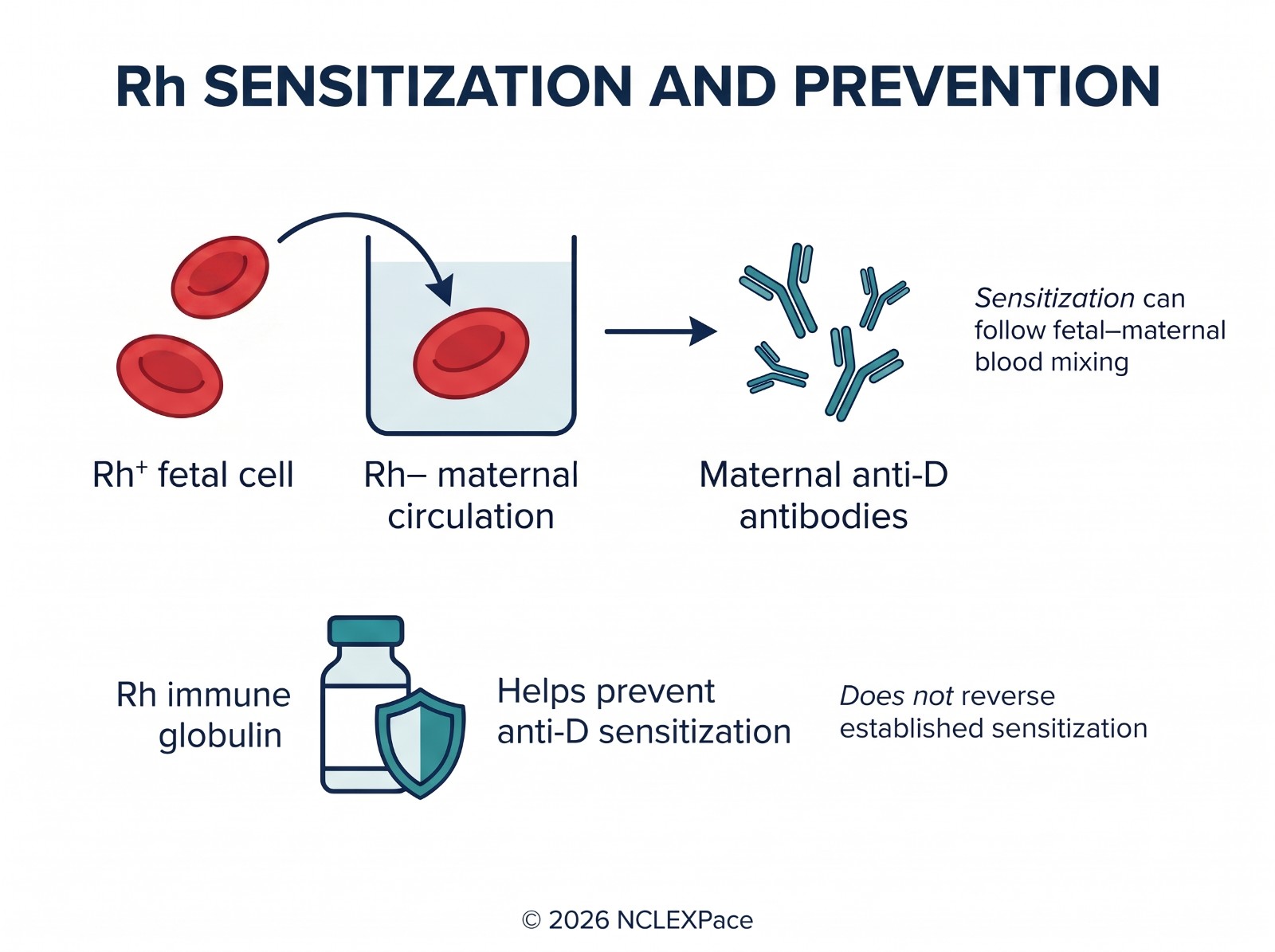
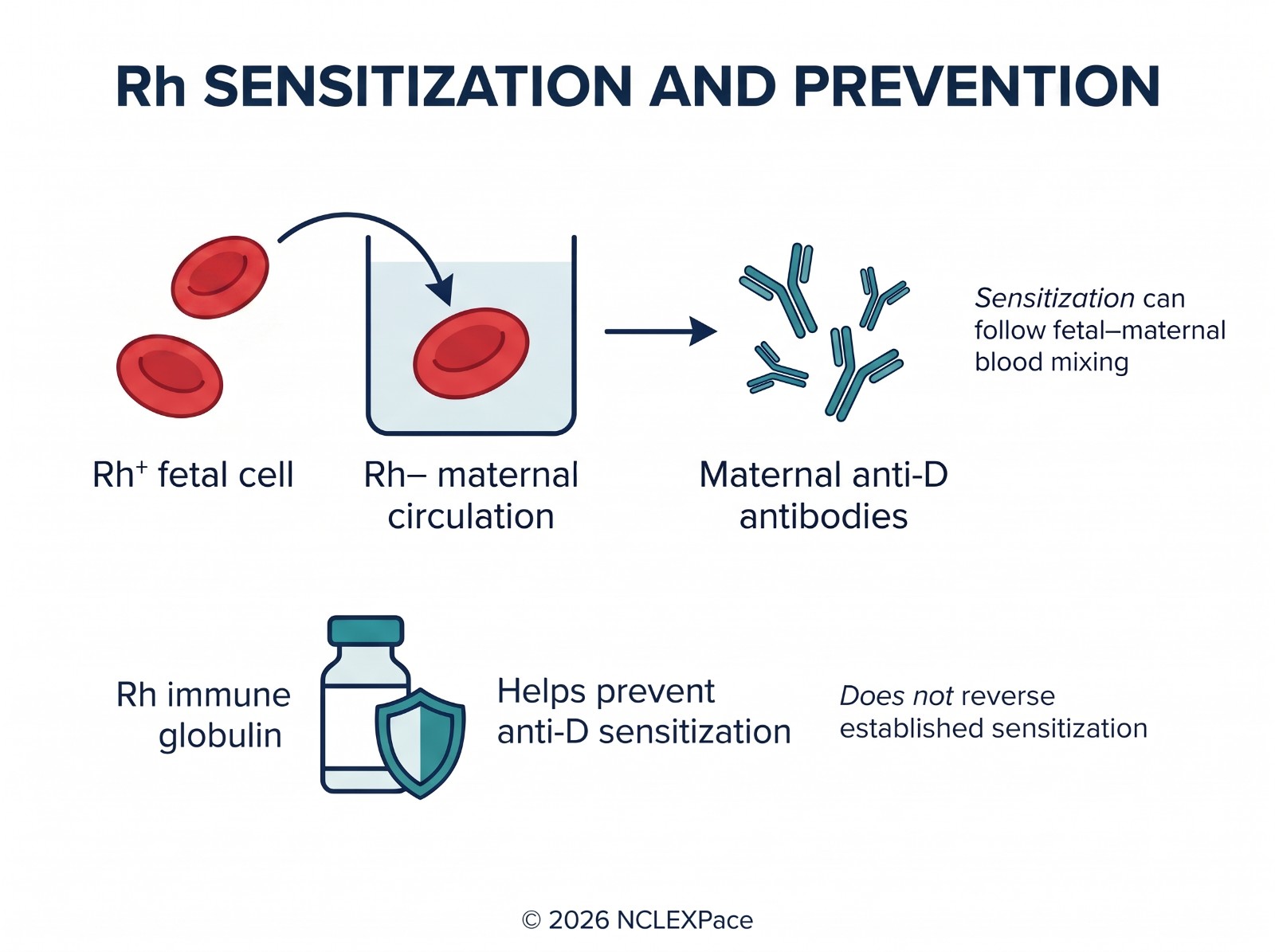
Rh incompatibility occurs when an Rh-negative mother carries an Rh-positive fetus and fetal red blood cells enter the maternal circulation, stimulating the mother to produce anti-D antibodies. This process is called Rh sensitization or alloimmunization. Maternal IgG anti-D antibodies can cross the placenta during a subsequent or ongoing pregnancy and destroy fetal red blood cells, causing hemolytic disease of the fetus and newborn (HDFN). Prevention with Rho(D) immune globulin is essential in unsensitized Rh-negative mothers.
What the NCLEX focuses on
- An Rh-negative mother carrying an Rh-positive fetus is at risk for Rh sensitization when fetal red blood cells enter her circulation.
- Previous pregnancies, miscarriage, ectopic pregnancy, abortion, abdominal trauma, vaginal bleeding, invasive prenatal procedures, and delivery can expose the mother to fetal Rh-positive blood.
- The indirect Coombs test, also called the indirect antiglobulin test, detects circulating maternal antibodies against red blood cell antigens.
- An Rh-negative mother should have an antibody screen during the initial prenatal assessment and repeat screening before routine Rh immune globulin administration.
- Rho(D) immune globulin prevents sensitization by binding fetal Rh-positive red blood cells in the maternal circulation before the mother's immune system develops its own anti-D antibodies.
- Routine prophylaxis is administered at approximately 28 weeks of gestation to an unsensitized Rh-negative mother when fetal Rh-positive status is possible.
- After delivery, Rho(D) immune globulin is indicated when an Rh-negative mother delivers an Rh-positive infant and has not already become sensitized.
- When the mother is already sensitized, Rho(D) immune globulin no longer helps. Antibody titers are followed, and the fetus is monitored for anemia with middle cerebral artery Doppler studies.
- Fetal hemolysis can cause anemia, hyperbilirubinemia, jaundice, hepatosplenomegaly, and severe hydrops fetalis.
- Severe untreated neonatal hyperbilirubinemia can cause kernicterus, resulting in permanent neurologic injury.
Priority nursing actions
- Verify maternal ABO and Rh blood type and obtain the prescribed maternal antibody screen during prenatal care.
- Identify potential sensitizing events, including vaginal bleeding, pregnancy loss, abdominal trauma, amniocentesis, and other invasive procedures, and promptly notify the obstetric provider.
- Verify that the maternal antibody screen is negative for immune anti-D before administering prophylactic Rho(D) immune globulin.
- Administer the prescribed Rho(D) immune globulin at the recommended gestational time and after qualifying sensitizing events.
- After delivery, verify the newborn's Rh status and administer postpartum prophylaxis when indicated.
- Monitor an at-risk newborn for anemia, early jaundice, elevated bilirubin, and other findings of hemolysis, and report abnormal findings promptly.
Numbers to know
| Value | Number | Why it matters |
|---|---|---|
| Routine antepartum prophylaxis | 28 weeks | Prevents maternal sensitization during the third trimester. |
| Postpartum administration | Within 72 hours | Administer when the newborn is Rh-positive and the mother is unsensitized. |
| Standard RhoGAM dose | 300 mcg | Standard full dose used for routine antepartum and postpartum prophylaxis in the United States. |
| Newborn jaundice of concern | Within 24 hours | Jaundice appearing this early requires prompt evaluation for possible hemolysis. |
Common exam traps
- Choosing Rho(D) immune globulin for an already sensitized mother: wrong because prophylactic Rh immune globulin does not reverse established maternal anti-D antibody production.
- Choosing postpartum Rh immune globulin for every Rh-negative mother: wrong because postpartum prophylaxis depends on the newborn's Rh status and maternal sensitization status.
- Choosing the direct Coombs test to screen maternal circulating antibodies: wrong because the indirect Coombs test detects antibodies in maternal serum, whereas the direct test detects antibodies attached to red blood cells.
- Choosing to delay Rh immune globulin after delivery: wrong because administration is most effective within 72 hours.
- Choosing to administer Rh immune globulin only after the first pregnancy: wrong because sensitization can occur during an initial pregnancy or following a sensitizing event.
What to teach
- Explain that Rh incompatibility does not automatically mean the fetus has hemolytic disease.
- Teach the mother the importance of receiving scheduled Rho(D) immune globulin even when the pregnancy is progressing normally.
- Instruct the mother to report vaginal bleeding, abdominal trauma, miscarriage, or invasive prenatal procedures promptly because additional prophylaxis may be necessary.
- Explain that postpartum prophylaxis is needed when the newborn is Rh-positive, even if antepartum prophylaxis was received.
- Teach that each pregnancy requires reassessment of maternal blood type and antibody status because Rh immune globulin does not provide permanent protection.
2 NCLEX questions with rationales on this topic
From the NCLEXPace question bank. Choose your answer first, then open the correct answer and the full rationale under each question.
An Rh-negative client at 28 weeks of gestation in her third pregnancy has a positive indirect Coombs test with an anti-D titer of 1:32. Which plan of care should the nurse anticipate?
Select the best answer.
- A. Rh immune globulin 300 mcg now, with a postpartum dose if the newborn is Rh positive
- B. Serial middle cerebral artery Doppler studies for fetal anemia
- C. Routine prenatal follow-up, because the antibodies show past exposure only
- D. Repeat the anti-D titer at 36 weeks and decide then about further testing
Show the correct answer and rationale
Correct answer:
- B. Serial middle cerebral artery Doppler studies for fetal anemia
Rationale
Overview
- Definition: Rh alloimmunization occurs when an Rh-negative client develops immune anti-D antibodies. These antibodies cross the placenta and destroy Rh-positive fetal erythrocytes, causing fetal anemia and hemolytic disease of the fetus and newborn.
- Surveillance: A critical anti-D titer, commonly 1:16, requires assessment of fetal antigen status and surveillance for fetal anemia when the fetus is susceptible.
- Diagnosis: Middle cerebral artery peak systolic velocity (MCA-PSV) above 1.5 multiples of the median indicates significant fetal anemia and requires specialist evaluation.
Nursing key points
- Verify that the positive anti-D represents immune sensitization rather than passive antibodies from recent prophylaxis.
- Refer promptly to maternal-fetal medicine for a critical anti-D titer of 1:32.
- Arrange MCA-PSV Doppler surveillance approximately every 1 to 2 weeks when the fetus is at risk.
- Report MCA-PSV above 1.5 multiples of the median for fetal anemia evaluation.
- Prepare for fetal blood sampling and intrauterine transfusion when indicated.
- Anticipate individualized birth planning, often at 37 to 38 weeks in stable pregnancies, and neonatal assessment for anemia and hyperbilirubinemia.
Answer analysis
| Plan of care | Rationale |
|---|---|
| Rh immune globulin 300 mcg now, with a postpartum dose if the newborn is Rh positive | Not correct. Rh immune globulin prevents anti-D sensitization and does not treat established immune alloimmunization. |
| Serial middle cerebral artery Doppler studies for fetal anemia | Correct. Increased MCA peak systolic velocity identifies fetal anemia caused by maternal anti-D-mediated hemolysis. |
| Routine prenatal follow-up, because the antibodies show past exposure only | Not correct. A clinically significant anti-D titer places an antigen-positive fetus at risk for severe anemia and hydrops fetalis. |
| Repeat the anti-D titer at 36 weeks and decide then about further testing | Not correct. A titer of 1:32 requires prompt fetal risk assessment rather than delayed testing. |
The nurse reviews the records of several Rh-negative clients with negative antibody screens. Which clients should receive Rh immune globulin? Select all that apply.
- A. A client at 28 weeks of gestation with an uncomplicated pregnancy
- B. A client at 20 weeks whose partner is confirmed Rh negative and who has no other partner
- C. A client whose newborn, born 12 hours ago, is Rh positive
- D. A client who had an amniocentesis this morning at 16 weeks
- E. A client whose newborn, born 12 hours ago, is Rh negative
- F. A client treated yesterday for an ectopic pregnancy at 7 weeks
Show the correct answer and rationale
Correct answers:
- A. A client at 28 weeks of gestation with an uncomplicated pregnancy
- C. A client whose newborn, born 12 hours ago, is Rh positive
- D. A client who had an amniocentesis this morning at 16 weeks
- F. A client treated yesterday for an ectopic pregnancy at 7 weeks
Rationale
Overview
- Definition: Rh immune globulin contains anti-D immunoglobulin that prevents maternal Rh alloimmunization after exposure to Rh-positive fetal erythrocytes.
- When it is given: Routine prophylaxis occurs at approximately 28 weeks and within 72 hours after birth of an Rh-positive newborn. Additional indications include invasive prenatal procedures and other sensitizing events.
- Early pregnancy: Rh immune globulin is given after ectopic pregnancy, miscarriage, or abortion as prescribed; a 50-mcg dose is acceptable before 13 weeks.
Nursing key points
- Verify maternal Rh-negative status and a negative antibody screen before prophylaxis.
- Administer routine Rh immune globulin at approximately 28 weeks as prescribed.
- Administer postpartum prophylaxis within 72 hours after delivery of an Rh-positive newborn.
- Give prescribed prophylaxis after amniocentesis, chorionic villus sampling, abdominal trauma, external cephalic version, or significant antepartum bleeding.
- Give prescribed Rh immune globulin after ectopic pregnancy, including at 7 weeks.
- Use 300 mcg IM for routine prophylaxis at 28 weeks and postpartum, with additional dosing guided by fetomaternal hemorrhage testing.
Answer analysis
| Client under review | Rationale |
|---|---|
| A client at 28 weeks of gestation with an uncomplicated pregnancy | Correct. Routine antenatal prophylaxis prevents sensitization from fetomaternal hemorrhage later in pregnancy. |
| A client at 20 weeks whose partner is confirmed Rh negative and who has no other partner | Not correct. Confirmed Rh-negative biological parentage excludes an Rh-positive fetus under standard Rh inheritance. |
| A client whose newborn, born 12 hours ago, is Rh positive | Correct. Rh immune globulin within 72 hours prevents maternal sensitization after exposure to Rh-positive fetal erythrocytes. |
| A client who had an amniocentesis this morning at 16 weeks | Correct. Amniocentesis creates a risk of fetal erythrocytes entering maternal circulation. |
| A client whose newborn, born 12 hours ago, is Rh negative | Not correct. An Rh-negative newborn does not create an indication for postpartum anti-D prophylaxis. |
| A client treated yesterday for an ectopic pregnancy at 7 weeks | Correct. Ectopic pregnancy is a sensitizing event; prophylaxis is given as prescribed, and some guidelines recommend or offer prophylaxis for early ectopic pregnancy, while current ACOG and SOGC guidance does not require routine administration before 12 weeks. |
The NCLEXPace bank has 3,200+ NCLEX questions with full rationales, sorted by topic, with your progress tracked as you practice. Create your account to start.
Create Account →More topics in Maternal & Newborn
Labor Induction and Oxytocin NCLEX Questions With RationalesReviews induction indications, Bishop scoring, cervical ripening, oxytocin administration, tachysystole, fetal monitoring, and amniotomy care.Congenital Hypothyroidism NCLEX Questions With RationalesReviews newborn screening, early treatment, clinical findings, levothyroxine administration, laboratory monitoring, and parent education.Neonatal Sepsis NCLEX Questions With RationalesCovers neonatal sepsis onset, maternal and newborn risk factors, clinical findings, diagnosis, antibiotic treatment, and nursing priorities.Sources
- American College of Obstetricians and Gynecologists. The Rh Factor: How It Can Affect Your Pregnancy. Current edition.
- United States Preventive Services Task Force. Rh(D) Incompatibility: Screening. 2004.
- Merck Manual Professional Edition. Hemolytic Disease of the Fetus and Neonate. Current edition.
- National Library of Medicine, NCBI Bookshelf. Hemolytic Disease of the Fetus and Newborn. 2024.
3,200+ NCLEX questions with think-like-a-nurse rationales, unfolding case studies and adaptive readiness exams. Start with free practice questions, then choose a plan when you are ready.
Create Account →