Pericarditis and Cardiac Tamponade NCLEX Questions With Rationales
What it is
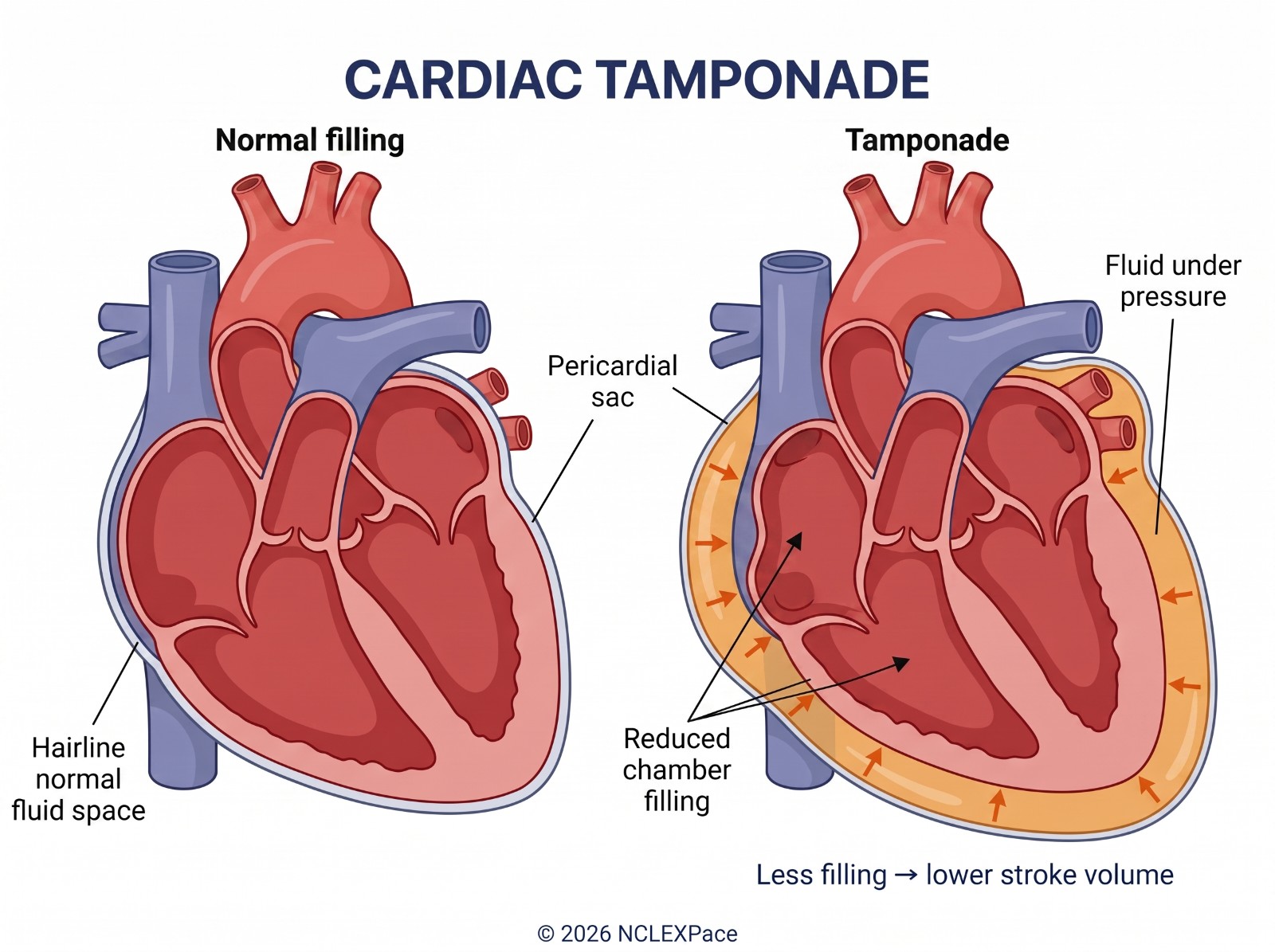
Pericarditis is inflammation of the pericardium, the protective sac surrounding the heart. It may cause characteristic positional chest pain, a pericardial friction rub, and electrocardiographic changes. Cardiac tamponade is a life-threatening complication in which fluid or blood accumulates in the pericardial space, compressing the heart and preventing adequate ventricular filling and cardiac output.
What the NCLEX focuses on
- Chest pain: Acute pericarditis typically causes sharp, pleuritic chest pain that worsens with inspiration, coughing, and lying flat. Pain often improves when the client sits upright and leans forward.
- Pericardial friction rub: A scratchy or grating sound heard during cardiac auscultation is characteristic of pericardial inflammation and may vary with position.
- ECG findings: Acute pericarditis commonly produces widespread, diffuse ST-segment elevation and PR-segment depression rather than changes limited to one coronary artery territory.
- Causes: Pericarditis may follow viral infections, occur after myocardial infarction or cardiac surgery, or result from autoimmune disease, malignancy, kidney failure, and other inflammatory conditions.
- Treatment: First-line treatment for uncomplicated acute idiopathic or viral pericarditis generally includes an NSAID or aspirin together with colchicine, as prescribed.
- Colchicine reduces inflammation and recurrence risk. The nurse monitors gastrointestinal adverse effects, medication tolerance, and prescribed renal and hepatic assessments.
- Pericardial effusion: Fluid accumulation between the pericardial layers may be asymptomatic or may progress to impaired cardiac filling and tamponade.
- Beck triad: Classic findings of cardiac tamponade include hypotension, jugular venous distention, and muffled or distant heart sounds.
- Pulsus paradoxus: An exaggerated decrease in systolic blood pressure during inspiration is associated with cardiac tamponade and reflects impaired ventricular filling.
- Other tamponade findings: Tachycardia, narrowed pulse pressure, hypotension, respiratory distress, and reduced cardiac output may occur as the condition progresses.
- Pericardiocentesis: This emergency procedure removes fluid from the pericardial space to relieve cardiac compression and improve ventricular filling.
- Distinguishing myocardial infarction: Pericarditis pain is commonly positional and pleuritic, whereas myocardial infarction pain is often described as pressure or squeezing and may radiate to the arm, jaw, or back. ECG and cardiac biomarker assessment are necessary because symptoms can overlap.
Priority nursing actions
- Assess chest pain, blood pressure, heart rate, respiratory status, oxygen saturation, heart sounds, jugular venous pressure, and peripheral perfusion.
- Obtain and monitor ECG findings and prescribed cardiac biomarkers to evaluate pericarditis and exclude acute coronary syndrome.
- Position the client upright and leaning forward when this reduces pericarditis-related discomfort, and provide prescribed analgesics and anti-inflammatory medications.
- Monitor for pericardial effusion and tamponade, especially worsening hypotension, tachycardia, jugular venous distention, narrowed pulse pressure, and altered mental status.
- Recognize suspected cardiac tamponade as an emergency, activate the appropriate emergency response, notify the provider immediately, and prepare for urgent pericardiocentesis.
- After pericardiocentesis, monitor vital signs, cardiac rhythm, drainage, insertion site, respiratory status, and signs of recurrent effusion or complications.
Numbers to know
| Value | Number | Why it matters |
|---|---|---|
| Diagnostic criteria for acute pericarditis | At least 2 of 4 | Chest pain, pericardial friction rub, characteristic ECG changes, or new or worsening pericardial effusion. |
| Pulsus paradoxus | More than 10 mm Hg | Excessive inspiratory reduction in systolic blood pressure, commonly associated with tamponade. |
| NSAID treatment duration | Usually 1 to 2 weeks | Common initial treatment period for uncomplicated acute pericarditis, adjusted according to symptoms and inflammatory markers. |
| Colchicine treatment duration | 3 months | Common recommended treatment duration for a first episode of acute pericarditis. |
Common exam traps
- Choosing to position a client with pericarditis flat: wrong because lying flat commonly worsens pericardial chest pain.
- Choosing to treat suspected tamponade with anti-inflammatory medication alone: wrong because cardiac tamponade requires urgent relief of pericardial pressure.
- Choosing to interpret hypotension, jugular venous distention, and muffled heart sounds as uncomplicated pericarditis: wrong because these findings suggest cardiac tamponade.
- Choosing to delay emergency intervention until all diagnostic results return: wrong because suspected tamponade with hemodynamic instability requires immediate treatment.
- Choosing to assume diffuse ST elevation confirms myocardial infarction: wrong because widespread ST elevation may occur with acute pericarditis and requires clinical correlation.
What to teach
- Take prescribed NSAIDs and colchicine as directed and report severe gastrointestinal symptoms, unusual bleeding, or medication intolerance.
- Avoid strenuous physical activity during active pericarditis until symptoms and inflammation resolve and the provider approves returning to exercise.
- Attend follow-up appointments for clinical assessment, ECG monitoring, and echocardiography when prescribed.
- Seek emergency care for worsening chest pain, fainting, severe shortness of breath, marked weakness, or sudden dizziness.
- Explain that recurrence is possible and that completing prescribed colchicine treatment helps reduce recurrence risk.
2 NCLEX questions with rationales on this topic
From the NCLEXPace question bank. Choose your answer first, then open the correct answer and the full rationale under each question.
Select the best answer.
- A. Semi-Fowler position with the back supported
- B. Right side-lying with the head elevated
- C. Supine with the head of the bed elevated 30 degrees
- D. Upright while leaning forward
Show the correct answer and rationale
Correct answer:
- D. Upright while leaning forward
Rationale
Overview
- Definition: Acute pericarditis is inflammation of the pericardium that produces sharp pleuritic chest pain.
- Symptoms: Deep inspiration and supine positioning worsen pain; sitting upright and leaning forward relieve discomfort.
- Treatment: First-line therapy is a prescribed NSAID, such as ibuprofen, or aspirin, together with colchicine to relieve pain and reduce recurrence. Give with food and monitor for gastrointestinal bleeding. Encourage rest until symptoms resolve and an upright, forward-leaning position for comfort.
Nursing key points
- Assist the client upright with a forward lean; assess comfort and stability.
- Continue prescribed anti-inflammatory treatment and reassess pain.
- Monitor hemodynamics and symptoms despite positional pain relief.
- Report new dyspnea, restlessness, hypotension, or distended neck veins immediately.
- Prepare urgent intervention for tamponade; positioning and analgesia do not relieve pericardial compression.
Answer analysis
| Position | Rationale |
|---|---|
| Semi-Fowler position with the back supported | Not correct. General breathing comfort does not provide the characteristic relief of upright forward leaning. |
| Right side-lying with the head elevated | Not correct. Side-lying is not the characteristic pain-relieving position. |
| Supine with the head of the bed elevated 30 degrees | Not correct. Remaining supine continues to aggravate pericarditic discomfort. |
| Upright while leaning forward | Correct. This position reduces the characteristic positional pain of pericarditis. |
| Supports tamponade | Does not support tamponade | |
|---|---|---|
| Muffled heart sounds | ||
| Bounding peripheral pulses | ||
| Jugular venous distention | ||
| Blood pressure 82/64 mm Hg | ||
| Unilateral absence of breath sounds | ||
| Narrowing pulse pressure |
Show the correct answer and rationale
Correct answers:
- Muffled heart sounds: Supports tamponade
- Bounding peripheral pulses: Does not support tamponade
- Jugular venous distention: Supports tamponade
- Blood pressure 82/64 mm Hg: Supports tamponade
- Unilateral absence of breath sounds: Does not support tamponade
- Narrowing pulse pressure: Supports tamponade
Rationale
Overview
- Definition: Cardiac tamponade occurs when pericardial pressure restricts cardiac filling and reduces cardiac output (refer to the image below).
- Findings: Beck’s triad comprises hypotension, jugular venous distention, and muffled heart sounds; narrowing pulse pressure, weak pulses, and pulsus paradoxus accompany reduced output.
- Treatment: Deteriorating perfusion requires urgent assessment and procedural or surgical drainage.
Nursing key points
- Assess blood pressure, pulse quality, consciousness, breathing, and venous pressure.
- Know the reference value: pulsus paradoxus is an inspiratory systolic pressure decrease greater than 10 mm Hg.
- Do not wait for the full triad or a fixed sequence of findings.
- Escalate deterioration immediately and prepare for urgent drainage.
Answer analysis
| Additional finding | Supports tamponade? | Why |
|---|---|---|
| Muffled heart sounds | Supports tamponade. | Pericardial fluid attenuates heart sounds in this clinical setting. |
| Bounding peripheral pulses | Does not support tamponade. | Bounding pulses conflict with the typical low-output pattern but do not independently exclude tamponade. |
| Jugular venous distention | Supports tamponade. | Elevated venous pressure indicates impaired filling from pericardial compression. |
| Blood pressure 82/64 mm Hg | Supports tamponade. | Hypotension with pulse pressure of 18 mm Hg indicates compromised output. |
| Unilateral absence of breath sounds | Does not support tamponade. | This indicates a separate pulmonary or pleural concern, including pneumothorax, requiring urgent assessment. |
| Narrowing pulse pressure | Supports tamponade. | Reduced stroke volume narrows pulse pressure; interpret the complete assessment. |
The NCLEXPace bank has 3,200+ NCLEX questions with full rationales, sorted by topic, with your progress tracked as you practice. Create your account to start.
Create Account →More topics in Medical-Surgical
Lyme Disease NCLEX Questions With RationalesCovers Lyme disease stages, clinical manifestations, doxycycline treatment, tick removal, nursing priorities, and prevention.Influenza NCLEX Questions With RationalesReviews seasonal influenza symptoms, high-risk groups, antiviral treatment, isolation, vaccination, complications, and nursing care.Atopic Dermatitis (Eczema) NCLEX Questions With RationalesReviews childhood eczema manifestations, age-related distribution, triggers, skin care, topical medications, infection prevention, and parent education.Sources
- American Heart Association. Pericarditis. Current edition.
- National Library of Medicine, MedlinePlus. Pericarditis. Current edition.
- National Library of Medicine, NCBI Bookshelf. Cardiac Tamponade. 2023.
3,200+ NCLEX questions with think-like-a-nurse rationales, unfolding case studies and adaptive readiness exams. Start with free practice questions, then choose a plan when you are ready.
Create Account →