Parkinson Disease NCLEX Questions With Rationales
What it is
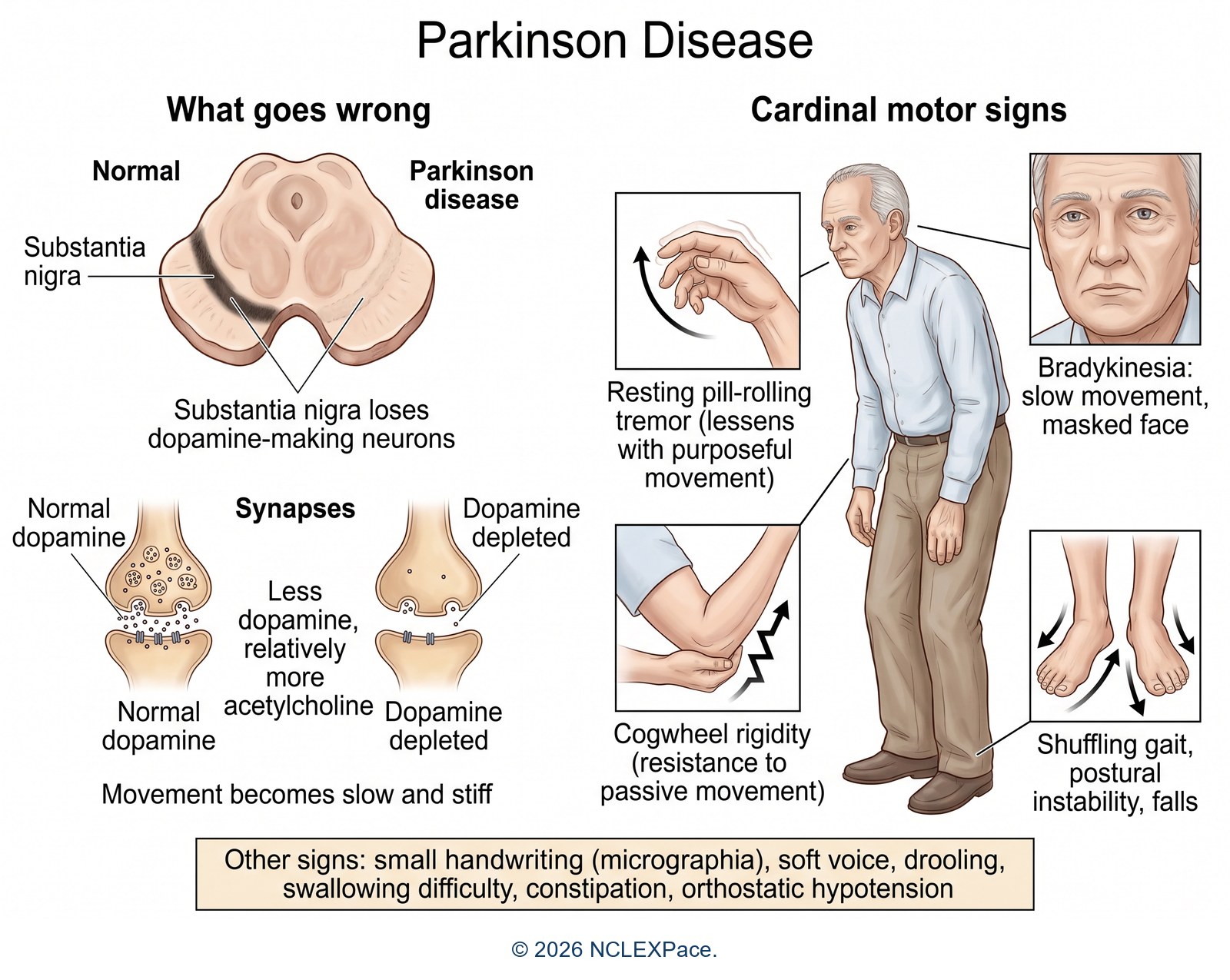
Parkinson disease is a slowly progressive neurodegenerative disorder caused by loss of dopamine-producing neurons in the substantia nigra. With less dopamine, the excitatory neurotransmitter acetylcholine is left out of balance, and control of voluntary movement declines. The four cardinal signs are resting tremor, rigidity, bradykinesia and postural instability. Treatment relieves symptoms by raising dopamine levels or mimicking dopamine in the brain.
What the NCLEX focuses on
- The resting tremor often starts in one hand as a pill-rolling movement and lessens with purposeful movement.
- Rigidity is resistance to passive movement, often with a ratchet-like (cogwheel) quality.
- Bradykinesia, a masklike face, soft monotone speech and a shuffling gait with a forward-bent posture are expected findings.
- Postural instability develops later and puts the client at high risk for falls.
- Dysphagia raises the risk of aspiration and malnutrition.
- Autonomic findings include orthostatic hypotension, constipation, drooling and urinary retention.
- Levodopa is converted to dopamine in the brain; carbidopa keeps levodopa from being broken down before it reaches the brain.
- Dyskinesia (involuntary movements such as facial grimacing and head bobbing) is a common adverse effect of long-term levodopa therapy.
- On-off fluctuations are unpredictable swings between good and poor symptom control during long-term levodopa therapy.
- Drugs that interfere with dopamine cause or worsen symptoms: antipsychotics, metoclopramide and prochlorperazine.
Priority nursing actions
- Give carbidopa-levodopa and other antiparkinson drugs exactly on schedule to keep therapeutic levels steady.
- Start fall precautions, monitor for orthostatic hypotension and have the client change position slowly.
- Check chewing and swallowing before oral intake and follow the speech-language pathologist's plan, such as soft foods and thickened liquids.
- Report acute confusion, hallucinations and new involuntary movements to the provider.
- Prevent complications of immobility: pressure injuries, constipation and contractures.
- Clarify any prescription for metoclopramide, prochlorperazine or an antipsychotic before giving it.
Numbers to know
| Value | Number | Why it matters |
|---|---|---|
| Cardinal signs | 4 | Resting tremor, rigidity, bradykinesia, postural instability |
| Dopamine loss before symptoms appear | About 80% | Explains the gradual, late onset of symptoms |
| Dyskinesia with levodopa | Often after about 5 to 10 years of use | Report it; the provider adjusts the dose or schedule |
Common exam traps
- Choosing to stop carbidopa-levodopa abruptly when adverse effects appear: wrong because sudden withdrawal can cause a serious syndrome of fever and rigid muscles that resembles neuroleptic malignant syndrome.
- Choosing an intention tremor as the expected finding: wrong because the tremor of Parkinson disease occurs at rest and lessens with purposeful movement.
- Choosing to give levodopa with a high-protein meal: wrong because protein can reduce levodopa absorption.
- Choosing metoclopramide for nausea: wrong because it interferes with dopamine in the basal ganglia and worsens parkinsonism.
- Choosing to report dark saliva, urine or sweat as bleeding: wrong because this discoloration is a harmless effect of levodopa.
What to teach
- Take carbidopa-levodopa at the prescribed times and do not stop it without talking to the provider.
- Talk to the provider before changing to a high-protein diet or starting iron supplements or vitamins that contain iron.
- Rise slowly from lying or sitting, because dizziness and fainting can occur.
- Do not drive until the effects are known, because levodopa can cause sudden sleep during daily activities.
- Report uncontrolled movements, hallucinations, or symptoms that return or vary during the day.
- Remove rugs and clutter, use assistive devices, and increase fluids and fiber for constipation.
2 NCLEX questions with rationales on this topic
From the NCLEXPace question bank. Choose your answer first, then open the correct answer and the full rationale under each question.
A client with Parkinson disease and dysphagia is at lunch. Which nursing action best prevents aspiration?
Select the best answer.
- A. Recline the client slightly to reduce fatigue
- B. Encourage a faster eating pace early in the meal
- C. Offer thin liquids between bites to clear food
- D. Position upright, allow unhurried time, offer small bites
Show the correct answer and rationale
Correct answer:
- D. Position upright, allow unhurried time, offer small bites
Rationale
Overview
- Definition: Dysphagia is impaired swallowing. In Parkinson disease, bradykinesia and impaired swallowing coordination increase aspiration risk.
- Signs and symptoms: Coughing during meals, wet vocal quality, drooling, prolonged swallowing, and residual food in the mouth.
- Safe swallowing: Upright positioning, small bites, slow pacing, and prescribed food textures and liquid consistency reduce aspiration risk.
Nursing key points
- Position the client upright at 90 degrees during meals.
- Use the chin-tuck maneuver and double swallowing when prescribed by speech-language pathology.
- Offer small bites and wait for complete swallowing before the next bite.
- Provide thickened liquids at the prescribed consistency. Thin liquids move rapidly and increase aspiration risk in affected clients.
- Maintain upright positioning for at least 30 minutes after eating.
- Coordinate levodopa administration so the client has optimal motor function during meals. Stop feeding and report coughing, choking, or wet vocal quality.
Answer analysis
| Nursing action | Rationale |
|---|---|
| Recline the client slightly to reduce fatigue | Not correct. Reclining reduces airway protection and increases aspiration risk. |
| Encourage a faster eating pace early in the meal | Not correct. Rapid feeding interferes with complete swallowing. |
| Offer thin liquids between bites to clear food | Not correct. Thin liquids increase aspiration risk when liquid control is impaired. |
| Position upright, allow unhurried time, offer small bites | Correct. Upright positioning and slow, small bites improve swallowing safety. |
For each finding, click to specify whether it is a cardinal motor sign of Parkinson disease or NOT a typical feature.
| Cardinal Parkinson sign | Not a typical feature | |
|---|---|---|
| Shuffling, festinating gait with stooped posture | ||
| Rhythmic intention tremor that appears only during reaching | ||
| Cogwheel rigidity of the limbs | ||
| Pill-rolling tremor that lessens with purposeful movement | ||
| Sudden hemiparesis with facial droop | ||
| Bradykinesia with a masked, expressionless face |
Show the correct answer and rationale
Correct answers:
- Shuffling, festinating gait with stooped posture: Cardinal Parkinson sign
- Rhythmic intention tremor that appears only during reaching: Not a typical feature
- Cogwheel rigidity of the limbs: Cardinal Parkinson sign
- Pill-rolling tremor that lessens with purposeful movement: Cardinal Parkinson sign
- Sudden hemiparesis with facial droop: Not a typical feature
- Bradykinesia with a masked, expressionless face: Cardinal Parkinson sign
Rationale
Overview
- Definition: Parkinson disease is a progressive neurodegenerative disorder involving loss of dopaminergic neurons in the substantia nigra.
- Cardinal signs: TRAP represents Tremor at rest, Rigidity, Akinesia or bradykinesia, and Postural instability.
- Look-alikes: Sudden hemiparesis with facial droop indicates an acute neurologic emergency. Intention tremor is characteristic of cerebellar dysfunction.
Nursing key points
- Assess resting tremor that decreases with voluntary movement.
- Evaluate rigidity through passive limb movement and assess bradykinesia during repetitive movements.
- Observe gait for short steps, festination, stooped posture, and impaired balance.
- Assess facial movement for hypomimia, also called masked facies.
- Activate the stroke response immediately for sudden hemiparesis or facial droop.
Answer analysis
| Assessment finding | Cardinal Parkinson sign or not a typical feature? | Why |
|---|---|---|
| Shuffling, festinating gait with stooped posture | Cardinal Parkinson sign. | These characteristic gait abnormalities reflect impaired motor control. |
| Rhythmic intention tremor that appears only during reaching | Not a typical feature. | Intention tremor indicates cerebellar dysfunction, including involvement associated with multiple sclerosis. |
| Cogwheel rigidity of the limbs | Cardinal Parkinson sign. | Cogwheel rigidity produces intermittent resistance during passive movement. |
| Pill-rolling tremor that lessens with purposeful movement | Cardinal Parkinson sign. | Resting tremor characteristically decreases during purposeful movement. |
| Sudden hemiparesis with facial droop | Not a typical feature. | Abrupt focal weakness requires emergency stroke evaluation. |
| Bradykinesia with a masked, expressionless face | Cardinal Parkinson sign. | Reduced voluntary movement contributes to hypomimia. |
The NCLEXPace bank has 3,200+ NCLEX questions with full rationales, sorted by topic, with your progress tracked as you practice. Create your account to start.
Create Account →More topics in Medical-Surgical
Lyme Disease NCLEX Questions With RationalesCovers Lyme disease stages, clinical manifestations, doxycycline treatment, tick removal, nursing priorities, and prevention.Influenza NCLEX Questions With RationalesReviews seasonal influenza symptoms, high-risk groups, antiviral treatment, isolation, vaccination, complications, and nursing care.Atopic Dermatitis (Eczema) NCLEX Questions With RationalesReviews childhood eczema manifestations, age-related distribution, triggers, skin care, topical medications, infection prevention, and parent education.Sources
- StatPearls (NCBI Bookshelf). Parkinson Disease. Last update 2025.
- Open RN (NCBI Bookshelf). Health Alterations, Chapter 9: Nervous System Alterations. 2024.
- MedlinePlus (National Library of Medicine). Levodopa and Carbidopa. 2026.
- Merck Manual Professional Edition. Parkinson Disease. 2026.
3,200+ NCLEX questions with think-like-a-nurse rationales, unfolding case studies and adaptive readiness exams. Start with free practice questions, then choose a plan when you are ready.
Create Account →