Pacemaker Care NCLEX Questions With Rationales
What it is
A permanent pacemaker is an implanted electronic device that delivers electrical impulses when needed to maintain an appropriate heart rhythm. It commonly treats symptomatic bradycardia and certain cardiac conduction disorders. Capture means a delivered electrical impulse produces myocardial depolarization, while sensing means the device recognizes intrinsic cardiac electrical activity. Pacemaker care focuses on effective pacing, early recognition of malfunction, incision healing, and safe daily activities.
What the NCLEX focuses on
- A pacemaker generator contains the battery and electronic circuitry that control electrical stimulation.
- Traditional pacemakers use implanted leads to deliver electrical impulses to cardiac tissue.
- Successful ventricular capture is demonstrated by an appropriate QRS complex following a ventricular pacing stimulus.
- Failure to capture occurs when a pacing stimulus does not produce the expected myocardial depolarization.
- Undersensing occurs when the pacemaker fails to detect intrinsic electrical activity appropriately.
- Oversensing occurs when the device incorrectly detects signals and may inhibit necessary pacing.
- Lead displacement, electrical problems, and battery depletion can contribute to pacemaker malfunction.
- Dizziness, fainting, fatigue, or recurrent bradycardia may indicate inadequate pacing.
- Redness, increasing pain, swelling, or drainage at the incision may indicate infection.
Priority nursing actions
- Assess airway, breathing, circulation, blood pressure, pulse, consciousness, and symptoms when pacemaker malfunction is suspected.
- Initiate emergency response procedures for severe symptomatic bradycardia, hemodynamic instability, or loss of consciousness.
- Monitor cardiac rhythm and compare pacing spikes with appropriate cardiac responses when ECG monitoring is indicated.
- Report suspected failure to capture, abnormal sensing, or changes in pacing effectiveness promptly and prepare for ordered device evaluation.
- Inspect the insertion site for bleeding, swelling, drainage, and infection while following prescribed wound care instructions.
- Reinforce activity restrictions, pulse monitoring, identification card use, and scheduled pacemaker follow-up.
Numbers to know
| Value | Number | Why it matters |
|---|---|---|
| Initial lifting restriction | Heavier than 10 to 15 pounds for 2 to 3 weeks | Helps protect the healing implantation area. |
| Operative-side arm restriction | Several weeks | Avoid lifting above shoulder level until cleared. |
| Initial incision dryness | 4 to 5 days | Follow the specific postoperative wound instructions. |
| Cell phone separation | At least 6 inches | Reduces potential electromagnetic interference. |
| Common device follow-up interval | 6 to 12 months | Allows routine assessment of battery and lead function. |
| Typical battery life | 6 to 15 years | Battery longevity varies by device and pacing requirements. |
Common exam traps
- Choosing to interpret every pacing spike as successful capture: wrong because the expected myocardial response must occur.
- Choosing to ignore dizziness after implantation: wrong because symptoms may indicate inadequate pacing or another complication.
- Choosing to raise the operative-side arm above the shoulder immediately after insertion: wrong because temporary movement restrictions protect the healing area.
- Choosing to prohibit MRI permanently for every pacemaker recipient: wrong because some systems permit MRI under specific device and monitoring conditions.
- Choosing to skip routine device checks when the client feels well: wrong because device problems may develop without obvious symptoms.
What to teach
- Check the pulse as instructed, record unusual changes, and report a rate below the individualized limit provided by the cardiac team.
- Avoid heavy lifting and excessive pushing, pulling, or twisting with the operative-side arm during the initial healing period.
- Keep the incision clean and follow specific instructions for bathing, dressing care, and activity resumption.
- Carry the pacemaker identification card and inform healthcare personnel before procedures, especially MRI examinations.
- Keep cell phones and strong magnets away from the implanted generator and discuss equipment-related concerns with the cardiac team.
- Attend scheduled device checks and seek immediate evaluation for fainting, severe breathing difficulty, chest pain, or significant device-related symptoms.
2 NCLEX questions with rationales on this topic
From the NCLEXPace question bank. Choose your answer first, then open the correct answer and the full rationale under each question.
Select the best answer.
- A. "It sends a small electrical signal to the upper chamber of your heart (atrium) before each beat; then your heart's own wiring carries the beat to the pumping chambers (ventricles)."
- B. "It sends the signal to the lower chambers of your heart, so they beat on their own schedule."
- C. "It sends a signal to the upper and the lower chambers for every beat."
- D. "It only monitors and records your rhythm; it does not send any signals."
Show the correct answer and rationale
Correct answer:
- A. "It sends a small electrical signal to the upper chamber of your heart (atrium) before each beat; then your heart's own wiring carries the beat to the pumping chambers (ventricles)."
Rationale
Overview
- Definition: A single-chamber atrial pacemaker stimulates the atrium (upper chamber) when the client’s own rate falls below the programmed rate.
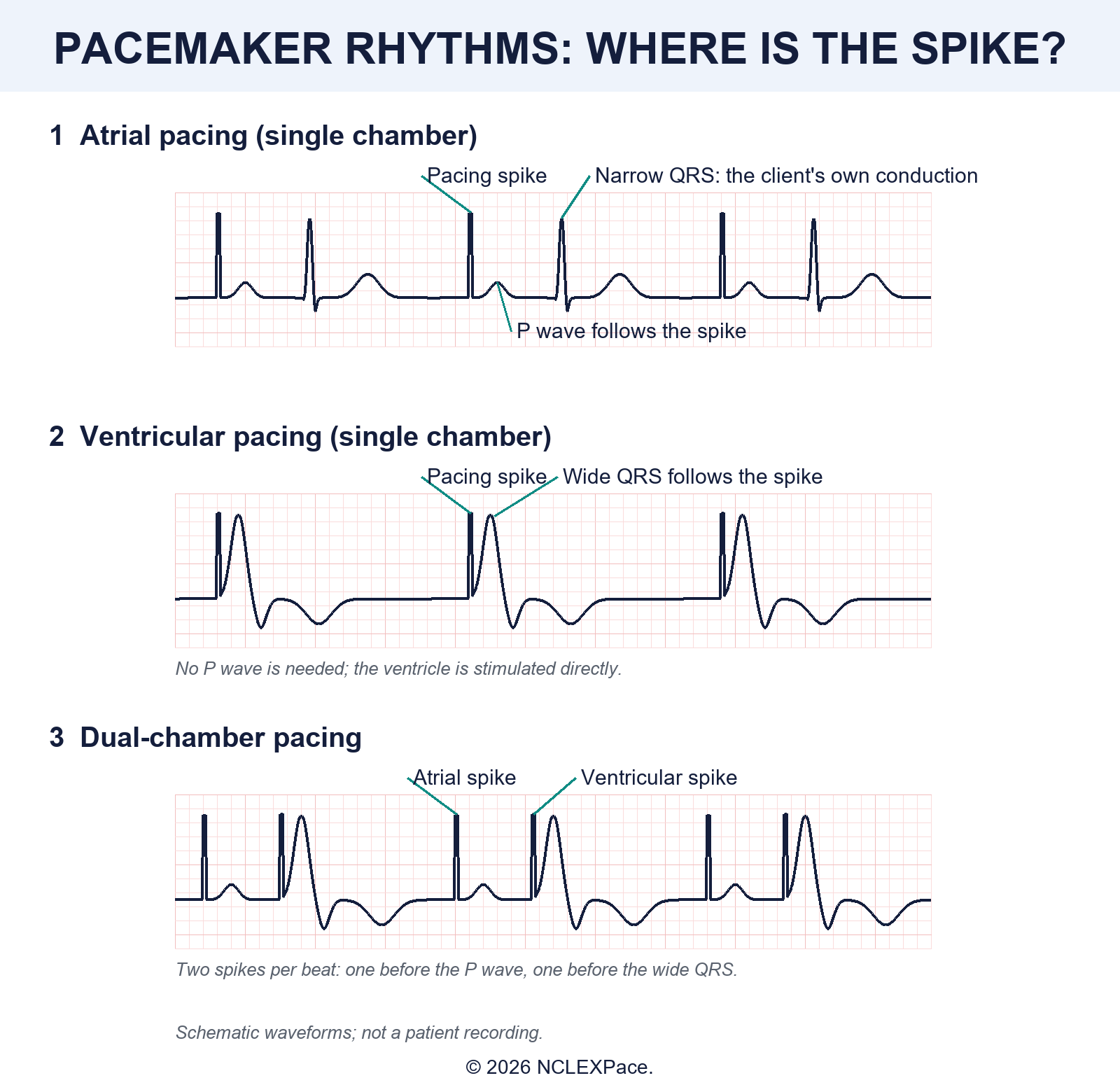
- Electrocardiographic findings: A pacing spike immediately precedes the P wave, followed by the client’s own narrow QRS complex.
- Conduction: The normal conduction pathway carries the impulse to the ventricles; atrial pacing requires intact atrioventricular conduction.
Nursing key points
- Identify atrial pacing by a spike immediately before the P wave.
- Identify ventricular pacing by a spike before a wide QRS; spikes before both indicate dual-chamber pacing.
- Teach daily pulse checks; report rates below the set rate, dizziness, fainting, or persistent hiccups.
- Teach carrying the device card and keeping follow-up and device-check visits.
- Follow prescribed restrictions: no heavy lifting or device-side arm elevation above shoulder level for 4–6 weeks to prevent lead displacement.
Answer analysis
| Nurse's explanation | Rationale |
|---|---|
| "It sends a small electrical signal to the upper chamber of your heart (atrium) before each beat; then your heart's own wiring carries the beat to the pumping chambers (ventricles)." | Correct. Atrial pacing: the atrium is stimulated, and normal conduction carries each beat to the ventricles. |
| "It sends the signal to the lower chambers of your heart, so they beat on their own schedule." | Not correct. This is ventricular pacing: a spike before a wide QRS. |
| "It sends a signal to the upper and the lower chambers for every beat." | Not correct. This describes dual-chamber pacing: spikes before the P wave and the QRS. |
| "It only monitors and records your rhythm; it does not send any signals." | Not correct. This describes a loop recorder, which monitors the rhythm but does not pace. |
| Correct instruction | Incorrect instruction | |
|---|---|---|
| Keep a cell phone away from the generator site | ||
| Tell providers about the device before MRI | ||
| Carry the device identification card | ||
| Inform airport security | ||
| Avoid all microwave ovens |
Show the correct answer and rationale
Correct answers:
- Keep a cell phone away from the generator site: Correct instruction
- Tell providers about the device before MRI: Correct instruction
- Carry the device identification card: Correct instruction
- Inform airport security: Correct instruction
- Avoid all microwave ovens: Incorrect instruction
Rationale
Overview
- Definition: A permanent pacemaker delivers electrical impulses to maintain an adequate heart rate.
- Interference: Strong magnets and nearby electronic devices interfere with pacemaker function.
- Imaging safety: Magnetic resonance imaging requires identification of the generator and leads and confirmation of a specialized scanning protocol.
Nursing key points
- Keep phones and magnetic accessories at least 6 inches (15 cm) from the generator; follow manufacturer instructions.
- Use the opposite ear and never carry a phone in a pocket over the device.
- Carry device identification and inform healthcare providers and security staff.
- Avoid prolonged handheld security screening directly over the generator.
- Report fainting, dizziness, or a persistently unexpected pulse; attend device follow-up.
Answer analysis
| Instruction | Correct or incorrect instruction? | Why |
|---|---|---|
| Keep a cell phone away from the generator site | Correct instruction. | Recommended separation reduces electromagnetic and magnetic interference. |
| Tell providers about the device before MRI | Correct instruction. | The complete system requires assessment before an approved scanning protocol is selected. |
| Carry the device identification card | Correct instruction. | The card identifies the device for medical care, imaging, and security screening. |
| Inform airport security | Correct instruction. | Notification allows device-specific screening precautions. |
| Avoid all microwave ovens | Incorrect instruction. | Properly functioning household microwave ovens do not require avoidance. |
The NCLEXPace bank has 3,200+ NCLEX questions with full rationales, sorted by topic, with your progress tracked as you practice. Create your account to start.
Create Account →More topics in Medical-Surgical
Lyme Disease NCLEX Questions With RationalesCovers Lyme disease stages, clinical manifestations, doxycycline treatment, tick removal, nursing priorities, and prevention.Influenza NCLEX Questions With RationalesReviews seasonal influenza symptoms, high-risk groups, antiviral treatment, isolation, vaccination, complications, and nursing care.Atopic Dermatitis (Eczema) NCLEX Questions With RationalesReviews childhood eczema manifestations, age-related distribution, triggers, skin care, topical medications, infection prevention, and parent education.Sources
3,200+ NCLEX questions with think-like-a-nurse rationales, unfolding case studies and adaptive readiness exams. Start with free practice questions, then choose a plan when you are ready.
Create Account →