Otitis Media NCLEX Questions With Rationales
What it is
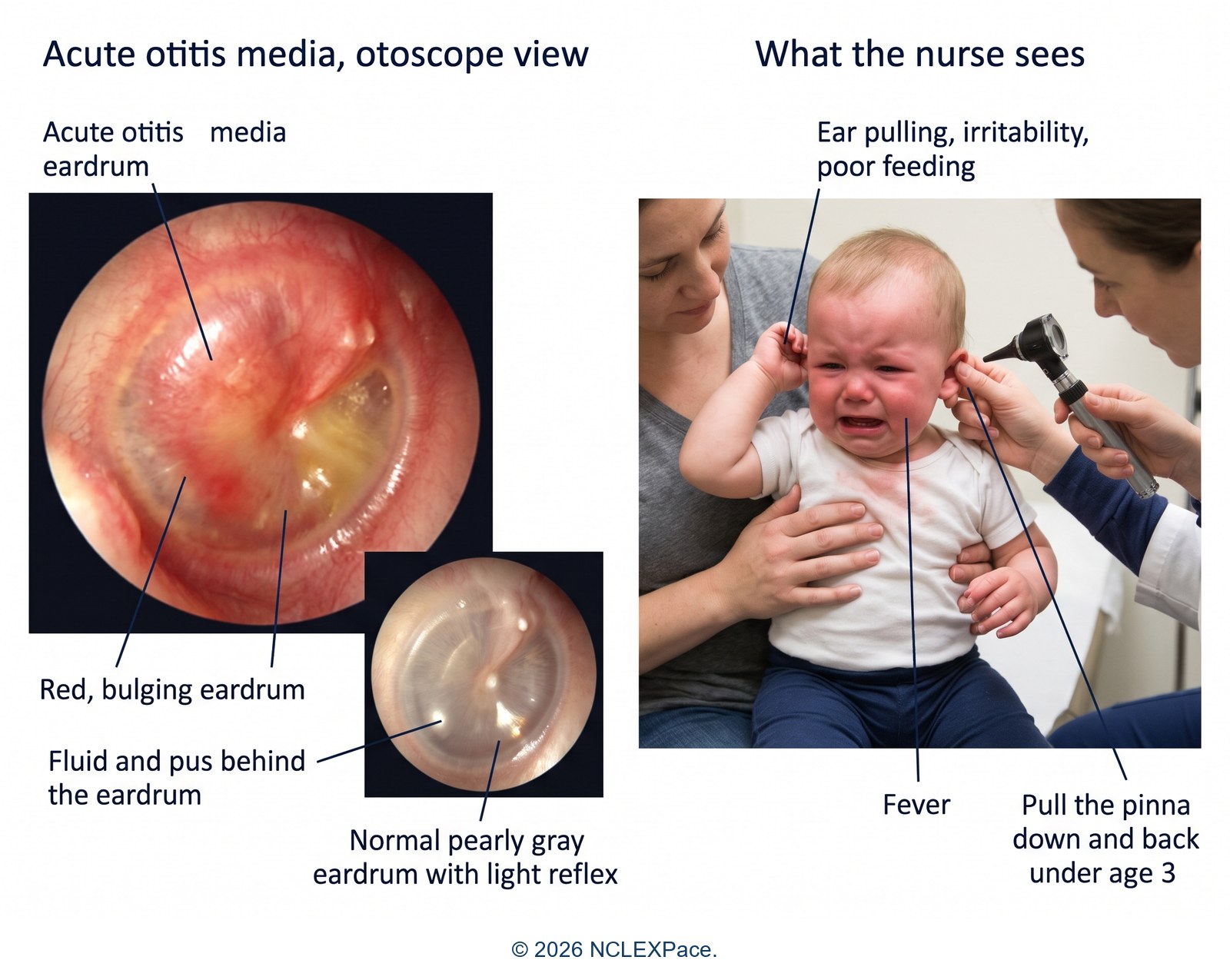
Acute otitis media (AOM) is an infection and inflammation of the middle ear associated with middle ear effusion and acute symptoms. It commonly develops in infants and young children following an upper respiratory infection because inflammation and dysfunction of the eustachian tube allow fluid to accumulate behind the tympanic membrane. Common bacterial pathogens include Streptococcus pneumoniae, Haemophilus influenzae, and Moraxella catarrhalis. Viral infections may also contribute to the development of middle ear inflammation.
What the NCLEX focuses on
- Ear pain: Older children may report earache, while infants and toddlers may demonstrate irritability, crying, disturbed sleep, or ear pulling.
- Physical findings: A bulging tympanic membrane with evidence of middle ear effusion is an important diagnostic finding. Reduced tympanic membrane mobility supports the presence of effusion.
- Otoscopy: For a child younger than 3 years, pull the pinna down and back. For an older child or adult, pull it up and back.
- Associated symptoms: Fever, decreased appetite, difficulty sleeping, and temporary hearing changes may occur.
- Risk factors: Young age, daycare attendance, exposure to tobacco smoke, bottle feeding while lying down, and frequent upper respiratory infections increase the likelihood of AOM.
- Pain management: Acetaminophen or ibuprofen, when age appropriate and prescribed or recommended according to clinical guidance, helps relieve discomfort. Antibiotics do not provide immediate pain relief.
- Antibiotic selection: Amoxicillin is generally the first-line antibiotic when treatment is indicated and there has been no recent amoxicillin exposure, concurrent purulent conjunctivitis, or relevant penicillin allergy.
- Watchful waiting: Selected children with nonsevere AOM may be observed with adequate pain management and reliable follow-up. Observation is an option for unilateral AOM in children 6 to 23 months and for unilateral or bilateral AOM in children 24 months or older.
- Immediate treatment: Antibiotics are recommended for severe AOM, bilateral nonsevere AOM in children 6 to 23 months, and AOM accompanied by otorrhea.
- Tympanostomy tubes: Children with recurrent infections or persistent middle ear effusion with hearing difficulties may be candidates for ear tubes. Uncomplicated drainage through tubes is generally treated with prescribed topical antibiotic ear drops rather than oral antibiotics.
Priority nursing actions
- Assess airway, breathing, circulation, temperature, hydration, pain, and general appearance. Identify signs of systemic illness or complications.
- Assess the ears and associated symptoms. Report severe pain, persistent fever, mastoid tenderness, swelling behind the ear, or displacement of the external ear.
- Provide age-appropriate pain relief using prescribed or recommended analgesics and reassess the child's response.
- Administer prescribed antibiotics when indicated and assess for allergic reactions, diarrhea, and other adverse effects.
- For watchful waiting, reinforce the follow-up plan and ensure that caregivers understand when to initiate the safety-net prescription or return for reassessment.
- For tympanostomy tube drainage, administer prescribed non-ototoxic topical antibiotic drops and reinforce appropriate administration and follow-up instructions.
Numbers to know
| Value | Number | Why it matters |
|---|---|---|
| Minimum age for the AAP AOM treatment recommendations | 6 months | The guideline's treatment recommendations apply to children in this age group and older. |
| Severe fever criterion | 39°C (102.2°F) or higher | Supports classification as severe AOM and the need for antibiotic treatment. |
| Observation period | 48 to 72 hours | Symptoms should be reassessed, and antibiotics initiated if the child worsens or fails to improve. |
| Recurrent AOM | 3 episodes in 6 months or 4 episodes in 12 months, with at least 1 episode in the preceding 6 months | Helps determine eligibility for consideration of tympanostomy tubes. |
| Post-tube examination | Within 3 months | The surgeon or designee should examine the ears after tube insertion. |
Common exam traps
- Choosing antibiotics for every mild ear infection: wrong because selected nonsevere cases can be managed with watchful waiting and reliable follow-up.
- Choosing watchful waiting for severe bilateral AOM in a young child: wrong because immediate antibiotic therapy is recommended.
- Choosing antibiotics as the primary method of immediate pain relief: wrong because analgesics provide symptomatic pain control.
- Choosing oral antibiotics for uncomplicated drainage through tympanostomy tubes: wrong because topical antibiotic ear drops alone are recommended.
- Choosing routine earplugs for every child with ear tubes: wrong because routine prophylactic water precautions are not recommended.
What to teach
- Complete the entire prescribed antibiotic course, even when symptoms improve, and report medication reactions or persistent symptoms.
- Use age-appropriate acetaminophen or ibuprofen according to healthcare instructions. Never give aspirin to children unless specifically directed by a healthcare professional.
- Encourage breastfeeding, particularly exclusive breastfeeding for at least 6 months, when possible.
- Avoid propping bottles during feeding and avoid feeding infants while they are lying flat.
- Maintain a smoke-free environment and avoid exposure to secondhand tobacco smoke.
- Keep pneumococcal conjugate and annual influenza vaccinations current according to the CDC immunization schedule. Attend recommended ear examinations and hearing follow-up after tube placement.
2 NCLEX questions with rationales on this topic
From the NCLEXPace question bank. Choose your answer first, then open the correct answer and the full rationale under each question.
A nursing student prepares to perform an otoscopic examination on a 2-year-old with suspected acute otitis media. Which action by the student requires the nurse to intervene?
Select the best answer.
- A. Having the parent hold the child's arms and steady the head
- B. Saving the otoscopic examination until the end of the visit
- C. Inserting the speculum only into the outer part of the canal
- D. Pulling the pinna up and back to insert the speculum
Show the correct answer and rationale
Correct answer:
- D. Pulling the pinna up and back to insert the speculum
Rationale
Overview
- Definition: Otoscopic examination is visualization of the external auditory canal and tympanic membrane using an otoscope.
- Pediatric anatomy: In children younger than 3 years, the external auditory canal is shorter and oriented differently from the mature ear canal.
- Technique: Pull the pinna down and back in children younger than 3 years. Pull it up and back in children age 3 years and older and adults. Stabilize the otoscope to prevent canal injury.
Nursing key points
- Pull the pinna gently down and back when examining a 2-year-old.
- Ask the parent to hold the child's arms and stabilize the head against the parent's chest.
- Perform less invasive assessment components before otoscopy when the child is stable.
- Select the largest comfortable speculum and insert it gently into the outer ear canal.
- Brace the hand holding the otoscope against the child's head to prevent injury during movement.
Answer analysis
| Student action | Rationale |
|---|---|
| Having the parent hold the child's arms and steady the head | No intervention needed. Caregiver stabilization reduces sudden movement and ear canal injury. |
| Saving the otoscopic examination until the end of the visit | No intervention needed. Completing less distressing assessments first promotes cooperation. |
| Inserting the speculum only into the outer part of the canal | No intervention needed. Shallow insertion and stabilization protect the external auditory canal. |
| Pulling the pinna up and back to insert the speculum | Needs intervention. A 2-year-old requires downward and backward pinna traction for safe visualization. |
A 9-month-old is brought to the clinic 3 days after the onset of a cold, with a temperature of 102.2 F (39 C). Which findings support a diagnosis of acute otitis media? Select all that apply.
- A. Irritability with rolling of the head side to side
- B. Pain when the right tragus is pressed
- C. Pulling and rubbing at the right ear
- D. Refusing the bottle after two or three sucks
- E. Bilaterally retracted tympanic membranes
Show the correct answer and rationale
Correct answers:
- A. Irritability with rolling of the head side to side
- C. Pulling and rubbing at the right ear
- D. Refusing the bottle after two or three sucks
Rationale
Overview
- Definition: Acute otitis media (AOM) is an acute infection and inflammation of the middle ear with middle-ear effusion. It frequently follows a viral upper respiratory infection.
- Signs and symptoms: Fever, irritability, ear pulling, disturbed sleep, and feeding difficulty indicate ear discomfort in infants.
- Diagnosis: A bulging tympanic membrane with evidence of middle-ear effusion is a key otoscopic finding. Reduced tympanic membrane mobility indicates middle-ear fluid.
Nursing key points
- Assess irritability, head movements, ear pulling, sleep disruption, and feeding refusal.
- Check temperature and hydration. Report persistent poor intake or decreased wet diapers.
- Inspect the tympanic membrane for bulging, inflammation, and middle-ear effusion.
- Assess tympanic membrane mobility using pneumatic otoscopy when available.
- Recognize that sucking and swallowing change middle-ear pressure and increase discomfort.
- Use age-appropriate pain assessment and administer prescribed analgesia.
Answer analysis
| Finding | Rationale |
|---|---|
| Irritability with rolling of the head side to side | Correct. These behaviors reflect discomfort in an infant unable to describe otalgia. |
| Pain when the right tragus is pressed | Not correct. Tragal tenderness is characteristic of external auditory canal inflammation. |
| Pulling and rubbing at the right ear | Correct. Ear pulling and rubbing are common nonverbal pain behaviors. |
| Refusing the bottle after two or three sucks | Correct. Sucking and swallowing increase discomfort through middle-ear pressure changes. |
| Bilaterally retracted tympanic membranes | Not correct. Retraction indicates negative middle-ear pressure rather than the characteristic bulging of AOM. |
The NCLEXPace bank has 3,200+ NCLEX questions with full rationales, sorted by topic, with your progress tracked as you practice. Create your account to start.
Create Account →More topics in Pediatrics
Measles and Varicella NCLEX Questions With RationalesReviews measles and chickenpox symptoms, transmission, isolation, complications, treatment, vaccination, and nursing interventions.Pertussis (Whooping Cough) NCLEX Questions With RationalesCovers pertussis stages, transmission, diagnosis, antibiotic treatment, isolation, infant complications, nursing interventions, and vaccination.Wilms Tumor NCLEX Questions With RationalesCovers Wilms tumor manifestations, prevention of tumor rupture, surgical treatment, postoperative nursing care, and long-term kidney protection.Sources
- American Academy of Pediatrics. The Diagnosis and Management of Acute Otitis Media. 2013.
- American Academy of Otolaryngology-Head and Neck Surgery Foundation. Clinical Practice Guideline: Tympanostomy Tubes in Children (Update). 2022.
- Centers for Disease Control and Prevention. Child and Adolescent Immunization Schedule by Age. 2026.
3,200+ NCLEX questions with think-like-a-nurse rationales, unfolding case studies and adaptive readiness exams. Start with free practice questions, then choose a plan when you are ready.
Create Account →