Osteoarthritis NCLEX Questions With Rationales
What it is
Osteoarthritis is a chronic joint disorder involving progressive cartilage loss and changes in surrounding bone and joint structures. It commonly affects the knees, hips, hands, and spine. Joint pain typically worsens with activity and improves with rest. Treatment emphasizes symptom control, preservation of mobility, and improved daily functioning.
What the NCLEX focuses on
- Osteoarthritis causes gradually developing joint pain, brief morning stiffness, decreased range of motion, and sometimes crepitus.
- Bony enlargement and osteophyte formation are characteristic structural findings.
- Heberden nodes occur at distal finger joints, while Bouchard nodes occur at proximal finger joints.
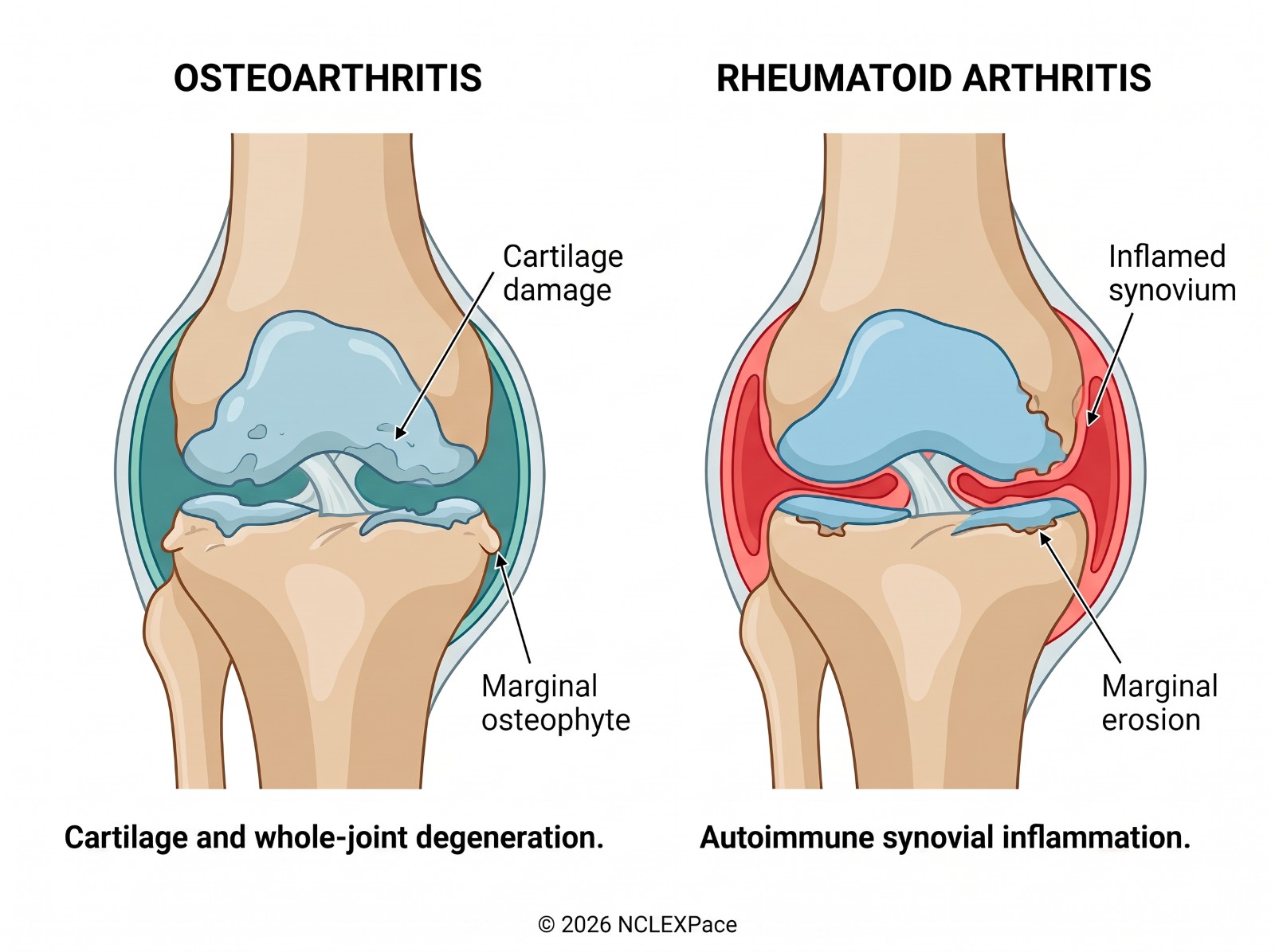
- Rheumatoid arthritis is primarily inflammatory and commonly produces prolonged morning stiffness and persistent synovial swelling.
- Osteoarthritis radiographs may demonstrate joint space narrowing, osteophytes, and subchondral sclerosis.
- Exercise and weight management are important nonpharmacologic treatments.
- Topical nonsteroidal anti-inflammatory drugs are preferred as initial medication treatment for suitable superficial joints.
- Oral nonsteroidal anti-inflammatory drugs can cause gastrointestinal bleeding, kidney injury, and cardiovascular complications.
- Acetaminophen may provide limited symptom relief but requires attention to liver toxicity and total daily intake.
Priority nursing actions
- Assess pain, stiffness duration, joint swelling, mobility limitations, and effects on daily activities.
- Report an acutely hot, markedly swollen joint with fever promptly because another diagnosis, including infection, may require urgent evaluation.
- Administer prescribed analgesics and monitor medication response, gastrointestinal symptoms, kidney-related concerns, and adverse reactions.
- Encourage prescribed strengthening, range-of-motion, and low-impact aerobic activities, with appropriate periods of rest.
- Assist with mobility devices, fall prevention, physical therapy recommendations, and postoperative care when joint replacement is performed.
Numbers to know
| Value | Number | Why it matters |
|---|---|---|
| Osteoarthritis morning stiffness | Less than 30 minutes | Typical stiffness is brief and improves with movement. |
| Rheumatoid arthritis morning stiffness | Longer than 30 minutes, often more than 1 hour | Prolonged stiffness supports consideration of inflammatory arthritis. |
| Adult acetaminophen maximum | 4,000 mg/day | This is the general maximum from all products combined; lower limits may apply. |
Common exam traps
- Choosing complete joint immobilization: wrong because prolonged inactivity worsens stiffness and can promote contractures.
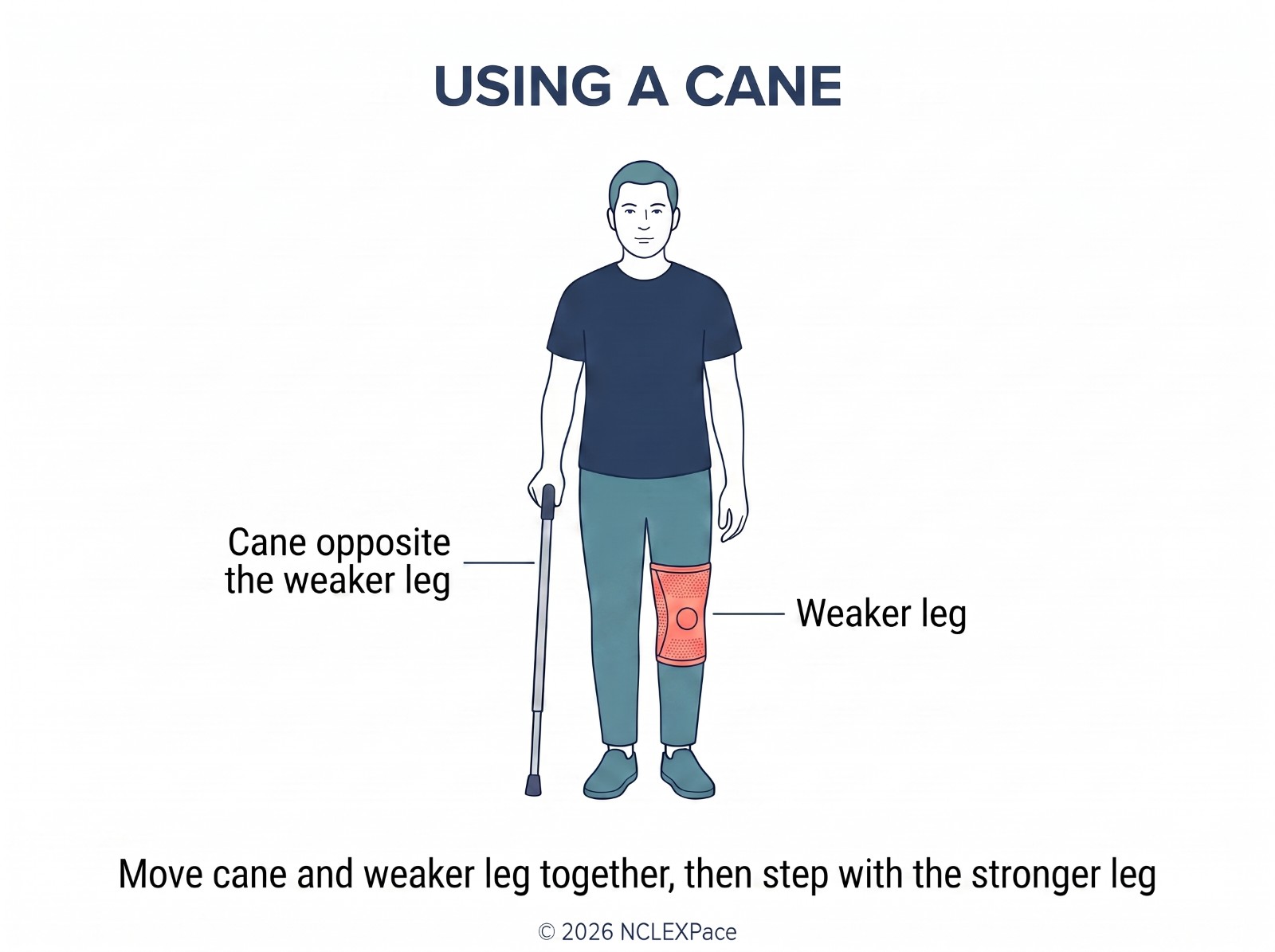
- Choosing to hold a cane on the affected side: wrong because the cane generally belongs in the hand opposite the affected leg.
- Choosing prolonged oral NSAID therapy without reassessment: wrong because gastrointestinal, cardiovascular, and kidney risks require monitoring.
- Choosing to treat persistent inflammatory joint swelling as uncomplicated osteoarthritis: wrong because alternative diagnoses require evaluation.
- Choosing joint replacement as initial treatment: wrong because appropriate nonsurgical treatments are generally attempted before surgery.
What to teach
- Perform low-impact activities such as walking, swimming, or aquatic exercise within individual tolerance.
- Use heat or cold for symptom relief and protect the skin during application.
- Maintain a healthy weight to reduce stress on weight-bearing joints.
- Hold the cane on the stronger side, advancing it with the affected leg before stepping through with the stronger leg.
- Discuss regular NSAID use with the provider and check combination products for acetaminophen.
- Understand that joint replacement may improve severe pain and function when appropriate nonsurgical treatment is insufficient.
2 NCLEX questions with rationales on this topic
From the NCLEXPace question bank. Choose your answer first, then open the correct answer and the full rationale under each question.
A client with severe osteoarthritis of the left knee is being fitted for a single point cane. Where should the nurse teach the client to hold the cane?
Select the best answer.
- A. In the left hand, tip directly in front of the painful left foot
- B. In the left hand, tip about 6 inches lateral to the left foot
- C. In the right hand, tip about 6 inches to the side of the foot
- D. In whichever hand feels comfortable, changing sides as needed
Show the correct answer and rationale
Correct answer:
- C. In the right hand, tip about 6 inches to the side of the foot
Rationale
Overview
- Definition: A single-point cane provides unilateral support during ambulation.
- Hand placement: Holding the cane opposite the affected leg reduces loading on the painful joint and widens the base of support.
- Gait pattern: Advance the cane with the affected leg, followed by the stronger leg.
Nursing key points
- Teach right-hand cane use for left-knee osteoarthritis.
- Position the tip about 6 inches (15 cm) lateral and slightly forward.
- Fit the handle at wrist-crease level with the client standing upright.
- Maintain elbow flexion of 15 to 30 degrees.
- Advance the cane and left leg together, then the right leg.
Answer analysis
| Cane placement | Rationale |
|---|---|
| In the left hand, tip directly in front of the painful left foot | Not correct. Same-side use provides less effective unloading; direct placement obstructs the foot's path. |
| In the left hand, tip about 6 inches lateral to the left foot | Not correct. The cane belongs opposite the affected left knee. |
| In the right hand, tip about 6 inches to the side of the foot | Correct. Opposite-side support reduces left-knee loading and improves stability. |
| In whichever hand feels comfortable, changing sides as needed | Not correct. Consistent opposite-side use maintains the intended support pattern. |
The nurse assesses a 66 year old client with osteoarthritis of the knees and hands. Which findings are consistent with the condition? Select all that apply.
- A. Morning stiffness that eases within 20 minutes
- B. Warm, symmetrically swollen wrists and knuckles
- C. Knee pain that worsens after walking and improves with rest
- D. Low grade fever with fatigue and weight loss
- E. Hard bony enlargements at the joints nearest the fingertips
- F. Crepitus when the knee is flexed and extended
Show the correct answer and rationale
Correct answers:
- A. Morning stiffness that eases within 20 minutes
- C. Knee pain that worsens after walking and improves with rest
- E. Hard bony enlargements at the joints nearest the fingertips
- F. Crepitus when the knee is flexed and extended
Rationale
Overview
- Definition: Osteoarthritis is a degenerative joint disorder involving progressive cartilage deterioration, osteophyte formation, and changes in subchondral bone.
- Signs and symptoms: Activity-related joint pain, crepitus, reduced range of motion, and morning stiffness lasting less than 30 minutes are characteristic findings.
- Joint changes: Heberden nodes affect distal interphalangeal joints. Bouchard nodes affect proximal interphalangeal joints. Systemic manifestations are absent in uncomplicated osteoarthritis.
Nursing key points
- Assess pain during weight-bearing activity and relief after rest.
- Inspect distal and proximal finger joints for hard bony enlargement.
- Assess crepitus and measure active joint range of motion.
- Document morning stiffness duration; osteoarthritis stiffness generally resolves within 30 minutes.
- Report fever, unexplained weight loss, or marked symmetrical inflammatory swelling for further evaluation.
Answer analysis
| Assessment finding | Rationale |
|---|---|
| Morning stiffness that eases within 20 minutes | Include. Osteoarthritis produces brief morning stiffness. |
| Warm, symmetrically swollen wrists and knuckles | Do not include. Symmetric inflammatory swelling is not characteristic of uncomplicated osteoarthritis. |
| Knee pain that worsens after walking and improves with rest | Include. Mechanical loading increases osteoarthritic pain. |
| Low grade fever with fatigue and weight loss | Do not include. Osteoarthritis does not produce systemic constitutional manifestations. |
| Hard bony enlargements at the joints nearest the fingertips | Include. Heberden nodes result from osteophyte formation at distal interphalangeal joints. |
| Crepitus when the knee is flexed and extended | Include. Irregular joint surfaces produce palpable or audible crepitus. |
The NCLEXPace bank has 3,200+ NCLEX questions with full rationales, sorted by topic, with your progress tracked as you practice. Create your account to start.
Create Account →More topics in Medical-Surgical
Lyme Disease NCLEX Questions With RationalesCovers Lyme disease stages, clinical manifestations, doxycycline treatment, tick removal, nursing priorities, and prevention.Influenza NCLEX Questions With RationalesReviews seasonal influenza symptoms, high-risk groups, antiviral treatment, isolation, vaccination, complications, and nursing care.Atopic Dermatitis (Eczema) NCLEX Questions With RationalesReviews childhood eczema manifestations, age-related distribution, triggers, skin care, topical medications, infection prevention, and parent education.Sources
- Merck Manual Professional Edition. Osteoarthritis (OA). 2026.
- Merck Manual Professional Edition. Rheumatoid Arthritis (RA). 2026.
- National Library of Medicine. Osteoarthritis. 2025.
- National Library of Medicine. Using a cane. 2025.
3,200+ NCLEX questions with think-like-a-nurse rationales, unfolding case studies and adaptive readiness exams. Start with free practice questions, then choose a plan when you are ready.
Create Account →