Myxedema Coma NCLEX Questions With Rationales
What it is
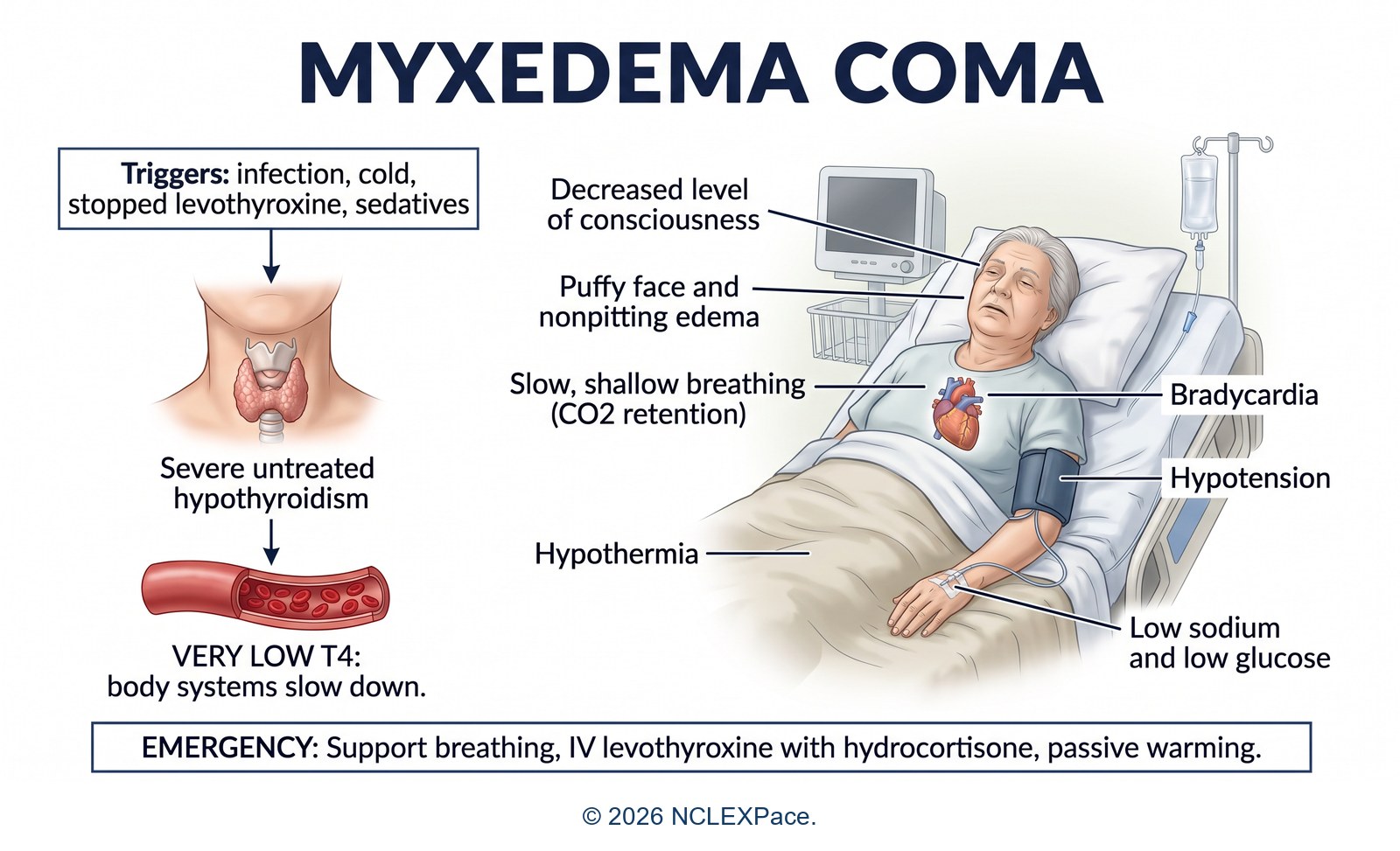
Myxedema coma is the most severe, life-threatening form of hypothyroidism, with a decreased level of consciousness, hypothermia and slowing of multiple organs. It usually develops when a stressor such as infection overwhelms a client with long-standing hypothyroidism. Most clients are lethargic or confused, not truly comatose. Mortality stays high even with intensive care, so treatment starts on clinical suspicion, before thyroid results return.
What the NCLEX focuses on
- Precipitating factors: infection (the most common), cold exposure, surgery, trauma, stroke, stopping levothyroxine, and drugs such as sedatives, opioids, anesthetics, amiodarone and lithium.
- The typical client is an older woman with known thyroid disease who presents in winter.
- Altered mental status and hypothermia are the 2 most common findings; bradycardia, hypotension and hypoventilation are also common.
- Laboratory findings: hyponatremia, hypoglycemia, hypercapnia with respiratory acidosis and, in primary hypothyroidism, a high TSH with a very low free T4.
- Hypoventilation with carbon dioxide retention is the main threat, and most clients need mechanical ventilation.
- IV hydrocortisone is given before IV levothyroxine and continued until adrenal insufficiency is excluded, because thyroid hormone can precipitate adrenal crisis.
- Rapid rewarming causes peripheral vasodilation, hypotension and shock.
Priority nursing actions
- Maintain the airway and support ventilation first; anticipate intubation and monitor arterial blood gases.
- Provide intensive care monitoring: continuous cardiac monitor, core temperature, blood pressure and level of consciousness.
- Draw blood for TSH, free T4 and cortisol as prescribed, then give IV hydrocortisone.
- Give IV levothyroxine as prescribed and watch for chest pain and dysrhythmias.
- Rewarm passively and slowly with blankets and a warm room.
- Give IV fluids and dextrose as prescribed, avoid hypotonic fluids, and monitor sodium and glucose.
- Help find and treat the trigger, such as infection, and avoid sedatives and opioids.
Numbers to know
| Value | Normal or target | Why it matters |
|---|---|---|
| Temperature | Often below 95.9°F (35.5°C) | Prognosis worsens as temperature falls |
| IV hydrocortisone | 100 mg first dose, before levothyroxine | Covers possible adrenal insufficiency |
| IV levothyroxine loading dose | 200 to 400 mcg once | Lower dose for older adults or cardiac disease |
| Severe hyponatremia | Sodium below 120 mEq/L | 3% sodium chloride may be prescribed and is given carefully |
| Thyroid laboratory tests | Repeated every 24 to 48 hours | Guide dose adjustment |
| Mortality | About 20% to 60% | Requires intensive care admission |
Common exam traps
- Choosing to give levothyroxine before hydrocortisone: wrong because thyroid hormone speeds cortisol metabolism and can trigger adrenal crisis.
- Choosing rapid active rewarming to correct the temperature quickly: wrong because vasodilation worsens hypotension.
- Choosing to wait for TSH and free T4 results before treatment: wrong because delay raises mortality.
- Choosing oral levothyroxine first: wrong because gut edema and slowed motility impair absorption, so the IV route is used.
- Choosing a sedative for restlessness or an opioid for pain: wrong because drug metabolism is slow and breathing is already depressed.
- Choosing hypotonic IV fluids: wrong because they worsen hyponatremia.
What to teach
- Take levothyroxine every day and never stop it without talking to the provider.
- Seek care early for infection, and avoid prolonged exposure to cold.
- Tell every provider about hypothyroidism before surgery or before taking sedatives or opioid pain medicine.
- Family members call emergency services for increasing drowsiness, confusion, slow breathing or a very low body temperature.
2 NCLEX questions with rationales on this topic
From the NCLEXPace question bank. Choose your answer first, then open the correct answer and the full rationale under each question.
The emergency nurse triages an unresponsive 80-year-old client brought from home in January. The family reports untreated "thyroid problems" and recent use of an over-the-counter sleep aid. Findings:
| Finding | Value |
|---|---|
| Temperature | 34.2°C (93.6°F) |
| Heart rate | 46/min |
| Respirations | 8/min and shallow |
| Face | Periorbital edema |
| Abdomen | Distended |
The nurse recognizes these findings as most consistent with which condition?
Select the best answer.
- A. Thyroid storm causing severe metabolic decompensation with altered consciousness and cardiovascular instability
- B. Adrenal crisis causing hypotension, altered consciousness, hypoglycemia, and acute electrolyte abnormalities
- C. Septic shock from pneumonia causing hypothermia, depressed consciousness, and progressive respiratory failure
- D. Myxedema coma
Show the correct answer and rationale
Correct answer:
- D. Myxedema coma
Rationale
Overview
- Definition: Myxedema coma is life-threatening decompensated hypothyroidism with severe depression of metabolic activity, impaired consciousness, and respiratory and cardiovascular dysfunction.
- Triggers: Cold exposure, infection, sedative medications, and untreated hypothyroidism precipitate decompensation.
- Treatment: Emergency airway and ventilatory support, intravenous levothyroxine, empiric intravenous hydrocortisone until adrenal insufficiency is excluded, passive rewarming, and correction of metabolic disturbances.
| Feature | Myxedema coma | Thyroid storm |
|---|---|---|
| Temperature | Hypothermia | Hyperthermia |
| Heart rate | Bradycardia | Marked tachycardia |
| Respiration | Hypoventilation | Increased respiratory demand |
| Consciousness | Lethargy, stupor, coma | Agitation, delirium, altered consciousness |
| Skin and face | Dry skin, periorbital edema | Warm skin, diaphoresis |
| Gastrointestinal | Constipation, ileus | Diarrhea, increased motility |
Nursing key points
- Assess airway protection immediately and prepare assisted ventilation for respirations of 8/min.
- Administer prescribed intravenous hydrocortisone before or with thyroid hormone replacement.
- Prepare prescribed intravenous levothyroxine and continuous cardiac monitoring.
- Use passive rewarming with blankets; avoid aggressive external heating.
- Monitor glucose, sodium, temperature, blood pressure, and cardiac rhythm.
- Assess for infection and avoid additional sedative medications.
Answer analysis
| Condition | Rationale |
|---|---|
| Thyroid storm causing severe metabolic decompensation with altered consciousness and cardiovascular instability | Not correct. Thyroid storm produces hypermetabolism with fever and marked tachycardia. |
| Adrenal crisis causing hypotension, altered consciousness, hypoglycemia, and acute electrolyte abnormalities | Not correct. The combined bradycardia, hypothermia, hypoventilation, and myxedematous findings identify severe hypothyroidism more specifically. |
| Septic shock from pneumonia causing hypothermia, depressed consciousness, and progressive respiratory failure | Not correct. Infection is a recognized precipitant, but the pronounced hypometabolic pattern identifies myxedema coma. |
| Myxedema coma | Correct. Untreated hypothyroidism with hypothermia, bradycardia, hypoventilation, edema, and decreased consciousness indicates myxedema coma. |
A 74-year-old client with untreated hypothyroidism is admitted with these findings.
| Finding | Value |
|---|---|
| Temperature | 34.5°C |
| Heart rate | 46/min |
| Respirations | 8/min |
| Glasgow Coma Scale score | 9 |
For each intervention, click to specify whether it is indicated or not indicated for a client with myxedema coma.
| Indicated | Not indicated | |
|---|---|---|
| Cover the client with warm blankets for passive rewarming | ||
| Give a sedative to reduce agitation during procedures | ||
| Administer intravenous hydrocortisone as prescribed | ||
| Administer intravenous levothyroxine as prescribed | ||
| Apply a heating pad and immerse the feet in warm water | ||
| Prepare for endotracheal intubation and mechanical ventilation |
Show the correct answer and rationale
Correct answers:
- Cover the client with warm blankets for passive rewarming: Indicated
- Give a sedative to reduce agitation during procedures: Not indicated
- Administer intravenous hydrocortisone as prescribed: Indicated
- Administer intravenous levothyroxine as prescribed: Indicated
- Apply a heating pad and immerse the feet in warm water: Not indicated
- Prepare for endotracheal intubation and mechanical ventilation: Indicated
Rationale
Overview
- Definition: Myxedema coma is severe decompensated hypothyroidism with hypothermia, hypoventilation, bradycardia, and altered consciousness.
- Treatment: Immediate ventilatory support, IV hydrocortisone, IV levothyroxine, and passive rewarming address respiratory and endocrine failure. Aggressive peripheral heating causes vasodilation and circulatory instability.
Nursing key points
- Prepare immediate ventilatory support for respirations 8/min and GCS 9.
- Administer prescribed hydrocortisone before thyroid hormone.
- Monitor core temperature and use passive rewarming.
- Assess ECG, blood pressure, glucose, sodium, and respiratory status.
- Avoid aggressive peripheral heating and routine sedatives.
Answer analysis
| Intervention | Indicated or not indicated? | Why |
|---|---|---|
| Cover the client with warm blankets for passive rewarming | Indicated. | Passive rewarming reduces heat loss without abrupt peripheral vasodilation. |
| Give a sedative to reduce agitation during procedures | Not indicated. | Routine sedation worsens respiratory depression and impaired consciousness. |
| Administer intravenous hydrocortisone as prescribed | Indicated. | Hydrocortisone provides glucocorticoid coverage before thyroid hormone increases cortisol metabolism. |
| Administer intravenous levothyroxine as prescribed | Indicated. | Thyroid hormone replacement treats the underlying endocrine deficiency. |
| Apply a heating pad and immerse the feet in warm water | Not indicated. | Aggressive peripheral heating causes vasodilation, hypotension, and circulatory instability. |
| Prepare for endotracheal intubation and mechanical ventilation | Indicated. | Severe hypoventilation and impaired consciousness threaten gas exchange and airway protection. |
The NCLEXPace bank has 3,200+ NCLEX questions with full rationales, sorted by topic, with your progress tracked as you practice. Create your account to start.
Create Account →More topics in Medical-Surgical
Lyme Disease NCLEX Questions With RationalesCovers Lyme disease stages, clinical manifestations, doxycycline treatment, tick removal, nursing priorities, and prevention.Influenza NCLEX Questions With RationalesReviews seasonal influenza symptoms, high-risk groups, antiviral treatment, isolation, vaccination, complications, and nursing care.Atopic Dermatitis (Eczema) NCLEX Questions With RationalesReviews childhood eczema manifestations, age-related distribution, triggers, skin care, topical medications, infection prevention, and parent education.Sources
- StatPearls, NCBI Bookshelf (NIH). Myxedema Coma. Last update 2025.
- American Thyroid Association. Guidelines for the Treatment of Hypothyroidism. Thyroid. 2014.
- Merck Manual Professional Edition. Hypothyroidism (section on myxedema coma). Reviewed 2026.
3,200+ NCLEX questions with think-like-a-nurse rationales, unfolding case studies and adaptive readiness exams. Start with free practice questions, then choose a plan when you are ready.
Create Account →