Multiple Sclerosis NCLEX Questions With Rationales
What it is
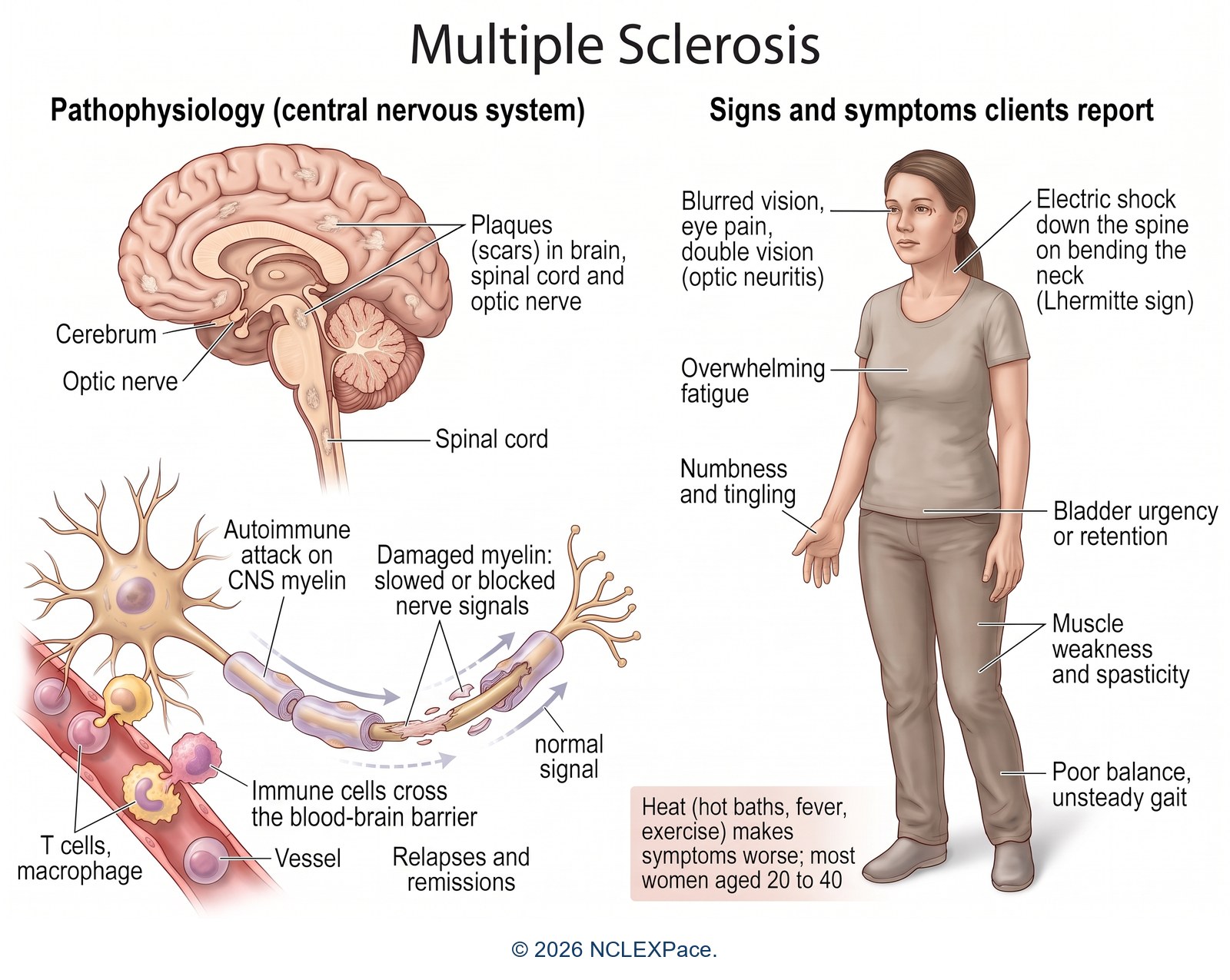
Multiple sclerosis (MS) is a chronic immune-mediated disease in which the immune system attacks myelin in the brain and spinal cord (the central nervous system). The damage leaves scar-like plaques, and the findings depend on where the plaques are and how large they are. Onset is typically between ages 20 and 40, and women are affected more often than men. In the relapsing-remitting course, attacks (relapses) are followed by partial or complete recovery (remission).
What the NCLEX focuses on
- Visual changes are common findings: optic neuritis (vision loss with pain on eye movement) and diplopia.
- Sensory and motor findings include numbness, tingling, weakness, spasticity with painful spasms, poor balance and tremor.
- Fatigue is common and is often worse in the late afternoon.
- Bladder dysfunction is common, and some clients need intermittent self-catheterization.
- Heat sensitivity: fever, a hot bath or warm weather can temporarily worsen symptoms (Uhthoff phenomenon).
- Heat, infection and stress can trigger or worsen symptoms.
- Corticosteroids, such as IV methylprednisolone for 3 to 5 days, speed recovery from a relapse but do not change the long-term course.
- Disease-modifying therapy reduces the frequency of relapses.
- Baclofen or tizanidine is prescribed for spasticity; baclofen must not be stopped abruptly because seizures, fever, confusion, muscle stiffness or hallucinations can occur.
Priority nursing actions
- Assess vision, strength, sensation, gait and bladder function, and compare with the client's baseline.
- Assess for and report signs of infection, including urinary tract infection, because infection worsens MS symptoms.
- Keep the client cool and avoid overheating.
- Prevent falls: provide assistive devices such as a cane or walker and a safe environment.
- Space activities with rest periods to conserve energy.
- Support bladder emptying, including intermittent catheterization when prescribed.
Numbers to know
| Item | Number | Why it matters |
|---|---|---|
| Usual age at onset | 20 to 40 years | MS is often diagnosed in young adults |
| Corticosteroid course for a relapse | 3 to 5 days, usually IV | Shortens the relapse; not a cure |
| Recovery after a relapse | Weeks to months | Recovery may be partial or complete |
| Secondary progressive course | Often 10 to 15 years after onset of relapsing-remitting MS | Gradual worsening replaces clear relapses |
Common exam traps
- Choosing a hot bath to relax spastic muscles: wrong because heat temporarily worsens MS symptoms.
- Choosing to stop baclofen suddenly when spasms improve: wrong because abrupt withdrawal can cause seizures and hallucinations.
- Choosing to describe corticosteroids as slowing the disease: wrong because they shorten a relapse but do not alter the long-term outcome.
- Choosing to stop disease-modifying therapy during remission: wrong because the therapy works by reducing future relapses.
- Choosing bed rest and avoiding exercise to prevent fatigue: wrong because regular physical activity improves strength, balance and fatigue.
What to teach
- Avoid very hot baths and showers, hot tubs, saunas and overheating.
- Pace activities, set priorities and get enough sleep.
- Stay as active as possible with a planned exercise program.
- Report burning on urination, fever, back pain or a frequent need to urinate.
- Make changes at home to prevent falls and keep the bathroom safe.
- Take disease-modifying therapy as prescribed, and do not stop baclofen without talking to the provider.
- Manage stress, and do not smoke, because smoking is linked to a more aggressive disease course.
2 NCLEX questions with rationales on this topic
From the NCLEXPace question bank. Choose your answer first, then open the correct answer and the full rationale under each question.
A client newly diagnosed with multiple sclerosis asks how to reduce symptom flares in daily life. Which teaching is correct?
Select the best answer.
- A. “Use hot baths or a sauna when stiffness increases because sustained warmth can relax spastic muscles and improve conduction through demyelinated nerves.”
- B. “Daily activities do not influence symptom severity, so temperature exposure, fatigue, and fever do not need to be considered when planning routines.”
- C. "Avoid overheating: skip hot baths and saunas, stay cool, and treat fevers promptly, because heat temporarily worsens symptoms."
- D. “Exercise intensely until significant fatigue develops several times each week because repeated exertion helps the nervous system compensate for demyelination.”
Show the correct answer and rationale
Correct answer:
- C. "Avoid overheating: skip hot baths and saunas, stay cool, and treat fevers promptly, because heat temporarily worsens symptoms."
Rationale
Overview
- Definition: Multiple sclerosis (MS) is an immune-mediated disorder of the central nervous system that causes demyelination and neuroaxonal injury.
- Heat sensitivity: Increased body temperature slows nerve conduction through demyelinated pathways. This temporary worsening of existing symptoms is called Uhthoff phenomenon.
- Daily planning: Heat, fever, and excessive fatigue worsen symptoms. Infection and stress are associated with relapses. Cooling strategies, moderate exercise, and planned rest support daily function.
Nursing key points
- Avoid hot baths, saunas, and prolonged exposure to high temperatures.
- Use cool showers, cooling vests, fans, and air conditioning.
- Monitor temperature during illness. Report fever and obtain prompt treatment of its cause.
- Perform regular moderate exercise with scheduled rest periods.
- Report new neurologic deficits or symptoms that persist after cooling and fever resolution.
Answer analysis
| Teaching statement | Rationale |
|---|---|
| “Use hot baths or a sauna when stiffness increases because sustained warmth can relax spastic muscles and improve conduction through demyelinated nerves.” | Not correct. Heat slows conduction through demyelinated pathways and temporarily worsens neurologic symptoms. |
| “Daily activities do not influence symptom severity, so temperature exposure, fatigue, and fever do not need to be considered when planning routines.” | Not correct. Temperature exposure, fever, and fatigue affect symptom severity and require daily planning. |
| "Avoid overheating: skip hot baths and saunas, stay cool, and treat fevers promptly, because heat temporarily worsens symptoms." | Correct. Cooling and prompt fever management reduce temporary heat-related worsening. |
| “Exercise intensely until significant fatigue develops several times each week because repeated exertion helps the nervous system compensate for demyelination.” | Not correct. Exercise must remain within tolerance and include rest to prevent exhaustion and overheating. |
A client with multiple sclerosis who has leg weakness, spasticity, and poor balance reviews safety and self care teaching with the nurse before discharge.
For each client statement, click to specify whether it indicates effective teaching or a need for further teaching.
| Effective teaching | Needs further teaching | |
|---|---|---|
| “A long hot bath every evening will loosen my stiff legs.” | ||
| “I removed the throw rugs and put a shower chair in the bathroom.” | ||
| “I will plan my errands for the morning and rest before my energy runs out.” | ||
| “I stopped the baclofen because the spasms are gone now.” | ||
| “I will walk with my feet a little apart and use the walker the therapist fitted.” | ||
| “I will get my flu shot and call the provider if I get a fever.” |
Show the correct answer and rationale
Correct answers:
- “A long hot bath every evening will loosen my stiff legs.”: Needs further teaching
- “I removed the throw rugs and put a shower chair in the bathroom.”: Effective teaching
- “I will plan my errands for the morning and rest before my energy runs out.”: Effective teaching
- “I stopped the baclofen because the spasms are gone now.”: Needs further teaching
- “I will walk with my feet a little apart and use the walker the therapist fitted.”: Effective teaching
- “I will get my flu shot and call the provider if I get a fever.”: Effective teaching
Rationale
Overview
- Definition: Multiple sclerosis is an immune-mediated inflammatory disease of the central nervous system that damages myelin and axons.
- Signs and symptoms: Weakness, spasticity, fatigue, sensory deficits, and impaired balance affect mobility and independence.
- Safety teaching: Heat increases existing neurological symptoms. Infection causes temporary symptom worsening and is associated with increased relapse risk. Abrupt baclofen withdrawal causes rebound spasticity, hallucinations, and seizures.

Nursing key points
- Teach the client to use a properly fitted walker and a stable base of support.
- Recommend warm, not hot, bathing water and measures to prevent overheating.
- Schedule demanding activities during periods of greater energy and rest before exhaustion.
- Recommend indicated inactivated influenza vaccination and prompt assessment of fever.
- Teach the client never to discontinue baclofen abruptly.
- Remove loose rugs and install appropriate bathroom safety equipment.
Answer analysis
| Client statement | Effective teaching or Needs further teaching? | Why |
|---|---|---|
| “A long hot bath every evening will loosen my stiff legs.” | Needs further teaching. | Heat worsens neurological symptoms and increases fall risk. |
| “I removed the throw rugs and put a shower chair in the bathroom.” | Effective teaching. | Environmental modifications reduce falls. |
| “I will plan my errands for the morning and rest before my energy runs out.” | Effective teaching. | Activity planning and rest reduce fatigue. |
| “I stopped the baclofen because the spasms are gone now.” | Needs further teaching. | Abrupt baclofen withdrawal causes rebound spasticity and serious neurological complications. |
| “I will walk with my feet a little apart and use the walker the therapist fitted.” | Effective teaching. | A wider base and fitted walker improve balance. |
| “I will get my flu shot and call the provider if I get a fever.” | Effective teaching. | Inactivated influenza vaccination is safe; fever requires assessment. |
The NCLEXPace bank has 3,200+ NCLEX questions with full rationales, sorted by topic, with your progress tracked as you practice. Create your account to start.
Create Account →More topics in Medical-Surgical
Lyme Disease NCLEX Questions With RationalesCovers Lyme disease stages, clinical manifestations, doxycycline treatment, tick removal, nursing priorities, and prevention.Influenza NCLEX Questions With RationalesReviews seasonal influenza symptoms, high-risk groups, antiviral treatment, isolation, vaccination, complications, and nursing care.Atopic Dermatitis (Eczema) NCLEX Questions With RationalesReviews childhood eczema manifestations, age-related distribution, triggers, skin care, topical medications, infection prevention, and parent education.Sources
- National Institute of Neurological Disorders and Stroke (NIH). Multiple Sclerosis (MS).
- MedlinePlus Medical Encyclopedia (National Library of Medicine). Multiple sclerosis. Reviewed 2026.
- Merck Manual Professional Edition. Multiple Sclerosis (MS).
- MedlinePlus (National Library of Medicine). Baclofen. 2019.
3,200+ NCLEX questions with think-like-a-nurse rationales, unfolding case studies and adaptive readiness exams. Start with free practice questions, then choose a plan when you are ready.
Create Account →