IV Therapy Complications NCLEX Questions With Rationales
What it is
IV therapy delivers fluids, electrolytes, blood products, and medications directly into the bloodstream through venous access. Complications include infiltration, extravasation, phlebitis, infection, fluid volume overload, and air embolism. Early recognition and prompt intervention help prevent tissue injury, respiratory compromise, and systemic infection.
What the NCLEX focuses on
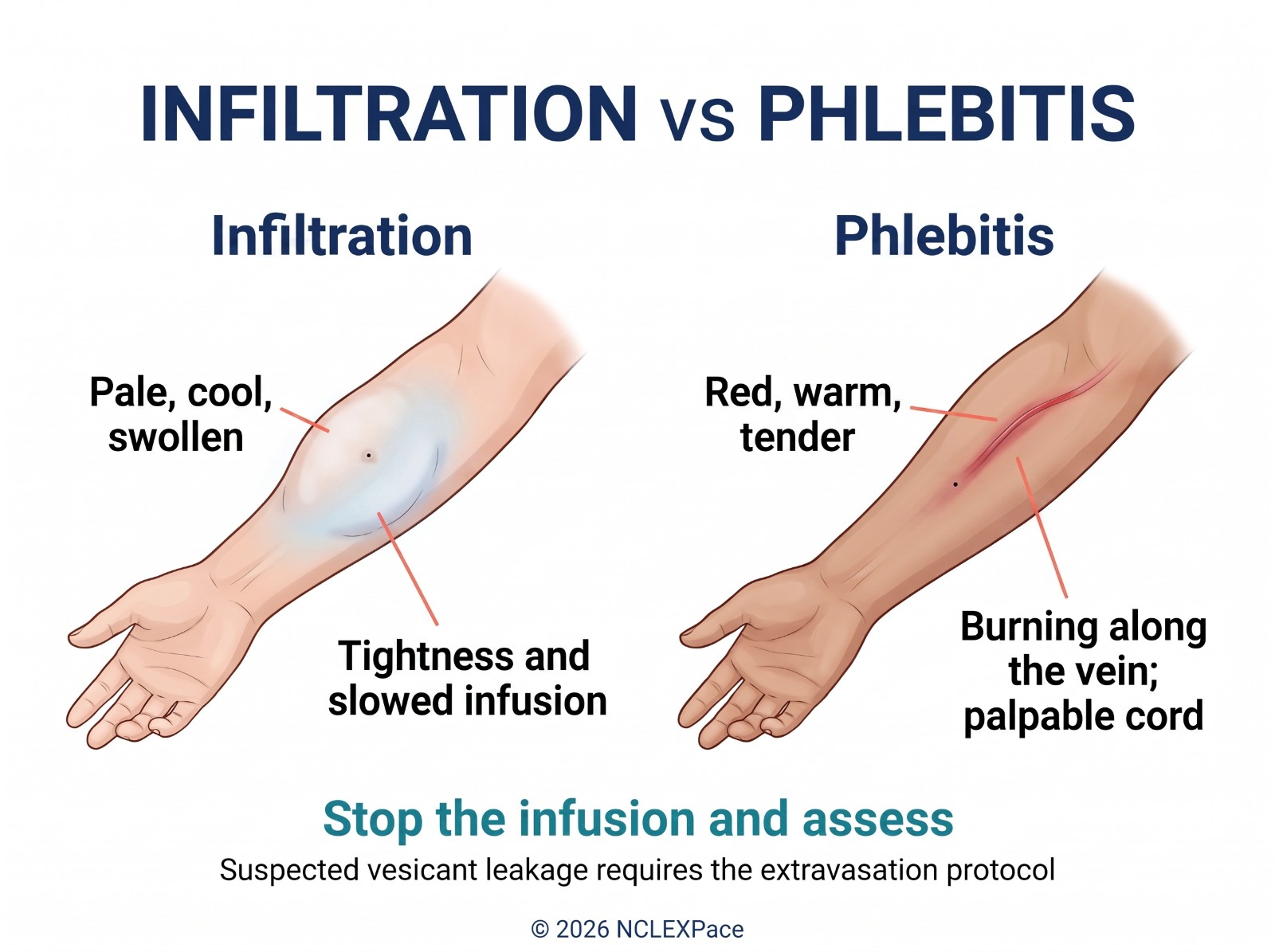
- Infiltration occurs when nonvesicant IV fluid or medication leaks into surrounding tissue, causing swelling, tight skin that is pale and cool, discomfort, and slowing of the infusion.
- Extravasation occurs when a vesicant medication leaks into surrounding tissue and can cause blistering, tissue necrosis, and permanent injury.
- Phlebitis is inflammation of the vein and commonly causes redness, warmth, tenderness, burning or a red streak along the vein, and a palpable venous cord.
- Vesicants include certain chemotherapy medications and vasopressors, which can cause serious tissue damage if extravasation occurs. Phentolamine is the antidote commonly prescribed for vasopressor extravasation.
- Local catheter infection may cause redness, warmth, tenderness, drainage, and fever, while bloodstream infection may cause systemic signs of illness.
- Fluid volume overload may cause hypertension, peripheral edema, weight gain, crackles, dyspnea, and decreased oxygen saturation, particularly in clients with heart or kidney disease.
- Air embolism may cause sudden dyspnea, chest discomfort, coughing, hypotension, altered mental status, and cardiovascular instability.
- Peripheral IV sites should be assessed regularly for pain, swelling, redness, warmth, leakage, dressing integrity, and infusion patency.
- For peripheral access, avoid areas of flexion and limbs with an arteriovenous fistula, compromised circulation, infection, or relevant lymphatic impairment.
Priority nursing actions
- Stop the infusion immediately when infiltration, phlebitis, or extravasation is suspected. Assess the site and the client's symptoms.
- For suspected extravasation, stop the infusion but leave the catheter in place initially to allow aspiration of residual medication or administration of an antidote when prescribed. Do not flush the catheter. Follow the medication-specific extravasation protocol.
- For uncomplicated infiltration, discontinue the affected peripheral catheter, elevate the extremity, and apply a warm or cold compress according to the infused solution and facility policy.
- For suspected phlebitis or infection, discontinue the affected peripheral IV when indicated, assess for systemic infection, notify the provider, and obtain prescribed investigations.
- For suspected fluid overload, slow or stop the infusion according to the client's condition and orders, assess respiratory status and oxygen saturation, elevate the head of the bed, and notify the provider promptly.
- For suspected air embolism, prevent further air entry by occluding the source, call the rapid response team, administer oxygen as directed, and position the client in the left lateral Trendelenburg position if not contraindicated.
Common exam traps
- Choosing to flush an infiltrated IV: wrong because additional fluid increases tissue swelling.
- Choosing to immediately remove a catheter during vesicant extravasation: wrong because the catheter may be needed to aspirate medication or administer an antidote.
- Choosing to massage an extravasation site: wrong because manipulation may increase tissue exposure to the damaging medication.
- Choosing to continue an infusion when crackles and dyspnea develop: wrong because these findings may indicate fluid overload.
- Choosing to place an air embolism client flat without considering the prescribed emergency positioning: wrong because left lateral positioning with head down may be indicated for venous air embolism.
What to teach
- Teach clients to report pain, burning, swelling, redness, wet dressings, or leakage around an IV site immediately.
- Explain that IV sites require regular assessment even when the infusion appears to be running normally.
- Teach clients with central lines and PICCs to keep dressings clean, dry, and intact.
- Explain that central line hubs must be disinfected before every access and allowed to dry according to product instructions.
- Teach clients with a PICC to avoid blood pressure measurements and unnecessary venipuncture in the PICC arm when an alternative limb is available.
- Explain that central line flushing must follow the prescribed solution, syringe size, device instructions, and facility protocol.
2 NCLEX questions with rationales on this topic
From the NCLEXPace question bank. Choose your answer first, then open the correct answer and the full rationale under each question.
A nurse notes blanching and swelling at a peripheral intravenous site where norepinephrine is infusing. Which action should the nurse take first?
Select the best answer.
- A. Document the blanching and swelling and reassess at the end of the shift
- B. Apply a warm compress and continue the infusion through the same line
- C. Stop the infusion immediately and notify the prescriber promptly
- D. Increase the infusion rate briefly to clear the catheter
Show the correct answer and rationale
Correct answer:
- C. Stop the infusion immediately and notify the prescriber promptly
Rationale
Overview
- Definition: Vasopressor extravasation occurs when norepinephrine enters surrounding tissue instead of remaining within the vein. Alpha-adrenergic vasoconstriction produces local ischemia and tissue necrosis.
- Signs: Blanching, swelling, coolness, pain, and reduced tissue perfusion at the infusion site indicate extravasation.
- Response and antidote: Immediately stop administration through the affected catheter. Phentolamine reverses local alpha-adrenergic vasoconstriction. Adult treatment uses 5 to 10 mg diluted in 10 to 15 mL of 0.9% sodium chloride for local infiltration as soon as possible, preferably within 12 hours.
Nursing key points
- Stop the infusion immediately and do not flush the affected catheter.
- Leave the catheter temporarily in place for attempted aspiration according to protocol.
- Notify the prescriber and initiate the institutional extravasation protocol.
- Administer prescribed phentolamine promptly using approved infiltration technique.
- Remove the catheter after protocol-directed treatment, elevate the limb, and document the affected area.
- Monitor blood pressure and restore prescribed norepinephrine through suitable alternative vascular access.
Answer analysis
| Nursing action | Rationale |
|---|---|
| Document the blanching and swelling and reassess at the end of the shift | Not correct. Continued norepinephrine exposure causes progressive local ischemia. |
| Apply a warm compress and continue the infusion through the same line | Not correct. A compress does not replace stopping the infusion or administering the antidote. |
| Stop the infusion immediately and notify the prescriber promptly | Correct. Immediate cessation limits tissue injury and permits urgent antidote treatment. |
| Increase the infusion rate briefly to clear the catheter | Not correct. Increasing the rate delivers more norepinephrine into surrounding tissue. |
The nurse assesses several peripheral intravenous sites. For each finding, indicate whether it suggests infiltration or phlebitis.
For each finding at a peripheral intravenous site, indicate whether it suggests infiltration or phlebitis.
| Infiltration | Phlebitis | |
|---|---|---|
| The infusion has slowed and the area feels tight | ||
| A red streak runs along the line of the vein | ||
| Skin around the site is pale, cool, and swollen | ||
| The client reports burning along the vein above the site | ||
| The site is warm and tender with a palpable cord |
Show the correct answer and rationale
Correct answers:
- The infusion has slowed and the area feels tight: Infiltration
- A red streak runs along the line of the vein: Phlebitis
- Skin around the site is pale, cool, and swollen: Infiltration
- The client reports burning along the vein above the site: Phlebitis
- The site is warm and tender with a palpable cord: Phlebitis
Rationale
Overview
- Definition: Phlebitis is inflammation of a vein. Infiltration is leakage of nonvesicant IV fluid into surrounding tissue.
- Signs: Phlebitis produces warmth, tenderness, linear erythema, and a palpable cord. Infiltration produces edema, tightness, pallor, coolness, and slowed flow.
- First actions: Stop the infusion and assess the solution before catheter removal.
Nursing key points
- Stop the infusion immediately; do not flush the affected catheter.
- Remove the catheter for phlebitis or uncomplicated nonvesicant infiltration.
- Apply a warm compress for phlebitis.
- Elevate the extremity for infiltration; select compresses according to the infused agent.
- For suspected vesicant extravasation, retain the catheter initially for aspiration and follow the agent-specific protocol.
Answer analysis
| Finding at the intravenous site | Infiltration or phlebitis? | Why |
|---|---|---|
| The infusion has slowed and the area feels tight | Infiltration. | Accumulated tissue fluid causes tightness and impedes infusion. |
| A red streak runs along the line of the vein | Phlebitis. | Linear erythema indicates venous inflammation. |
| Skin around the site is pale, cool, and swollen | Infiltration. | These findings indicate fluid leakage into surrounding tissue. |
| The client reports burning along the vein above the site | Phlebitis. | Burning along the vein indicates venous irritation. |
| The site is warm and tender with a palpable cord | Phlebitis. | These findings indicate inflammation along the vein. |
The NCLEXPace bank has 3,200+ NCLEX questions with full rationales, sorted by topic, with your progress tracked as you practice. Create your account to start.
Create Account →More topics in Pharmacology
Proton Pump Inhibitors and Antacids NCLEX Questions With RationalesReviews acid-suppressing medications, administration, adverse effects, drug interactions, and nursing priorities for gastrointestinal bleeding.Calcium Channel Blockers NCLEX Questions With RationalesReviews calcium channel blocker classes, cardiovascular uses, adverse effects, nursing assessments, medication safety, and client teaching.Statins NCLEX Questions With RationalesReviews statin medications, LDL reduction, adverse effects, drug interactions, laboratory monitoring, and client education.Sources
- National Library of Medicine. Chapter 23 IV Therapy Management. 2023.
- National Library of Medicine. Chapter 1 Initiate IV Therapy. 2023.
3,200+ NCLEX questions with think-like-a-nurse rationales, unfolding case studies and adaptive readiness exams. Start with free practice questions, then choose a plan when you are ready.
Create Account →