Hyperthyroidism NCLEX Questions With Rationales
What it is
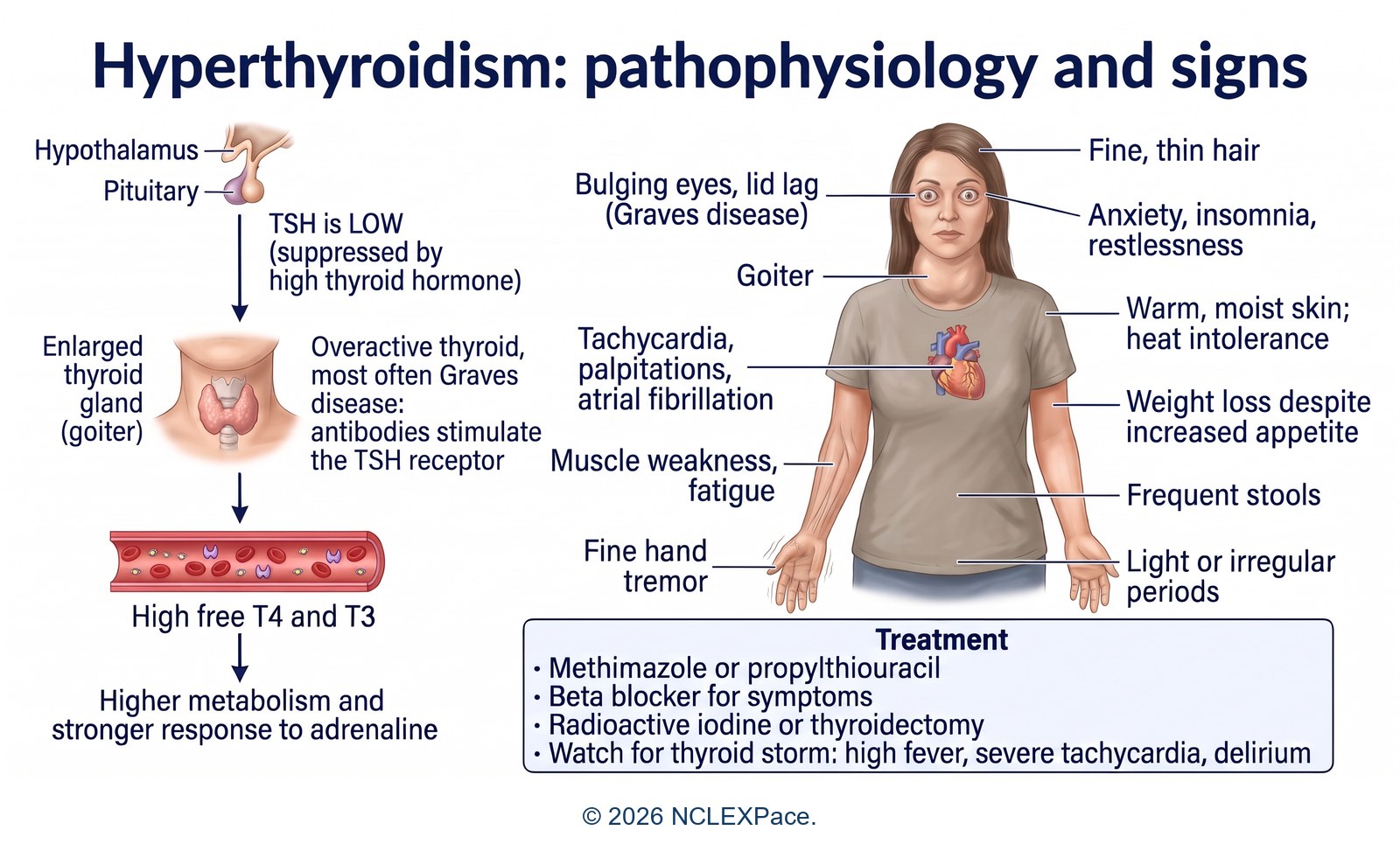
Hyperthyroidism is an overactive thyroid gland that makes more thyroid hormone than the body needs, which speeds up metabolism. Graves disease, an autoimmune disorder, is the most common cause in the United States. Laboratory results show a low or suppressed TSH with elevated free T4 and T3. Untreated disease can progress to thyroid storm, a life-threatening emergency.
What the NCLEX focuses on
- Classic findings: weight loss despite an increased appetite, heat intolerance, sweating, tremor, palpitations, anxiety, frequent bowel movements and a goiter.
- Cardiac findings are tachycardia, hypertension and sometimes atrial fibrillation.
- True eye disease with bulging eyes (exophthalmos) occurs only in Graves disease.
- Methimazole is the preferred antithyroid drug; propylthiouracil (PTU) is preferred in the first trimester of pregnancy.
- Agranulocytosis and liver toxicity are rare but serious adverse effects of methimazole and PTU; liver toxicity is more common with PTU.
- Beta blockers such as propranolol relieve tremor and tachycardia but do not stop thyroid hormone production.
- Radioactive iodine is not used during pregnancy or breastfeeding, and almost all clients become hypothyroid afterward and need thyroid hormone replacement.
- Thyroidectomy risks are bleeding, hypocalcemia from hypoparathyroidism and laryngeal nerve injury.
Priority nursing actions
- Assess heart rate and rhythm, blood pressure, temperature and weight, and report a new irregular pulse.
- Give the antithyroid drug and beta blocker as prescribed.
- Hold the antithyroid drug and report fever or sore throat in a client taking methimazole or PTU right away; a complete blood count with differential is needed to rule out agranulocytosis.
- Protect the eyes in Graves disease: lubricating eye drops, sunglasses, the head raised during sleep, and eyelids taped closed at night if they do not close fully.
- After thyroidectomy, monitor for bleeding, a low calcium level and voice changes.
- Report fever with severe tachycardia, sweating and anxiety immediately as possible thyroid storm.
Numbers to know
| Value | Normal or target | Why it matters |
|---|---|---|
| TSH | 0.4 to 4.8 microunits/mL | Low or suppressed in hyperthyroidism |
| Agranulocytosis | About 0.1% to 0.15% of clients on methimazole or PTU | Rare, so fever or sore throat must be reported |
| PTU in pregnancy | First trimester; a switch to methimazole may be prescribed after 16 weeks | Methimazole is linked to birth defects |
| Distance after radioactive iodine | About 6 feet from others | Limits radiation exposure, above all for children and pregnant women |
| Pregnancy after radioactive iodine | Delayed at least 6 to 12 months | Protects the fetus |
Common exam traps
- Choosing weight gain, cold intolerance and constipation as expected findings: wrong because those describe hypothyroidism.
- Choosing propranolol as the drug that corrects the thyroid hormone level: wrong because it only controls symptoms.
- Choosing to treat a sore throat and fever as a cold in a client taking methimazole: wrong because agranulocytosis must be ruled out first.
- Choosing radioactive iodine for a pregnant or breastfeeding client: wrong because it can harm the fetal thyroid and passes into breast milk.
What to teach
- Take the antithyroid drug exactly as prescribed and keep all laboratory appointments.
- Stop the antithyroid drug and report fever, chills, sore throat, or yellow skin or eyes right away.
- Avoid kelp, seaweed and iodine supplements, which can worsen hyperthyroidism.
- Stop smoking, because smoking makes Graves eye disease worse.
- After radioactive iodine, stay about 6 feet from others, sleep alone, do not share utensils and drink plenty of fluids for the number of days instructed.
2 NCLEX questions with rationales on this topic
From the NCLEXPace question bank. Choose your answer first, then open the correct answer and the full rationale under each question.
A client received radioactive iodine (I-131) therapy for Graves disease and is being discharged. Which instruction should the nurse include for the first several days?
Select the best answer.
- A. Sleep separately from your partner and avoid close, prolonged contact with pregnant women and young children
- B. Remain isolated in one room and avoid normal household activity for three days because physical movement increases radiation exposure to others
- C. Discard clothing worn during treatment and use special decontamination soap for several days to remove radioactive iodine from the skin
- D. No household precautions are necessary because therapeutic iodine is rapidly eliminated and does not expose other people after discharge
Show the correct answer and rationale
Correct answer:
- A. Sleep separately from your partner and avoid close, prolonged contact with pregnant women and young children
Rationale
Overview
- Definition: Radioactive iodine-131 is absorbed by thyroid tissue and destroys hormone-producing thyroid cells through beta radiation. It treats hyperthyroidism associated with Graves disease.
- Precautions: Temporary radiation precautions reduce exposure to others. Restrictions include separate sleeping arrangements, increased distance, careful hygiene, and limited close contact with pregnant women and children.
- After effects: Hypothyroidism commonly develops after treatment and requires thyroid function monitoring and levothyroxine replacement.
| Precaution | Why |
|---|---|
| Sleep in a separate bed | Reduces prolonged radiation exposure. |
| Avoid close contact with pregnant women and children | Protects radiation-sensitive tissues. |
| Flush the toilet twice when directed | Reduces radioactive contamination from urine. |
| Wash hands thoroughly | Limits transfer of radioactive material. |
| Use separate utensils and laundry when directed | Reduces contamination from body fluids. |
| Avoid pregnancy for at least 6 months | Protects the developing fetus. |
Nursing key points
- Reinforce the nuclear medicine team's written restrictions and their specific duration.
- Maintain recommended distance and sleep separately during the prescribed period.
- Follow instructions for toilet hygiene, handwashing, utensils, and laundry.
- Avoid pregnancy for at least 6 months after I-131 treatment and follow individualized reproductive counseling.
- Attend scheduled thyroid function testing to identify hypothyroidism.
Answer analysis
| Discharge instruction | Rationale |
|---|---|
| Sleep separately from your partner and avoid close, prolonged contact with pregnant women and young children | Correct. Distance and reduced contact time lower radiation exposure. |
| Remain isolated in one room and avoid normal household activity for three days because physical movement increases radiation exposure to others | Not correct. Routine household movement does not require strict room isolation. |
| Discard clothing worn during treatment and use special decontamination soap for several days to remove radioactive iodine from the skin | Not correct. Routine clothing disposal and special soap are unnecessary. |
| No household precautions are necessary because therapeutic iodine is rapidly eliminated and does not expose other people after discharge | Not correct. Residual radioactive iodine requires temporary household precautions. |
A clinic nurse screens a 34-year-old client whose chief concern is "feeling wired all the time." Which findings support a possible diagnosis of hyperthyroidism? Select all that apply.
- A. Weight loss of 6 kg despite increased appetite
- B. Preference for a warm room and extra blankets
- C. Resting heart rate of 112/min with palpitations
- D. Fine tremor of the outstretched hands
- E. Constipation with two bowel movements per week
- F. Menstrual periods that have become lighter and irregular
Show the correct answer and rationale
Correct answers:
- A. Weight loss of 6 kg despite increased appetite
- C. Resting heart rate of 112/min with palpitations
- D. Fine tremor of the outstretched hands
- F. Menstrual periods that have become lighter and irregular
Rationale
Overview
- Definition: Hyperthyroidism is excessive thyroid hormone synthesis and secretion, causing increased metabolic activity and adrenergic responsiveness.
- Signs: Weight loss despite increased appetite, heat intolerance, tachycardia, fine tremor, frequent bowel movements, and menstrual irregularities are characteristic findings.
- Tests: Primary hyperthyroidism typically produces suppressed TSH with elevated free T4, T3, or both.
Nursing key points
- Assess unintentional weight change and appetite.
- Measure resting pulse and assess for palpitations or dysrhythmias.
- Observe outstretched hands for fine postural tremor.
- Ask about heat intolerance, bowel frequency, and menstrual changes.
- Review TSH and free T4 results; suppressed TSH with elevated free T4 indicates overt primary hyperthyroidism.
- Report fever, marked tachycardia, or altered mental status urgently.
Answer analysis
| Screening finding | Rationale |
|---|---|
| Weight loss of 6 kg despite increased appetite | Supports hyperthyroidism. Increased metabolic activity causes weight loss despite greater caloric intake. |
| Preference for a warm room and extra blankets | Does not support. Cold intolerance is characteristic of hypothyroidism. |
| Resting heart rate of 112/min with palpitations | Supports hyperthyroidism. Thyroid hormone excess increases adrenergic responsiveness and heart rate. |
| Fine tremor of the outstretched hands | Supports hyperthyroidism. Increased adrenergic responsiveness produces fine postural tremor. |
| Constipation with two bowel movements per week | Does not support. Hyperthyroidism increases gastrointestinal motility and bowel frequency. |
| Menstrual periods that have become lighter and irregular | Supports hyperthyroidism. Excess thyroid hormone disrupts menstrual regulation. |
The NCLEXPace bank has 3,200+ NCLEX questions with full rationales, sorted by topic, with your progress tracked as you practice. Create your account to start.
Create Account →More topics in Medical-Surgical
Lyme Disease NCLEX Questions With RationalesCovers Lyme disease stages, clinical manifestations, doxycycline treatment, tick removal, nursing priorities, and prevention.Influenza NCLEX Questions With RationalesReviews seasonal influenza symptoms, high-risk groups, antiviral treatment, isolation, vaccination, complications, and nursing care.Atopic Dermatitis (Eczema) NCLEX Questions With RationalesReviews childhood eczema manifestations, age-related distribution, triggers, skin care, topical medications, infection prevention, and parent education.Sources
- National Institute of Diabetes and Digestive and Kidney Diseases (NIH). Hyperthyroidism (Overactive Thyroid). Last reviewed 2021.
- National Institute of Diabetes and Digestive and Kidney Diseases (NIH). Graves' Disease. Last reviewed 2021.
- StatPearls, NCBI Bookshelf (NIH). Hyperthyroidism. Last update 2023.
- American Thyroid Association. Radioactive Iodine.
3,200+ NCLEX questions with think-like-a-nurse rationales, unfolding case studies and adaptive readiness exams. Start with free practice questions, then choose a plan when you are ready.
Create Account →