Heparin NCLEX Questions With Rationales
What it is
Heparin is an anticoagulant that enhances antithrombin activity, inhibiting clotting factors and helping prevent clot formation and extension. Unfractionated heparin (UFH) may be administered intravenously or subcutaneously, while low molecular weight heparin (LMWH), such as enoxaparin, is commonly administered subcutaneously. Both medications increase bleeding risk and can cause heparin-induced thrombocytopenia (HIT).
What the NCLEX focuses on
- UFH has a less predictable anticoagulant response and commonly requires aPTT or anti-factor Xa monitoring during therapeutic intravenous infusion.
- Therapeutic aPTT targets depend on laboratory calibration and the facility's heparin protocol.
- LMWH has a more predictable response and generally does not require routine coagulation monitoring.
- Anti-factor Xa testing may be considered during LMWH therapy in selected situations, including renal impairment.
- Protamine sulfate reverses UFH anticoagulation and provides only partial reversal of LMWH anticoagulant activity.
- HIT is an immune-mediated complication associated with falling platelet counts and increased thrombosis risk.
- Suspected HIT requires prompt provider notification and evaluation for discontinuation of all heparin products.
- Heparin and LMWH are high-alert medications requiring appropriate safeguards against administration errors.
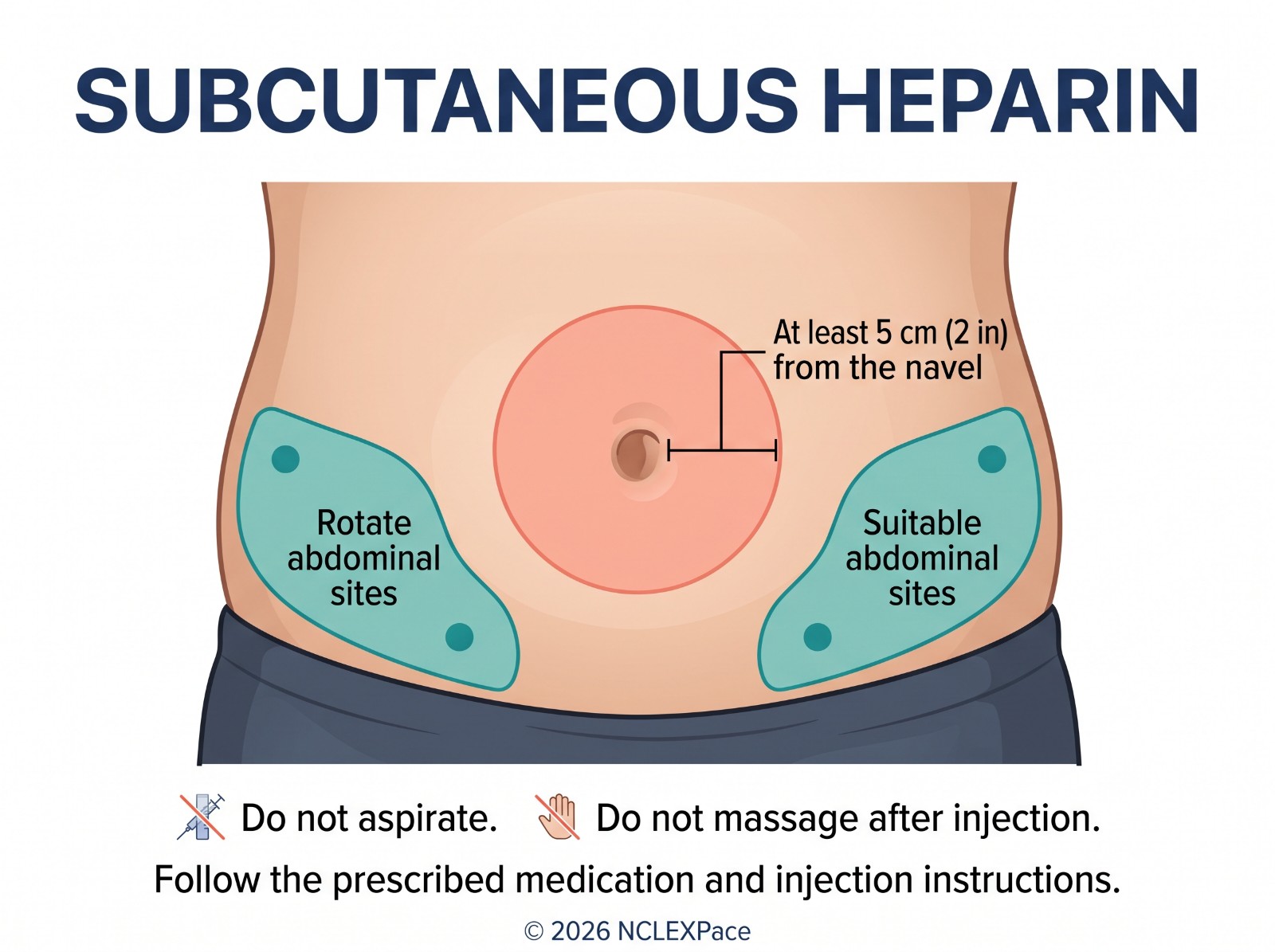
- Subcutaneous heparin injections must enter fatty tissue, and the injection site should not be rubbed afterward.
Priority nursing actions
- Assess active bleeding, hemodynamic stability, recent procedures, and relevant contraindications before administering prescribed heparin.
- Verify the prescribed dose, concentration, route, infusion rate, and client identity; perform an independent double check when required by facility policy.
- Review baseline and subsequent platelet counts, hemoglobin, hematocrit, and prescribed coagulation tests.
- Monitor intravenous UFH laboratory results and adjust infusion rates only according to authorized orders or protocols.
- Report major bleeding or suspected HIT immediately, withhold heparin when indicated by emergency procedures or authorized protocols, and prepare prescribed reversal or alternative anticoagulation.
- Administer subcutaneous injections using appropriate sites and technique, rotate sites, and avoid rubbing afterward.
Numbers to know
| Value | Number | Why it matters |
|---|---|---|
| UFH anti-factor Xa therapeutic range | 0.3 to 0.7 IU/mL | Common therapeutic range for intravenous UFH, subject to local protocol. |
| HIT platelet decrease | Greater than 50% | A characteristic platelet decline that raises suspicion for immune-mediated HIT. |
| Platelet monitoring period | Day 4 to day 14 | ASH suggests this period for indicated HIT surveillance without recent heparin exposure. |
| Subcutaneous injection distance from navel | 2 inches (5 centimeters) | Recommended minimum distance for heparin injection site selection. |
Common exam traps
- Choosing routine aPTT monitoring for LMWH: wrong because aPTT does not reliably measure LMWH anticoagulation.
- Choosing vitamin K to reverse heparin: wrong because protamine sulfate is the reversal medication for UFH.
- Choosing to continue heparin without escalation when HIT is strongly suspected: wrong because HIT can cause dangerous thrombosis despite thrombocytopenia.
- Choosing to rub a subcutaneous injection site: wrong because rubbing increases local bruising and tissue trauma.
- Choosing to administer an unchecked heparin infusion despite a required independent double check: wrong because heparin is a high-alert medication.
What to teach
- Report unusual bruising, bleeding gums, black stools, blood in urine, or persistent bleeding immediately.
- Use a soft toothbrush and an electric razor to reduce avoidable injury.
- Avoid aspirin, ibuprofen, and other medications that increase bleeding risk unless approved by the provider.
- Rotate prescribed injection sites, avoid bruised areas, and dispose of needles in an appropriate sharps container.
- Inform healthcare professionals about anticoagulant treatment before procedures or new prescriptions.
- Do not independently change doses or discontinue prescribed anticoagulation without medical guidance.
2 NCLEX questions with rationales on this topic
From the NCLEXPace question bank. Choose your answer first, then open the correct answer and the full rationale under each question.
A client is prescribed a subcutaneous injection of heparin. Which technique should the nurse use?
Select the best answer.
- A. Inject the abdomen; do not massage
- B. Aspirate for blood return before injecting
- C. Use the same abdominal area each day
- D. Massage the site for 30 seconds afterward
Show the correct answer and rationale
Correct answer:
- A. Inject the abdomen; do not massage
Rationale
Overview
- Definition: Subcutaneous heparin is an anticoagulant administered into subcutaneous tissue.
- Technique: Abdominal injection into a pinched skinfold with site rotation limits tissue injury.
- What to avoid: Aspiration and massage increase local trauma, bruising, and hematoma formation.
Nursing key points
- Select intact abdominal tissue at least 2 inches (5 cm) from the umbilicus.
- Rotate sites; avoid bruises, scars, and injured tissue.
- Insert a short subcutaneous needle at 90 degrees into a pinched fold.
- Do not aspirate or massage.
- Follow prefilled-syringe instructions; retain a manufacturer-specified air bubble.
- Review platelet counts and assess for bleeding.
Answer analysis
| Injection technique | Rationale |
|---|---|
| Inject the abdomen; do not massage | Correct. Abdominal subcutaneous tissue is suitable; avoiding massage reduces trauma. |
| Aspirate for blood return before injecting | Not correct. Aspiration increases tissue trauma and bruising. |
| Use the same abdominal area each day | Not correct. Rotate injection sites to reduce repeated tissue injury. |
| Massage the site for 30 seconds afterward | Not correct. Massage increases local bleeding and hematoma risk. |
A nurse is preparing an intravenous heparin infusion. Which action best meets the independent double check requirement?
Select the best answer.
- A. A second nurse watches the calculation and the pump programming
- B. A second nurse calculates it separately
- C. A second nurse checks the first nurse's completed arithmetic
- D. The pharmacist verifies the dose electronically before preparation
Show the correct answer and rationale
Correct answer:
- B. A second nurse calculates it separately
Rationale
Overview
- Definition: An independent double check consists of two clinicians separately verifying critical medication information before comparing results.
- Independence: Each clinician calculates from the original order without seeing the other's work.
- Requirements: Facility policy identifies required checks for heparin, insulin infusions, chemotherapy, and pediatric weight-based doses.
Nursing key points
- Give the second nurse access to the original order.
- Calculate the dose and infusion rate separately.
- Compare results only after both calculations are complete.
- Resolve discrepancies before administration.
- Verify the bag, concentration, pump settings, and line connection according to policy.
Answer analysis
| Method of checking | Rationale |
|---|---|
| A second nurse watches the calculation and the pump programming | Not correct. Observation exposes the second nurse to the first calculation and introduces confirmation bias. |
| A second nurse calculates it separately | Correct. Separate calculation from the original order preserves independence. |
| A second nurse checks the first nurse's completed arithmetic | Not correct. Reviewing an existing calculation is not independent calculation. |
| The pharmacist verifies the dose electronically before preparation | Not correct. Pharmacy review does not replace the required bedside independent check. |
The NCLEXPace bank has 3,200+ NCLEX questions with full rationales, sorted by topic, with your progress tracked as you practice. Create your account to start.
Create Account →More topics in Pharmacology
Proton Pump Inhibitors and Antacids NCLEX Questions With RationalesReviews acid-suppressing medications, administration, adverse effects, drug interactions, and nursing priorities for gastrointestinal bleeding.Calcium Channel Blockers NCLEX Questions With RationalesReviews calcium channel blocker classes, cardiovascular uses, adverse effects, nursing assessments, medication safety, and client teaching.Statins NCLEX Questions With RationalesReviews statin medications, LDL reduction, adverse effects, drug interactions, laboratory monitoring, and client education.Sources
3,200+ NCLEX questions with think-like-a-nurse rationales, unfolding case studies and adaptive readiness exams. Start with free practice questions, then choose a plan when you are ready.
Create Account →