Heart Valve Disease NCLEX Questions With Rationales
What it is
Heart valve disease occurs when one or more cardiac valves fail to open or close normally, disrupting blood flow through the heart. Stenosis means the valve does not open adequately, obstructing forward blood flow, while regurgitation means the valve does not close completely, allowing blood to flow backward. Both conditions can increase cardiac workload and eventually cause heart failure, dysrhythmias, and reduced cardiac output.
What the NCLEX focuses on
- Aortic stenosis produces left ventricular outflow obstruction and the classic symptom triad of angina, syncope, and exertional dyspnea.
- Clients with severe aortic stenosis are vulnerable to hypotension because cardiac output cannot increase adequately, so vasodilators, nitrates, and excessive diuresis require particular caution.
- Mitral stenosis obstructs blood flow from the left atrium to the left ventricle, increasing left atrial pressure and causing pulmonary congestion and pulmonary hypertension.
- Mitral stenosis increases the risk of atrial fibrillation because left atrial enlargement develops; atrial fibrillation also increases thromboembolic stroke risk.
- Mitral regurgitation allows blood to flow backward from the left ventricle into the left atrium during systole and can cause fatigue, dyspnea, pulmonary congestion, and heart failure.
- Mitral valve prolapse occurs when one or both mitral leaflets bulge into the left atrium during ventricular contraction and may produce palpitations or atypical chest discomfort.
- Mechanical valves are durable but require lifelong anticoagulation with a vitamin K antagonist, usually warfarin, to prevent valve thrombosis and systemic embolization.
- Bioprosthetic valves are made from animal or human tissue, generally have a lower long-term thrombosis risk, and may not require lifelong anticoagulation unless another indication exists.
- Clients with prosthetic heart valves require antibiotic prophylaxis before qualifying dental procedures involving gingival manipulation, the tooth root region, or oral mucosal perforation.
Priority nursing actions
- Assess heart sounds, peripheral pulses, blood pressure, oxygen saturation, respiratory status, activity tolerance, edema, and symptoms of reduced cardiac output.
- Monitor clients with aortic stenosis closely for syncope, chest pain, hypotension, and worsening dyspnea. Report symptomatic deterioration promptly.
- Monitor clients with mitral stenosis for atrial fibrillation, tachycardia, pulmonary congestion, and embolic complications. Report new irregular rhythms and neurological changes.
- After valve surgery, monitor ECG, blood pressure, oxygenation, neurological status, urine output, surgical wounds, and chest tube drainage.
- Report excessive or suddenly increasing chest tube drainage, hypotension, tachycardia, reduced urine output, new dysrhythmias, respiratory distress, or signs of cardiac tamponade.
- Monitor anticoagulation laboratory results and assess for bleeding, bruising, hematuria, gastrointestinal bleeding, and thromboembolic symptoms.
Numbers to know
| Value | Number | Why it matters |
|---|---|---|
| Mechanical aortic valve INR target | 2.5 | Usual target for a standard mechanical aortic prosthesis without additional thromboembolic risk factors. |
| Mechanical mitral valve INR target | 3.0 | Usual target because mechanical mitral valves have greater thromboembolic risk. |
| Mechanical valve anticoagulation | Lifelong | Warfarin is required to reduce prosthetic valve thrombosis. |
| Bioprosthetic surgical valve anticoagulation | 3 to 6 months | Warfarin may be reasonable during the initial postoperative period in selected clients. |
| Severe aortic stenosis valve area | 1.0 cm² or less | Supports classification of severe aortic stenosis when interpreted with other echocardiographic findings. |
Common exam traps
- Choosing aggressive diuresis for a client with severe aortic stenosis: wrong because excessive volume reduction can decrease preload and cardiac output.
- Choosing to ignore atrial fibrillation in mitral stenosis: wrong because it increases the risk of thromboembolic stroke and pulmonary congestion.
- Choosing to discontinue warfarin after mechanical valve replacement: wrong because mechanical valves require lifelong vitamin K antagonist anticoagulation.
- Choosing a direct oral anticoagulant instead of warfarin for a mechanical valve: wrong because direct oral anticoagulants are not recommended for mechanical prosthetic valves.
- Choosing to dismiss sudden chest tube output changes after valve surgery: wrong because they may indicate postoperative bleeding or another serious complication.
What to teach
- Teach clients taking warfarin to attend scheduled INR monitoring, take medication consistently, and report bleeding or symptoms of thrombosis.
- Maintain consistent vitamin K intake rather than eliminating green leafy vegetables. Avoid starting supplements or medications without checking for interactions.
- Explain that aspirin, NSAIDs, and certain herbal products may increase bleeding risk when combined with warfarin.
- Teach clients with mechanical valves to inform healthcare providers and dentists about their prosthetic valve and anticoagulation therapy before procedures.
- Encourage regular follow-up echocardiography and assessment for increasing dyspnea, edema, chest pain, palpitations, or syncope.
- Clients with mitral valve prolapse should report worsening palpitations, syncope, chest pain, or new exercise intolerance and follow the prescribed follow-up plan.
2 NCLEX questions with rationales on this topic
From the NCLEXPace question bank. Choose your answer first, then open the correct answer and the full rationale under each question.
Select the best answer.
- A. Progressive fatigue during usual daily activities
- B. Syncope during exertion
- C. Intermittent exertional dyspnea that resolves with rest
- D. Mild dependent ankle edema at the end of the day
Show the correct answer and rationale
Correct answer:
- B. Syncope during exertion
Rationale
Overview
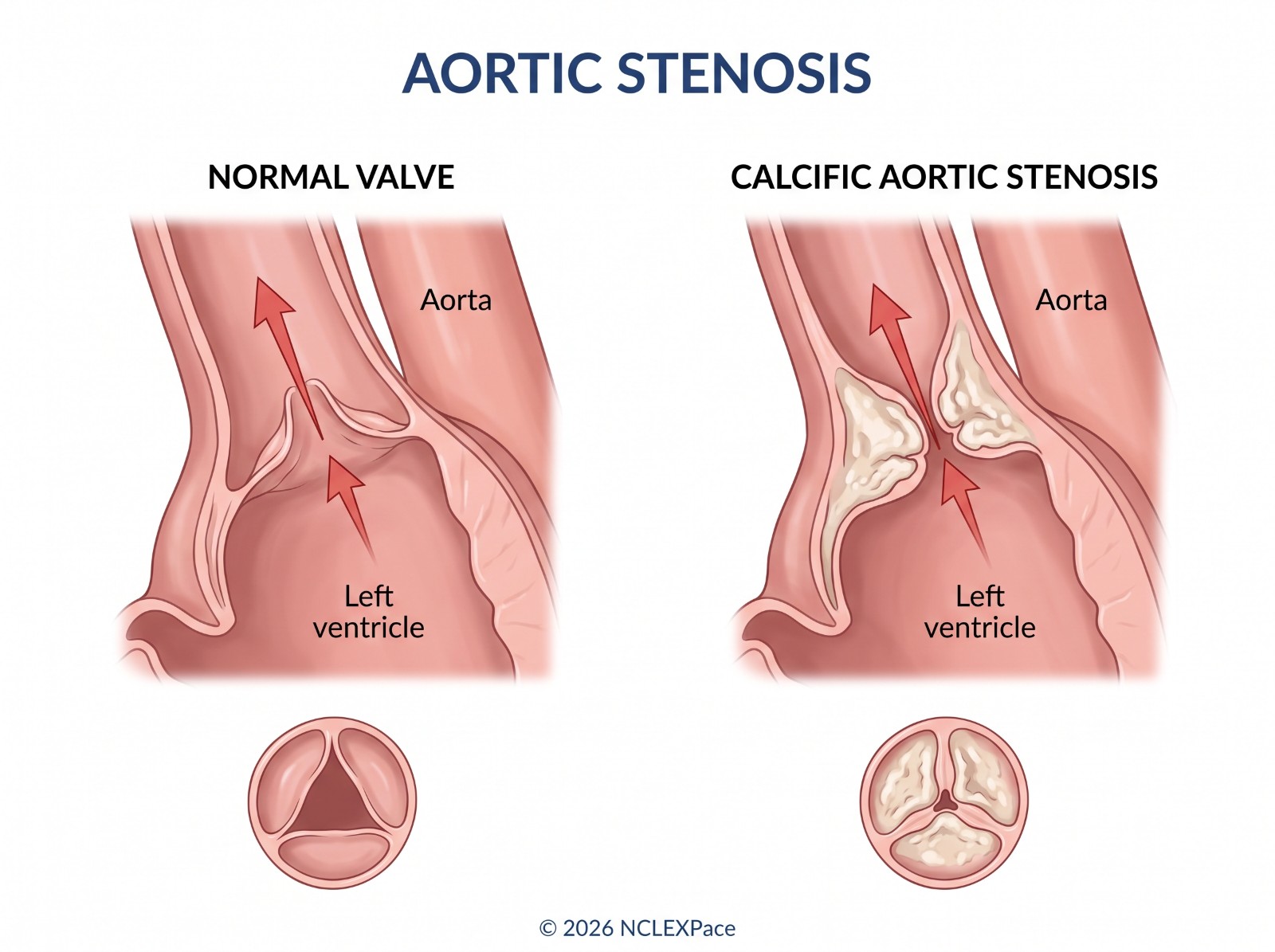
- Definition: Aortic stenosis is narrowing of the aortic valve that creates fixed obstruction of left ventricular outflow (refer to the image below).
- Symptoms: The classic triad is exertional angina, syncope, and dyspnea; limited output, vasodilation, and dysrhythmias impair cerebral perfusion.
- Diagnosis: A systolic ejection murmur at the right upper sternal border radiates toward the carotids; echocardiography measures severity.
- Treatment: Symptomatic severe stenosis requires evaluation for valve replacement.
Nursing key points
- Assess vital signs, rhythm, current symptoms, and injury after syncope.
- Arrange prompt specialist assessment for exertional syncope, angina, or dyspnea.
- Assess oxygenation and work of breathing for elevated filling pressure and pulmonary congestion.
- Teach avoidance of strenuous exertion and dehydration.
- Monitor prescribed nitrates and vasodilators cautiously because reduced pressure threatens perfusion.
Answer analysis
| Client report | Rationale |
|---|---|
| Progressive fatigue during usual daily activities | Not correct. Fatigue requires evaluation, but syncope identifies a more immediate cerebral perfusion threat. |
| Syncope during exertion | Correct. Loss of consciousness during activity indicates failure to maintain adequate cerebral perfusion. |
| Intermittent exertional dyspnea that resolves with rest | Not correct. Dyspnea warrants assessment, but exertional syncope has greater immediate safety implications. |
| Mild dependent ankle edema at the end of the day | Not correct. Mild dependent edema has several causes and is less urgent than exertional syncope. |
- A. “I will use an electric razor and a soft toothbrush.”
- B. “I can take ibuprofen whenever I have pain.”
- C. “I will have my INR checked as scheduled.”
- D. “I will keep my intake of green leafy vegetables consistent.”
- E. “I will ask my provider or pharmacist before taking herbal supplements or nonprescription medications.”
- F. “I should stop eating every food that contains vitamin K.”
- G. “I will wear medical identification stating that I take warfarin.”
Show the correct answer and rationale
Correct answers:
- A. “I will use an electric razor and a soft toothbrush.”
- C. “I will have my INR checked as scheduled.”
- D. “I will keep my intake of green leafy vegetables consistent.”
- E. “I will ask my provider or pharmacist before taking herbal supplements or nonprescription medications.”
- G. “I will wear medical identification stating that I take warfarin.”
Rationale
Overview
- Definition: Mechanical heart valves require lifelong anticoagulation with warfarin to prevent valve thrombosis and systemic embolism. Warfarin inhibits vitamin K-dependent clotting factor synthesis.
- INR targets: The usual target INR for a mechanical aortic valve without additional thromboembolic risk factors is 2.5 (range 2.0 to 3.0). A mechanical mitral valve or a mechanical aortic valve with thromboembolic risk factors generally requires a target INR of 3.0 (range 2.5 to 3.5), according to valve type and prescribed protocol.
- Teaching: Maintain consistent vitamin K intake, complete scheduled INR monitoring, and follow bleeding precautions. Vitamin K reverses warfarin's anticoagulant effect.
Nursing key points
- Monitor INR according to the prescribed anticoagulation schedule.
- Teach consistent dietary vitamin K intake without eliminating green leafy vegetables.
- Recommend an electric razor and soft toothbrush to reduce bleeding injuries.
- Avoid NSAIDs; acetaminophen is generally preferred for pain after pharmacist or provider review.
- Report unusual bruising, hematuria, melena, or prolonged bleeding immediately.
- Seek emergency evaluation after a head injury or for severe headache or uncontrolled bleeding.
Answer analysis
| Client statement | Rationale |
|---|---|
| “I will use an electric razor and a soft toothbrush.” | Correct understanding. These measures reduce skin injury and gingival bleeding. |
| “I can take ibuprofen whenever I have pain.” | Needs further teaching. Ibuprofen increases bleeding risk during warfarin therapy. |
| “I will have my INR checked as scheduled.” | Correct understanding. INR monitoring guides warfarin dosing and reduces thrombosis and bleeding risks. |
| “I will keep my intake of green leafy vegetables consistent.” | Correct understanding. Stable vitamin K intake maintains a predictable warfarin response. |
| “I will ask my provider or pharmacist before taking herbal supplements or nonprescription medications.” | Correct understanding. Drug and supplement interactions alter anticoagulation or increase bleeding. |
| “I should stop eating every food that contains vitamin K.” | Needs further teaching. Vitamin K foods should remain consistent rather than being eliminated. |
| “I will wear medical identification stating that I take warfarin.” | Correct understanding. Medical identification informs emergency personnel about anticoagulant use. |
The NCLEXPace bank has 3,200+ NCLEX questions with full rationales, sorted by topic, with your progress tracked as you practice. Create your account to start.
Create Account →More topics in Medical-Surgical
Lyme Disease NCLEX Questions With RationalesCovers Lyme disease stages, clinical manifestations, doxycycline treatment, tick removal, nursing priorities, and prevention.Influenza NCLEX Questions With RationalesReviews seasonal influenza symptoms, high-risk groups, antiviral treatment, isolation, vaccination, complications, and nursing care.Atopic Dermatitis (Eczema) NCLEX Questions With RationalesReviews childhood eczema manifestations, age-related distribution, triggers, skin care, topical medications, infection prevention, and parent education.Sources
- Merck Manual Professional Edition. Aortic Stenosis. 2026.
- Merck Manual Professional Edition. Mitral Stenosis. 2026.
- Merck Manual Professional Edition. Mitral Regurgitation. 2026.
- American Heart Association. Understanding Your Heart Valve Treatment Options. Current edition.
3,200+ NCLEX questions with think-like-a-nurse rationales, unfolding case studies and adaptive readiness exams. Start with free practice questions, then choose a plan when you are ready.
Create Account →