Head Injury NCLEX Questions With Rationales
What it is
Head injury is trauma to the scalp, skull, or brain that may cause temporary neurologic dysfunction or serious structural damage. Concussion is a mild traumatic brain injury that can produce headache, confusion, dizziness, and memory problems without requiring loss of consciousness. Severe injuries may involve cerebral edema, intracranial hemorrhage, or brain herniation.
What the NCLEX focuses on
- Concussion can cause neurologic symptoms even when initial brain imaging shows no acute structural injury.
- Epidural hematoma is bleeding between the skull and dura mater, commonly involving the middle meningeal artery.
- Epidural hematoma may produce a lucid interval followed by rapid neurologic deterioration.
- Subdural hematoma is bleeding between the dura and arachnoid, commonly involving torn bridging veins.
- Glasgow Coma Scale (GCS) assesses eye opening, verbal response, and motor response.
- Decreasing consciousness, worsening headache, vomiting, and pupillary changes can indicate increasing intracranial pressure (ICP).
- Cushing triad consists of hypertension, bradycardia, and abnormal respirations and suggests advanced intracranial hypertension.
- Clear fluid draining from the nose or ear after trauma may indicate a cerebrospinal fluid (CSF) leak associated with a basilar skull fracture.
Priority nursing actions
- Assess airway, breathing, and circulation immediately while maintaining cervical spine precautions when indicated.
- Perform serial neurologic assessments, including GCS components, pupil size and reactivity, limb movement, and vital signs.
- Report declining GCS, new weakness, unequal pupils, seizures, or other neurologic deterioration immediately.
- For suspected CSF leakage, promptly notify the provider, observe and document drainage, and avoid nasal instrumentation or obstructing drainage.
- Administer prescribed therapies and monitor oxygenation, blood pressure, and neurologic response according to the treatment plan.
- Prepare the client for urgent imaging and additional interventions when intracranial bleeding or worsening neurologic function is suspected.
Numbers to know
| Value | Number | Why it matters |
|---|---|---|
| GCS total range | 3 to 15 | Measures consciousness using three responses. |
| Mild traumatic brain injury | GCS 13 to 15 | Severity classification after assessment. |
| Moderate traumatic brain injury | GCS 9 to 12 | Requires hospital evaluation and monitoring. |
| Severe traumatic brain injury | GCS 3 to 8 | Indicates severe impairment and possible need for airway protection. |
| Adult supervision after concussion discharge | 12 to 24 hours | Supports observation for delayed deterioration. |
| Initial relative rest after concussion | 1 to 2 days | Follow with gradual return to tolerated activities. |
Common exam traps
- Choosing reassurance after a lucid interval: wrong because an epidural hematoma can expand rapidly despite temporary improvement.
- Choosing a normal pupil examination to exclude intracranial bleeding: wrong because serious injury can exist before pupillary abnormalities develop.
- Choosing to pack the nose tightly when CSF leakage is suspected: wrong because drainage must not be obstructed and urgent evaluation is necessary.
- Choosing routine observation for a declining GCS: wrong because neurologic deterioration requires immediate escalation.
What to teach
- Arrange responsible adult supervision during the initial observation period after discharge.
- Seek emergency care for worsening headache, repeated vomiting, seizures, increasing confusion, weakness, or difficulty awakening.
- Resume light activities gradually after brief relative rest, reducing activity if symptoms worsen.
- Avoid sports and activities with risk of another head injury until medically cleared.
- Avoid alcohol and sedating recreational drugs during recovery, and follow provider instructions regarding medications.
2 NCLEX questions with rationales on this topic
From the NCLEXPace question bank. Choose your answer first, then open the correct answer and the full rationale under each question.
Clear fluid drips from the ear of a client with a head injury. Which nursing action is correct?
Select the best answer.
- A. Place sterile gauze into the ear canal to absorb it
- B. Apply gentle suction at the ear canal opening
- C. Irrigate the ear canal with sterile saline first
- D. Place a loose sterile dressing and notify the provider
Show the correct answer and rationale
Correct answer:
- D. Place a loose sterile dressing and notify the provider
Rationale
Overview
- Definition: Cerebrospinal fluid (CSF) otorrhea is leakage of CSF through the external ear after injury to the skull base and meninges. It increases the risk of meningitis.
- Signs and symptoms: Clear, watery ear drainage after head trauma, with associated findings including periorbital ecchymosis (raccoon eyes) or mastoid ecchymosis (Battle sign).
- Diagnosis: Beta-2 transferrin testing identifies CSF in drainage. CT imaging evaluates skull fractures. A halo sign is a screening observation, not confirmation of CSF leakage.
- Care: Keep the ear canal unobstructed. Apply a loose sterile dressing and maintain head elevation as prescribed.
Nursing key points
- Apply a loose sterile dressing over the ear without inserting material into the canal.
- Assess drainage amount, color, and consistency. Observe for a halo sign on absorbent material, but do not use it to confirm CSF.
- Notify the provider immediately and collect drainage for beta-2 transferrin testing as prescribed.
- Maintain the head of the bed at 30 degrees or as prescribed.
- Monitor Glasgow Coma Scale (GCS), pupillary responses, temperature, and signs of meningitis, including fever and neck stiffness.
Answer analysis
| Nursing action | Rationale |
|---|---|
| Place sterile gauze into the ear canal to absorb it | Not correct. Packing obstructs CSF drainage and increases infection risk. |
| Apply gentle suction at the ear canal opening | Not correct. Suction traumatizes injured structures and disrupts drainage. |
| Irrigate the ear canal with sterile saline first | Not correct. Irrigation introduces fluid and microorganisms through damaged structures. |
| Place a loose sterile dressing and notify the provider | Correct. The dressing collects CSF without blocking drainage, and the provider evaluates the suspected leak. |
The nurse completes a cranial nerve assessment on a client admitted after a head injury.
For each assessment technique, click to specify the cranial nerve it tests.
| Optic (II) | Oculomotor (III) | Facial (VII) | Glossopharyngeal and vagus (IX and X) | Hypoglossal (XII) | |
|---|---|---|---|---|---|
| Asks the client to stick out the tongue and checks that it is midline | |||||
| Asks the client to smile, frown, and close the eyes tightly | |||||
| Shines a penlight into each eye and watches the pupil constrict | |||||
| Asks the client to say “ah” and watches the uvula rise symmetrically | |||||
| Asks the client to read the Snellen chart | |||||
| Touches the back of the throat with a tongue blade and watches for a gag |
Show the correct answer and rationale
Correct answers:
- Asks the client to stick out the tongue and checks that it is midline: Hypoglossal (XII)
- Asks the client to smile, frown, and close the eyes tightly: Facial (VII)
- Shines a penlight into each eye and watches the pupil constrict: Oculomotor (III)
- Asks the client to say “ah” and watches the uvula rise symmetrically: Glossopharyngeal and vagus (IX and X)
- Asks the client to read the Snellen chart: Optic (II)
- Touches the back of the throat with a tongue blade and watches for a gag: Glossopharyngeal and vagus (IX and X)
Rationale
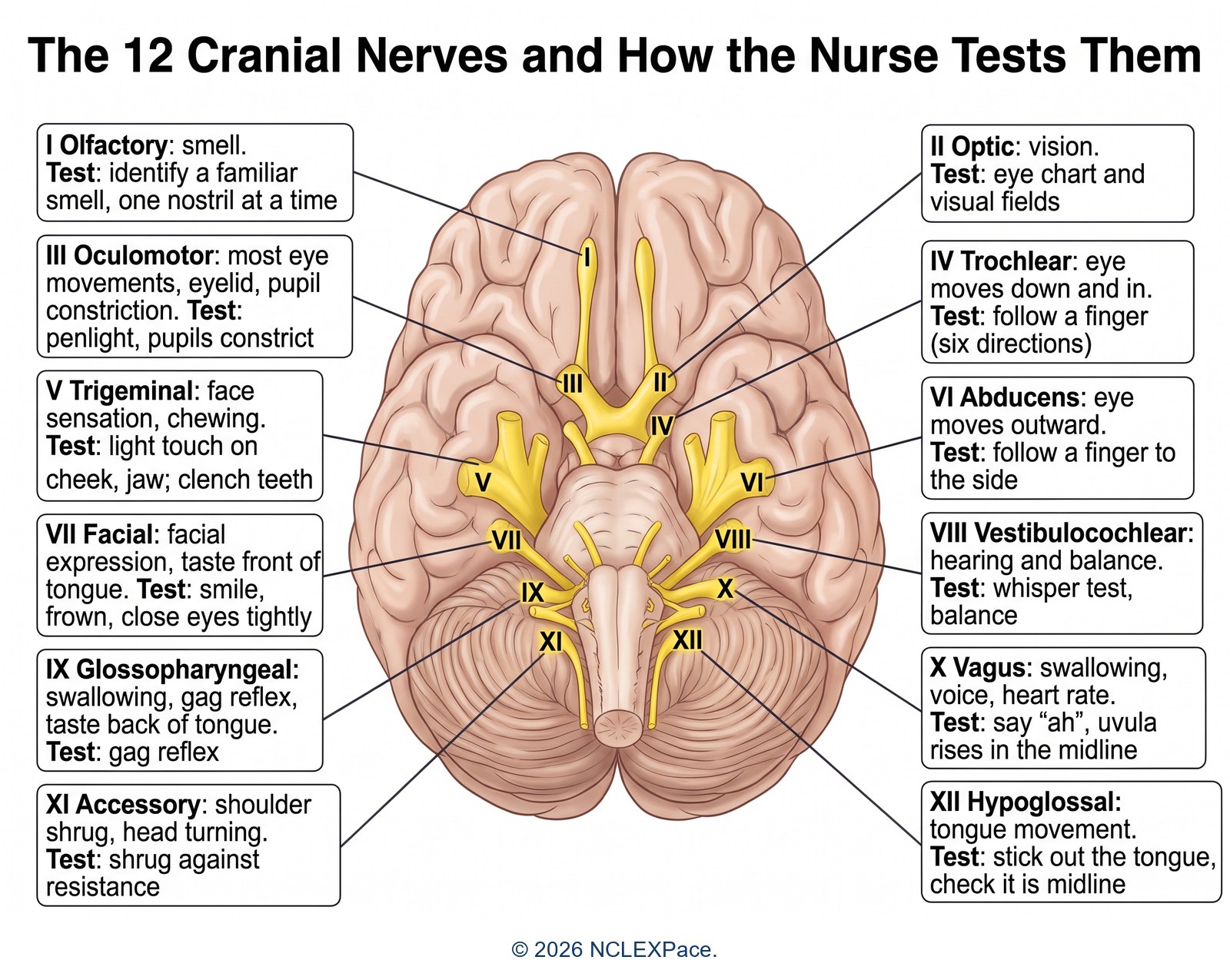
Overview
- Definition: The 12 pairs of cranial nerves provide sensory, motor, and autonomic functions of the head, neck, and selected internal organs.
- Bedside tests: CN II assesses vision and carries sensory input for the pupillary light reflex. CN III produces pupillary constriction. CN VII controls facial expression. CN IX and X participate in pharyngeal reflexes and swallowing. CN XII controls tongue movement.
- Clinical significance: A new dilated, poorly reactive pupil after head injury indicates possible oculomotor nerve compression associated with transtentorial herniation and requires emergency assessment.
Nursing key points
- Assess pupil size, symmetry, and direct and consensual light responses. CN II carries afferent input; CN III carries efferent output.
- Report new unilateral pupillary dilation or sluggish reactivity after head injury immediately because it indicates possible intracranial deterioration.
- Assess visual acuity with the Snellen chart when the client's condition permits.
- Compare facial movements bilaterally and document weakness or asymmetry.
- Assess tongue position, palatal elevation, voice quality, and swallowing. Escalate new abnormalities affecting airway protection.
Answer analysis
| Assessment technique | Cranial nerve tested | Why |
|---|---|---|
| Asks the client to stick out the tongue and checks that it is midline | Hypoglossal (XII). | CN XII controls tongue movement and protrusion. |
| Asks the client to smile, frown, and close the eyes tightly | Facial (VII). | CN VII controls the muscles of facial expression. |
| Shines a penlight into each eye and watches the pupil constrict | Oculomotor (III). | CN III supplies the parasympathetic motor pathway for pupillary constriction; CN II carries light input. |
| Asks the client to say “ah” and watches the uvula rise symmetrically | Glossopharyngeal and vagus (IX and X). | Palatal elevation primarily assesses vagal motor function within the IX to X examination. |
| Asks the client to read the Snellen chart | Optic (II). | CN II carries visual information necessary for visual acuity. |
| Touches the back of the throat with a tongue blade and watches for a gag | Glossopharyngeal and vagus (IX and X). | CN IX provides the primary sensory pathway, and CN X supplies the motor response. |
The NCLEXPace bank has 3,200+ NCLEX questions with full rationales, sorted by topic, with your progress tracked as you practice. Create your account to start.
Create Account →More topics in Medical-Surgical
Lyme Disease NCLEX Questions With RationalesCovers Lyme disease stages, clinical manifestations, doxycycline treatment, tick removal, nursing priorities, and prevention.Influenza NCLEX Questions With RationalesReviews seasonal influenza symptoms, high-risk groups, antiviral treatment, isolation, vaccination, complications, and nursing care.Atopic Dermatitis (Eczema) NCLEX Questions With RationalesReviews childhood eczema manifestations, age-related distribution, triggers, skin care, topical medications, infection prevention, and parent education.Sources
- Merck Manual Professional Edition. Traumatic Brain Injury (TBI). 2026.
- Merck Manual Professional Edition. Management of Traumatic Brain Injury Based on Severity of Injury. 2026.
- National Library of Medicine, MedlinePlus. Concussion in adults - discharge. 2026.
- Centers for Disease Control and Prevention. What to Do After a Mild TBI or Concussion. 2025.
3,200+ NCLEX questions with think-like-a-nurse rationales, unfolding case studies and adaptive readiness exams. Start with free practice questions, then choose a plan when you are ready.
Create Account →