Guillain-Barre Syndrome NCLEX Questions With Rationales
What it is
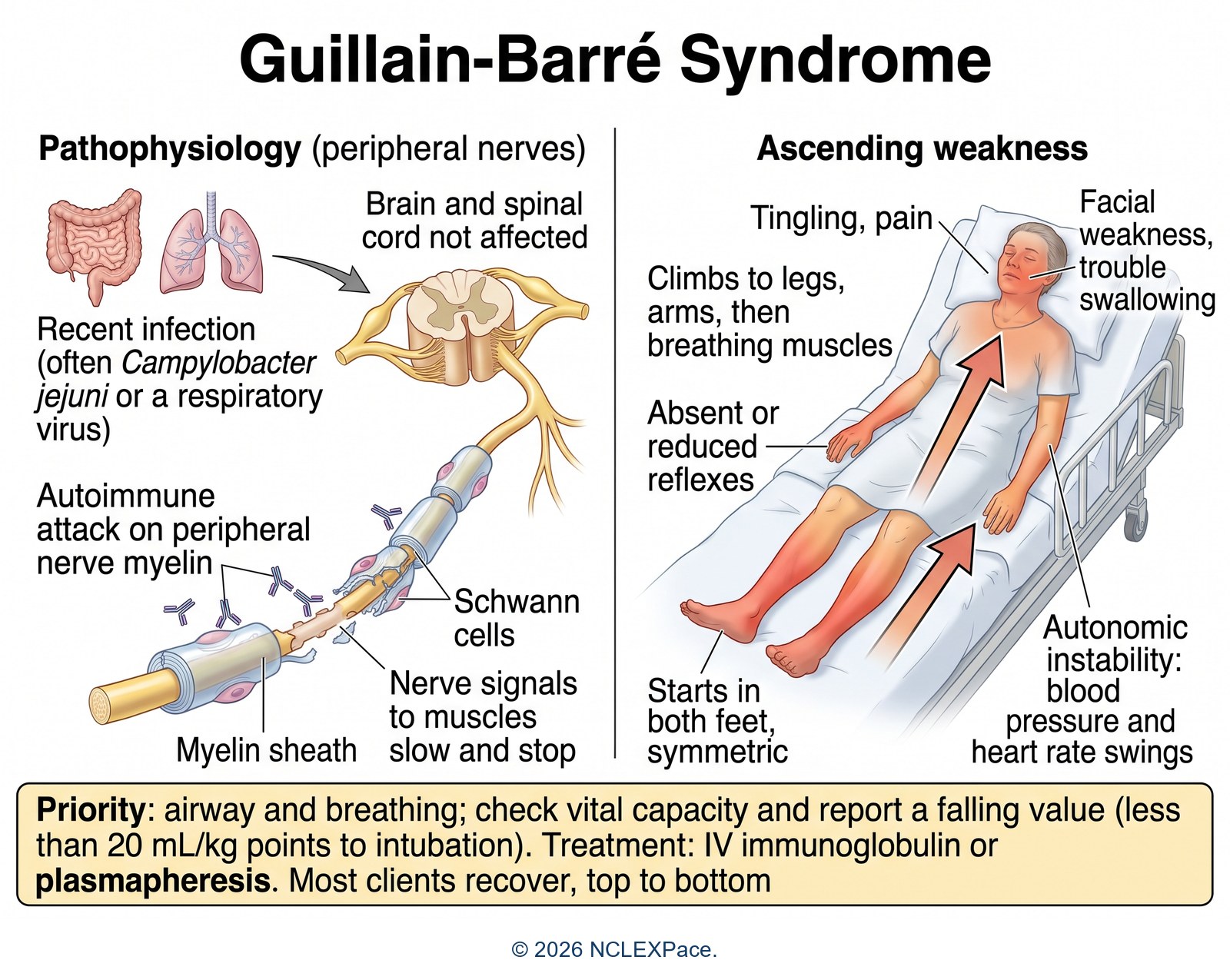
Guillain-Barré syndrome (GBS) is an acute, immune-mediated polyneuropathy in which the immune system attacks the peripheral nerves. In the most common type, acute inflammatory demyelinating polyradiculoneuropathy, the myelin sheath is damaged and nerve signals slow or stop. It usually begins days to weeks after a respiratory or gastrointestinal infection, and Campylobacter jejuni is the most common preceding infection. Weakness worsens over days to weeks, plateaus, and then slowly recovers.
What the NCLEX focuses on
- Weakness is symmetric and ascending: it starts in the legs and moves up to the arms, face and breathing muscles, often with tingling in the feet and hands.
- Deep tendon reflexes are decreased or absent.
- Respiratory muscle weakness can cause respiratory failure, so breathing is monitored first.
- Autonomic dysfunction causes labile blood pressure, dysrhythmias (most often sinus tachycardia), orthostatic hypotension, urinary retention and ileus.
- Cerebrospinal fluid typically shows high protein with a normal cell count.
- IVIG and plasma exchange are equally effective and shorten recovery; corticosteroids are not beneficial.
- Plasma exchange can cause hypotension and is generally avoided when autonomic instability is present.
- Pain is common and often undertreated, especially in a client who cannot communicate.
Priority nursing actions
- Monitor breathing first and often: respiratory rate and effort, oxygen saturation, cough and swallow, and forced vital capacity every 6 to 8 hours or as prescribed.
- Report a falling vital capacity at once and prepare for intubation and mechanical ventilation.
- Keep the client on continuous cardiac monitoring and check blood pressure frequently.
- Give IVIG as prescribed or monitor the client during plasma exchange, watching blood pressure and adverse reactions.
- Prevent complications of immobility with prescribed low-molecular-weight heparin, repositioning, skin care and mobility exercises.
- Assess and treat pain, set up a reliable way to communicate, and give emotional support.
Numbers to know
| Value | Number | Why it matters |
|---|---|---|
| Onset after infection | 5 days to 3 weeks | Ask about recent diarrhea or respiratory illness |
| Peak weakness | Usually within 2 weeks; plateau within 4 weeks | Closest respiratory monitoring during progression |
| Forced vital capacity checks | Every 6 to 8 hours | Detects impending respiratory failure |
| Impending respiratory failure | Vital capacity below 20 mL/kg, maximal inspiratory pressure below 30 cm H2O, or maximal expiratory pressure below 40 cm H2O | Prepare for mechanical ventilation |
| IVIG dose | 2 g/kg total over 2 to 5 days | Shortens time to recovery |
Common exam traps
- Choosing to assess leg strength before breathing in a client with ascending weakness: wrong because respiratory failure is life-threatening and respiratory function is checked first.
- Choosing corticosteroids as the expected treatment: wrong because they are not beneficial in GBS; IVIG or plasma exchange is used.
- Choosing descending weakness or brisk reflexes as expected findings: wrong because typical GBS ascends and reflexes are reduced or absent.
- Choosing to attribute blood pressure swings or tachycardia to anxiety: wrong because autonomic dysfunction can be life-threatening and needs continuous monitoring.
What to teach
- GBS is not contagious and is not inherited.
- Weakness usually peaks within the first 2 to 4 weeks, then recovery begins and can take weeks to years.
- Most people recover, but some have lasting weakness, numbness, fatigue or pain.
- Report shortness of breath, trouble swallowing, facial weakness or spreading weakness immediately.
- Counseling and support groups can ease emotional strain during recovery.
2 NCLEX questions with rationales on this topic
From the NCLEXPace question bank. Choose your answer first, then open the correct answer and the full rationale under each question.
A client with Guillain-Barré syndrome has ascending weakness. Serial forced vital capacity measurements decrease from 2.8 L to 1.9 L and then 1.2 L over 4 hours. The client can still speak, and SpO₂ is 96% on room air. Which action is the priority?
Select the best answer.
- A. Notify the rapid-response and airway teams and prepare for possible ventilatory support
- B. Increase respiratory exercises and repeat the forced vital capacity in 1 hour
- C. Obtain an arterial blood gas before notifying the airway team because the oxygen saturation remains normal
- D. Continue continuous pulse oximetry and repeat forced vital capacity measurements every 2 hours
Show the correct answer and rationale
Correct answer:
- A. Notify the rapid-response and airway teams and prepare for possible ventilatory support
Rationale
Overview
- Definition: Guillain-Barré syndrome is an acute immune-mediated peripheral neuropathy that produces progressive weakness, including respiratory muscle weakness.
- Why FVC, not SpO₂: Forced vital capacity (FVC) measures ventilatory reserve. Oxygen saturation remains normal during early respiratory muscle failure.
- Thresholds: FVC approaching 15 to 20 mL/kg or declining more than 30% indicates significant risk of respiratory failure. Rapid deterioration requires urgent airway evaluation.
| Measure | Threshold | Action |
|---|---|---|
| FVC | Approaching 15 to 20 mL/kg | Urgent airway assessment. |
| FVC trend | Decline greater than 30% | Escalate immediately. |
| Serial respiratory strength | Every 2 to 4 hours during close monitoring | Identify progressive weakness. |
| SpO₂ | Normal despite declining FVC | Do not delay airway evaluation. |
Nursing key points
- Trend FVC and prescribed respiratory muscle strength measurements.
- Recognize the decrease from 2.8 L to 1.2 L as a critical loss of ventilatory reserve.
- Notify the rapid-response and airway teams immediately.
- Assess respiratory effort, cough strength, swallowing, secretion clearance, and fatigue.
- Prepare for elective intubation before respiratory arrest or severe ventilatory failure develops.
Answer analysis
| Nursing action | Rationale |
|---|---|
| Notify the rapid-response and airway teams and prepare for possible ventilatory support | Correct. Rapid FVC decline indicates impending neuromuscular respiratory failure requiring immediate escalation. |
| Increase respiratory exercises and repeat the forced vital capacity in 1 hour | Not correct. Respiratory exercises do not reverse progressive respiratory muscle weakness. |
| Obtain an arterial blood gas before notifying the airway team because the oxygen saturation remains normal | Not correct. Waiting for arterial blood gas results delays airway preparation despite severe FVC deterioration. |
| Continue continuous pulse oximetry and repeat forced vital capacity measurements every 2 hours | Not correct. Monitoring without immediate escalation fails to address the rapid loss of ventilatory reserve. |
The nurse cares for a client in the paralytic phase of Guillain-Barré syndrome. Which supportive interventions are appropriate? Select all that apply.
- A. Offer frequent reassurance and explanation during the paralysis
- B. Perform skin care and reposition to prevent pressure injury
- C. Provide deep vein thrombosis prophylaxis
- D. Withhold all pain assessment since sensation is reduced
- E. Monitor for labile blood pressure and heart rate
- F. Monitor respiratory status and vital capacity on a set schedule
Show the correct answer and rationale
Correct answers:
- A. Offer frequent reassurance and explanation during the paralysis
- B. Perform skin care and reposition to prevent pressure injury
- C. Provide deep vein thrombosis prophylaxis
- E. Monitor for labile blood pressure and heart rate
- F. Monitor respiratory status and vital capacity on a set schedule
Rationale
Overview
- Definition: The paralytic phase of Guillain-Barré syndrome involves severe peripheral nerve dysfunction causing extensive weakness or paralysis with preserved consciousness.
- Supportive care: Respiratory monitoring, venous thromboembolism prevention, pressure injury prevention, pain management, and communication support reduce complications of immobility.
- Autonomic dysfunction: Fluctuating blood pressure, abnormal heart rate, and dysrhythmias require close cardiovascular monitoring.
Nursing key points
- Measure respiratory status and serial vital capacity according to the monitoring schedule. Escalate declining measurements.
- Administer prescribed anticoagulant prophylaxis and use mechanical prophylaxis when indicated.
- Reposition at least every 2 hours or according to the individualized skin protection plan.
- Assess pain regularly and administer prescribed analgesics for neuropathic or musculoskeletal pain.
- Explain procedures, provide reassurance, and establish accessible communication methods.
- Monitor blood pressure, heart rate, and cardiac rhythm for autonomic instability.
Answer analysis
| Supportive intervention | Rationale |
|---|---|
| Offer frequent reassurance and explanation during the paralysis | Include. Consciousness remains preserved, so communication and reassurance reduce fear. |
| Perform skin care and reposition to prevent pressure injury | Include. Regular repositioning and skin protection prevent prolonged pressure. |
| Provide deep vein thrombosis prophylaxis | Include. Immobility increases venous thromboembolism risk and requires appropriate prophylaxis. |
| Withhold all pain assessment since sensation is reduced | Do not include. Neuropathic and musculoskeletal pain require regular assessment and treatment. |
| Monitor for labile blood pressure and heart rate | Include. Autonomic dysfunction causes blood pressure fluctuations, heart rate instability, and dysrhythmias. |
| Monitor respiratory status and vital capacity on a set schedule | Include. Serial measurements detect progressive respiratory muscle weakness. |
The NCLEXPace bank has 3,200+ NCLEX questions with full rationales, sorted by topic, with your progress tracked as you practice. Create your account to start.
Create Account →More topics in Medical-Surgical
Lyme Disease NCLEX Questions With RationalesCovers Lyme disease stages, clinical manifestations, doxycycline treatment, tick removal, nursing priorities, and prevention.Influenza NCLEX Questions With RationalesReviews seasonal influenza symptoms, high-risk groups, antiviral treatment, isolation, vaccination, complications, and nursing care.Atopic Dermatitis (Eczema) NCLEX Questions With RationalesReviews childhood eczema manifestations, age-related distribution, triggers, skin care, topical medications, infection prevention, and parent education.Sources
- StatPearls (NCBI Bookshelf). Guillain-Barre Syndrome. Last update 2026.
- Merck Manual Professional Edition. Guillain-Barré Syndrome (GBS). 2026.
- National Institute of Neurological Disorders and Stroke (NIH). Guillain-Barré Syndrome.
- Centers for Disease Control and Prevention. Guillain-Barré Syndrome (Campylobacter). 2026.
3,200+ NCLEX questions with think-like-a-nurse rationales, unfolding case studies and adaptive readiness exams. Start with free practice questions, then choose a plan when you are ready.
Create Account →