Glomerulonephritis NCLEX Questions With Rationales
What it is
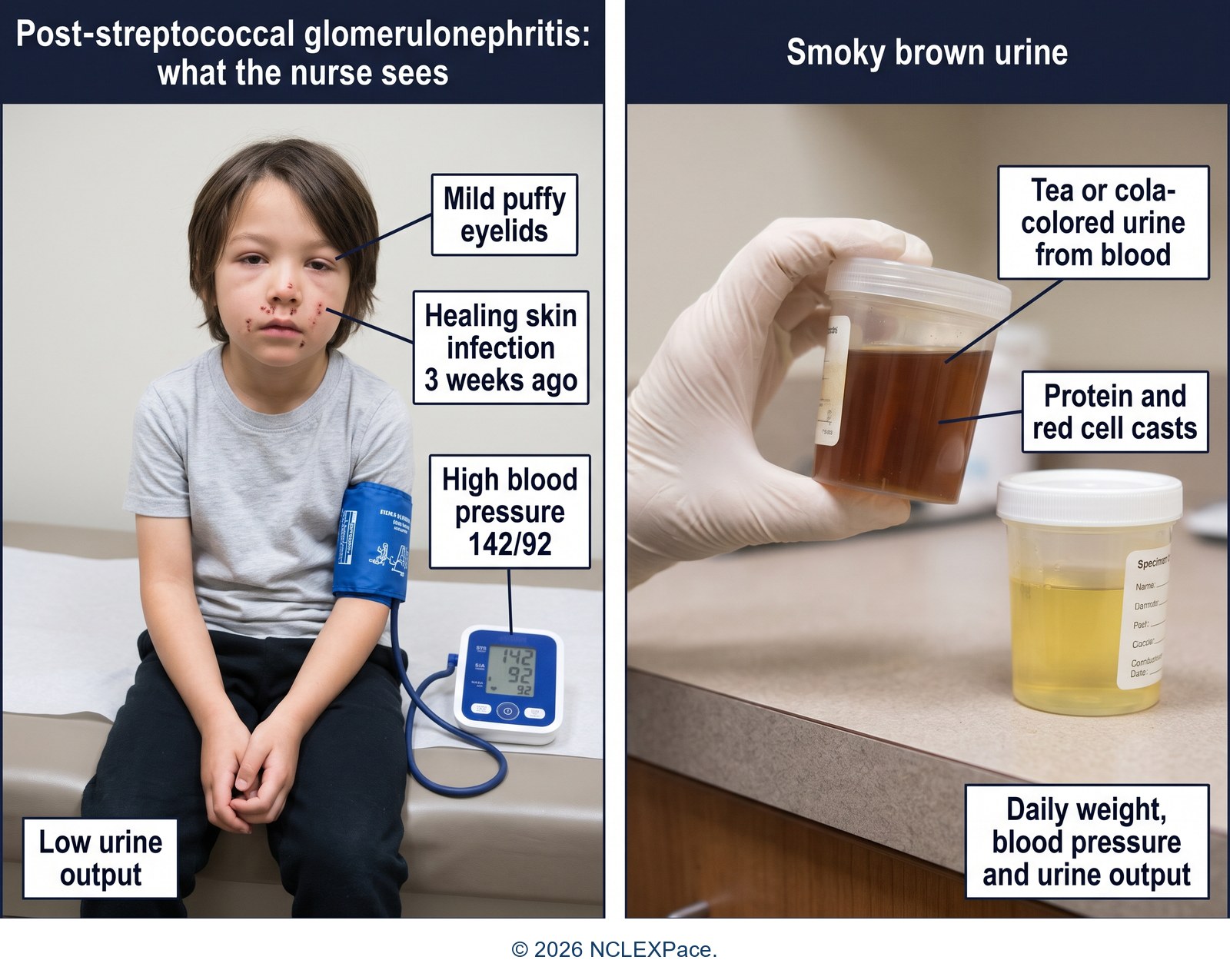
Acute poststreptococcal glomerulonephritis (APSGN) is an immune-mediated inflammation of the kidney glomeruli that develops after infection with certain strains of group A Streptococcus. It may follow streptococcal pharyngitis or a skin infection such as impetigo. Immune-related injury reduces kidney filtration and causes hematuria, fluid retention, hypertension, and proteinuria.
What the NCLEX focuses on
- APSGN typically develops approximately 10 days after streptococcal pharyngitis or up to 3 weeks after a streptococcal skin infection.
- Dark reddish-brown or cola-colored urine indicates visible hematuria caused by glomerular inflammation.
- Periorbital edema is often most noticeable in the morning, and swelling may involve the hands and feet.
- Hypertension develops primarily because impaired kidney function contributes to sodium and water retention.
- Urinalysis may reveal proteinuria, hematuria, and red blood cell casts.
- Decreased urine output indicates impaired kidney function and requires careful monitoring.
- Blood tests may show elevated blood urea nitrogen, elevated creatinine, and decreased complement C3.
- Severe complications include pulmonary edema, hypertensive encephalopathy, and acute kidney injury.
- Antibiotics eradicate remaining group A streptococci but do not directly reverse established immune-mediated kidney inflammation.
Priority nursing actions
- Assess respiratory status, oxygen saturation, lung sounds, and breathing effort; immediately report respiratory distress suggesting pulmonary edema.
- Monitor blood pressure and neurologic status, promptly reporting severe hypertension, headache, visual changes, seizures, or altered consciousness.
- Measure intake and output, assess edema, and obtain daily weights using the same scale under consistent conditions.
- Monitor prescribed kidney function tests and serum electrolytes, particularly potassium, and report concerning changes.
- Implement prescribed sodium and fluid restrictions, and administer ordered diuretics, antihypertensives, and antibiotics while monitoring responses.
Numbers to know
| Value | Number | Why it matters |
|---|---|---|
| After streptococcal pharyngitis | Approximately 10 days | Typical interval before kidney symptoms develop. |
| After streptococcal skin infection | Up to 3 weeks | Helps connect kidney findings with an earlier infection. |
| Urinary protein excretion | Usually less than 3 g/day | Proteinuria is generally below the nephrotic range. |
| Daily weight frequency | Every 24 hours | Weight trends help evaluate fluid retention and treatment response. |
| Recovery in children | More than 90% | Most affected children recover completely. |
Common exam traps
- Choosing unrestricted oral fluids: wrong because impaired kidney function may cause dangerous fluid overload.
- Choosing antibiotics as the sole treatment: wrong because managing hypertension, edema, and kidney complications remains essential.
- Choosing urine color alone to evaluate recovery: wrong because blood pressure, urine output, weight, and kidney function also require monitoring.
- Choosing to delay reporting dyspnea: wrong because pulmonary edema can rapidly impair oxygenation.
What to teach
- Explain that APSGN results from an immune response after infection rather than direct bacterial infection of the kidneys.
- Follow prescribed sodium and fluid limits, and avoid adding salt to meals when restriction is ordered.
- Monitor urine output, swelling, and weight as instructed, and report worsening findings.
- Seek urgent evaluation for breathing difficulty, seizures, marked confusion, or severe headache.
- Complete prescribed antibiotics and attend follow-up appointments for blood pressure, urinalysis, and kidney function testing.
2 NCLEX questions with rationales on this topic
From the NCLEXPace question bank. Choose your answer first, then open the correct answer and the full rationale under each question.
At the 0800 assessment of a 10-year-old with acute postinfectious glomerulonephritis, the nurse notes all of the following. Which finding should the nurse follow up first?
Select the best answer.
- A. The 2+ periorbital edema is more noticeable than last evening
- B. The weight has increased by 0.5 kg (1.1 lb) since yesterday morning
- C. Blood pressure 154/98 mm Hg with a new headache and blurred vision
- D. The urine is still dark cola-colored and has not become lighter
Show the correct answer and rationale
Correct answer:
- C. Blood pressure 154/98 mm Hg with a new headache and blurred vision
Rationale
Overview
- Definition: Acute postinfectious glomerulonephritis is immune-mediated inflammation of the renal glomeruli following infection, commonly caused by nephritogenic streptococci. Reduced glomerular filtration produces sodium and water retention, hypertension, and hematuria.
- Signs and symptoms: Periorbital edema, weight gain, oliguria, cola-colored urine, and hypertension are characteristic findings.
- Priority complication: Severe hypertension with headache or visual disturbances indicates acute neurologic involvement and requires immediate evaluation for hypertensive encephalopathy.
Nursing key points
- Notify the provider immediately for severe hypertension with new headache or visual changes.
- Repeat blood pressure promptly using an appropriate cuff without delaying emergency escalation.
- Assess neurologic status, visual symptoms, consciousness, vomiting, and seizure activity.
- Institute seizure precautions and administer prescribed antihypertensives and diuretics.
- Monitor daily weight, strict intake and output, urine output, and pulmonary edema findings.
Answer analysis
| Assessment finding | Rationale |
|---|---|
| The 2+ periorbital edema is more noticeable than last evening | Not correct. Increasing edema requires assessment, but symptomatic severe hypertension poses greater immediate risk. |
| The weight has increased by 0.5 kg (1.1 lb) since yesterday morning | Not correct. Weight gain indicates fluid retention but is less urgent than acute neurologic symptoms with hypertension. |
| Blood pressure 154/98 mm Hg with a new headache and blurred vision | Correct. Severe hypertension with headache and visual disturbance indicates possible hypertensive encephalopathy requiring emergency evaluation and treatment. |
| The urine is still dark cola-colored and has not become lighter | Not correct. Gross hematuria is characteristic of acute glomerulonephritis and requires continued monitoring, but it is not the immediate priority. |
- A. Daily weight at the same time on the same scale
- B. Encourage 3 liters of oral fluid daily
- C. Sodium and fluid restriction as prescribed
- D. Blood pressure monitoring and prescribed antihypertensives
- E. High-protein supplements at each meal
- F. Rest during the acute phase
Show the correct answer and rationale
Correct answers:
- A. Daily weight at the same time on the same scale
- C. Sodium and fluid restriction as prescribed
- D. Blood pressure monitoring and prescribed antihypertensives
- F. Rest during the acute phase
Rationale
Overview
- Definition: Acute glomerulonephritis is inflammation of the glomeruli that reduces filtration and causes hematuria, oliguria, sodium and water retention, edema, and hypertension.
- Care priorities: Treatment controls fluid overload and hypertension while monitoring renal function. Fluid allowance is commonly based on the previous 24-hour urine output plus approximately 500 mL for insensible losses.
- Nutrition: Sodium and fluid intake are restricted as prescribed. Protein intake is moderated when azotemia is present.
Nursing key points
- Measure daily weight at the same time using the same scale.
- Record accurate intake and output and report declining urine output.
- Follow prescribed sodium and fluid limits based on renal status.
- Monitor blood pressure and administer prescribed antihypertensives.
- Assess for crackles, dyspnea, and worsening edema indicating fluid overload.
- Report severe headache, visual changes, confusion, or seizures immediately.
Answer analysis
| Intervention | Rationale |
|---|---|
| Daily weight at the same time on the same scale | Include. Daily weight identifies fluid retention and treatment response. |
| Encourage 3 liters of oral fluid daily | Do not include. Excessive fluid intake worsens retention during oliguria. |
| Sodium and fluid restriction as prescribed | Include. Restriction reduces fluid overload and hypertension. |
| Blood pressure monitoring and prescribed antihypertensives | Include. Hypertension requires monitoring and prescribed treatment. |
| High-protein supplements at each meal | Do not include. Protein intake is individualized and moderated when azotemia is present. |
| Rest during the acute phase | Include. Rest reduces physical exertion during acute illness. |
The NCLEXPace bank has 3,200+ NCLEX questions with full rationales, sorted by topic, with your progress tracked as you practice. Create your account to start.
Create Account →More topics in Medical-Surgical
Lyme Disease NCLEX Questions With RationalesCovers Lyme disease stages, clinical manifestations, doxycycline treatment, tick removal, nursing priorities, and prevention.Influenza NCLEX Questions With RationalesReviews seasonal influenza symptoms, high-risk groups, antiviral treatment, isolation, vaccination, complications, and nursing care.Atopic Dermatitis (Eczema) NCLEX Questions With RationalesReviews childhood eczema manifestations, age-related distribution, triggers, skin care, topical medications, infection prevention, and parent education.Sources
- Centers for Disease Control and Prevention. Clinical Guidelines for Post-Streptococcal Glomerulonephritis. 2025.
- Centers for Disease Control and Prevention. About Post-Streptococcal Glomerulonephritis. 2024.
- NCBI Bookshelf. Infection-Related Glomerulonephritis. 2025.
- NCBI Bookshelf. Chapter 8 Renal and Urinary System Alterations. 2024.
3,200+ NCLEX questions with think-like-a-nurse rationales, unfolding case studies and adaptive readiness exams. Start with free practice questions, then choose a plan when you are ready.
Create Account →