Glaucoma and Eye Drops NCLEX Questions With Rationales
What it is
Glaucoma is a group of eye disorders that damage the optic nerve, often associated with increased intraocular pressure (IOP). Open-angle glaucoma usually develops gradually and causes progressive peripheral visual field loss, while acute angle-closure glaucoma causes a sudden increase in IOP and is an ophthalmic emergency. Treatment aims to lower intraocular pressure and prevent further optic nerve damage.
What the NCLEX focuses on
- Open-angle glaucoma is usually painless and progresses slowly, with gradual loss of peripheral vision that may eventually affect central vision.
- Acute angle-closure glaucoma causes sudden severe eye pain, blurred vision, halos around lights, headache, nausea, vomiting, and a red eye.
- A fixed, mid-dilated pupil and cloudy cornea may occur during acute angle closure and require immediate emergency ophthalmological treatment to prevent permanent vision loss.
- Prostaglandin analogs, including latanoprost, increase aqueous humor outflow and are commonly prescribed for open-angle glaucoma.
- Latanoprost can cause increased brown pigmentation of the iris, darkening of eyelid skin, and increased eyelash length, thickness, or number.
- Topical beta blockers, including timolol, reduce aqueous humor production but can be absorbed systemically and cause bradycardia, hypotension, and bronchospasm.
- Timolol is contraindicated in clients with bronchial asthma, a history of asthma, severe COPD, sinus bradycardia, and certain cardiac conduction disorders.
- Alpha-adrenergic agonists, such as brimonidine and apraclonidine, decrease aqueous humor production and may cause dry mouth, fatigue, and ocular irritation.
- Carbonic anhydrase inhibitors, including dorzolamide, brinzolamide, and acetazolamide, reduce aqueous humor production. Pilocarpine is a miotic that constricts the pupil and increases aqueous humor drainage.
- Anticholinergic medications and certain decongestants can precipitate acute angle closure in susceptible individuals by causing pupil dilation and narrowing the drainage angle.
Priority nursing actions
- Assess visual acuity, eye pain, redness, pupil response, visual field changes, and medication history.
- Recognize sudden severe eye pain with halos, headache, nausea, vomiting, and a fixed mid-dilated pupil as suspected acute angle closure. Arrange immediate emergency ophthalmological evaluation.
- Check the client's history of asthma, COPD, bradycardia, and cardiac conduction abnormalities before administering prescribed timolol.
- Administer prescribed eye drops using clean technique. Wash hands, pull down the lower eyelid, and instill the drop into the conjunctival sac without touching the bottle tip to the eye.
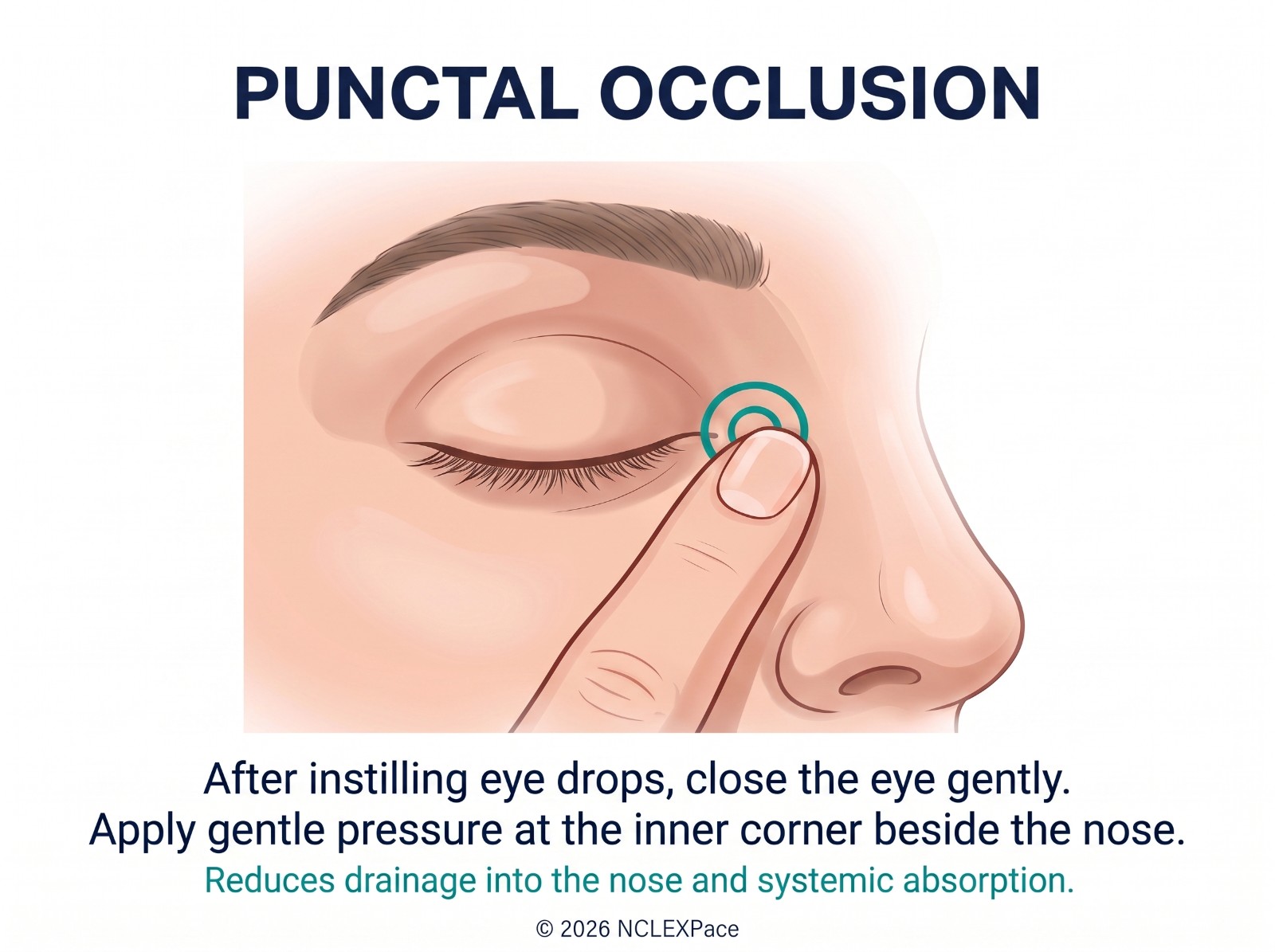
- Instruct the client to close the eye gently and apply pressure to the inner canthus to reduce systemic absorption. Allow the prescribed interval between different medications.
- Monitor for adverse effects, medication adherence, visual changes, and signs of worsening intraocular pressure or optic nerve damage.
Numbers to know
| Value | Number | Why it matters |
|---|---|---|
| Interval between different eye drops | At least 5 minutes | Reduces dilution and interference between medications. |
| Punctal occlusion | 1 to 2 minutes | Reduces systemic absorption through the nasolacrimal duct. |
| Contact lens reinsertion after latanoprost | 15 minutes | Allows the medication and preservative to disperse. |
| Latanoprost administration | Once daily in the evening | More frequent administration may reduce its pressure-lowering effect. |
| Normal intraocular pressure | 10 to 21 mm Hg | Pressure in acute angle closure rises far above this range. |
Common exam traps
- Choosing routine follow-up for sudden severe eye pain and halos: wrong because acute angle closure can cause permanent vision loss without immediate treatment.
- Choosing timolol for a client with asthma: wrong because topical beta blockers can cause serious bronchospasm.
- Choosing to discontinue latanoprost because the iris becomes darker: wrong because iris pigmentation is a recognized adverse effect that should be discussed with the prescriber.
- Choosing to touch the dropper tip to the conjunctiva: wrong because this can contaminate the medication and cause eye infection.
- Choosing to stop glaucoma drops when vision appears unchanged: wrong because treatment prevents progression rather than restoring lost vision.
What to teach
- Use prescribed glaucoma medications consistently, even when there is no pain or noticeable change in vision. Treatment is generally long-term.
- Wash hands before administration, avoid touching the bottle tip, close the eye gently, and apply pressure to the inner corner of the eye after instillation.
- Remove contact lenses before administering preserved eye drops and wait the product-specific recommended interval before reinserting them.
- Wait at least 5 minutes between different ophthalmic medications, instill drops before any eye ointment, and follow the prescribed dosing schedule.
- Report new eye pain, sudden blurred vision, halos, severe headache, nausea, or vomiting immediately.
- Inform the ophthalmologist before cataract surgery if taking tamsulosin, even if it was discontinued, because it is associated with intraoperative floppy iris syndrome and can complicate surgery.
2 NCLEX questions with rationales on this topic
From the NCLEXPace question bank. Choose your answer first, then open the correct answer and the full rationale under each question.
A client is prescribed timolol eye drops for glaucoma and has a history of asthma. Which action should the nurse take?
Select the best answer.
- A. Increase the timolol dose to keep the eye pressure controlled
- B. Proceed; eye drops stay local and do not affect the lungs
- C. Stop the asthma medications while timolol is started
- D. Notify the prescriber of the asthma history first
Show the correct answer and rationale
Correct answer:
- D. Notify the prescriber of the asthma history first
Rationale
Overview
- Definition: Ophthalmic timolol is a nonselective beta blocker. Nasolacrimal drainage permits systemic absorption and respiratory and cardiovascular effects.
- Contraindications: Asthma, a history of asthma, and severe COPD are contraindications.
- Nursing response: The prescription requires review before administration because systemic exposure causes bronchospasm, bradycardia, and hypotension.
Nursing key points
- Withhold timolol and notify the prescriber before the first dose.
- Request review of another class, such as a prostaglandin analog or carbonic anhydrase inhibitor.
- Continue prescribed asthma medications.
- If already administered, assess for wheezing, shortness of breath, bradycardia, and dizziness.
- With approved ophthalmic treatment, punctal occlusion for 1 to 2 minutes reduces absorption; it does not remove contraindications.
Answer analysis
| Nursing action | Rationale |
|---|---|
| Increase the timolol dose to keep the eye pressure controlled | Not correct. Increased exposure raises bronchospasm risk. |
| Proceed; eye drops stay local and do not affect the lungs | Not correct. Systemic absorption produces clinically significant effects. |
| Stop the asthma medications while timolol is started | Not correct. Stopping asthma therapy does not make timolol safe. |
| Notify the prescriber of the asthma history first | Correct. Asthma requires clarification before administration. |
A client is learning to instill their own eye drops. For each statement by the client, indicate whether it is correct or requires correction.
For each statement about eye drop administration, indicate whether it is correct or requires correction.
| Correct | Requires correction | |
|---|---|---|
| "I will put the ointment in first and the drops afterwards." | ||
| "I will wait 5 minutes before putting in my second kind of drop." | ||
| "I will pull down my lower lid and drop it into the pocket." | ||
| "I will let the dropper tip touch my eye so I do not miss." | ||
| "I will press the inner corner of my eye for about a minute after." |
Show the correct answer and rationale
Correct answers:
- "I will put the ointment in first and the drops afterwards.": Requires correction
- "I will wait 5 minutes before putting in my second kind of drop.": Correct
- "I will pull down my lower lid and drop it into the pocket.": Correct
- "I will let the dropper tip touch my eye so I do not miss.": Requires correction
- "I will press the inner corner of my eye for about a minute after.": Correct
Rationale
Overview
- Definition: Ophthalmic medication technique delivers prescribed medication into the lower conjunctival sac.
- Correct steps: Punctal occlusion limits systemic absorption. Space different drops and apply ointment last.
- Common errors: Dropper contact causes contamination or injury. Ointment applied first interferes with drop absorption.
Nursing key points
- Perform hand hygiene before handling ophthalmic medication.
- Pull the lower lid down and instill the prescribed drops into the conjunctival sac.
- Keep the dropper tip clear of the eye, lashes, and skin.
- Apply gentle pressure at the inner canthus for about 1 minute.
- Wait at least 5 minutes between different drops; apply ointment last.
Answer analysis
| Client statement | Correct or requires correction? | Why |
|---|---|---|
| "I will put the ointment in first and the drops afterwards." | Requires correction. | Instill drops before ointment. |
| "I will wait 5 minutes before putting in my second kind of drop." | Correct. | Spacing reduces dilution and washout. |
| "I will pull down my lower lid and drop it into the pocket." | Correct. | The lower conjunctival sac receives the medication. |
| "I will let the dropper tip touch my eye so I do not miss." | Requires correction. | Contact contaminates the tip and risks ocular injury. |
| "I will press the inner corner of my eye for about a minute after." | Correct. | Punctal occlusion reduces nasolacrimal drainage and systemic absorption. |
The NCLEXPace bank has 3,200+ NCLEX questions with full rationales, sorted by topic, with your progress tracked as you practice. Create your account to start.
Create Account →More topics in Pharmacology
Proton Pump Inhibitors and Antacids NCLEX Questions With RationalesReviews acid-suppressing medications, administration, adverse effects, drug interactions, and nursing priorities for gastrointestinal bleeding.Calcium Channel Blockers NCLEX Questions With RationalesReviews calcium channel blocker classes, cardiovascular uses, adverse effects, nursing assessments, medication safety, and client teaching.Statins NCLEX Questions With RationalesReviews statin medications, LDL reduction, adverse effects, drug interactions, laboratory monitoring, and client education.Sources
- National Eye Institute. Glaucoma Medicines. 2024.
- American Academy of Ophthalmology. Angle-Closure Glaucoma. 2013.
- National Library of Medicine, DailyMed. Latanoprost Ophthalmic Solution, Prescribing Information. 2025.
3,200+ NCLEX questions with think-like-a-nurse rationales, unfolding case studies and adaptive readiness exams. Start with free practice questions, then choose a plan when you are ready.
Create Account →