Diuretics NCLEX Questions With Rationales
What it is
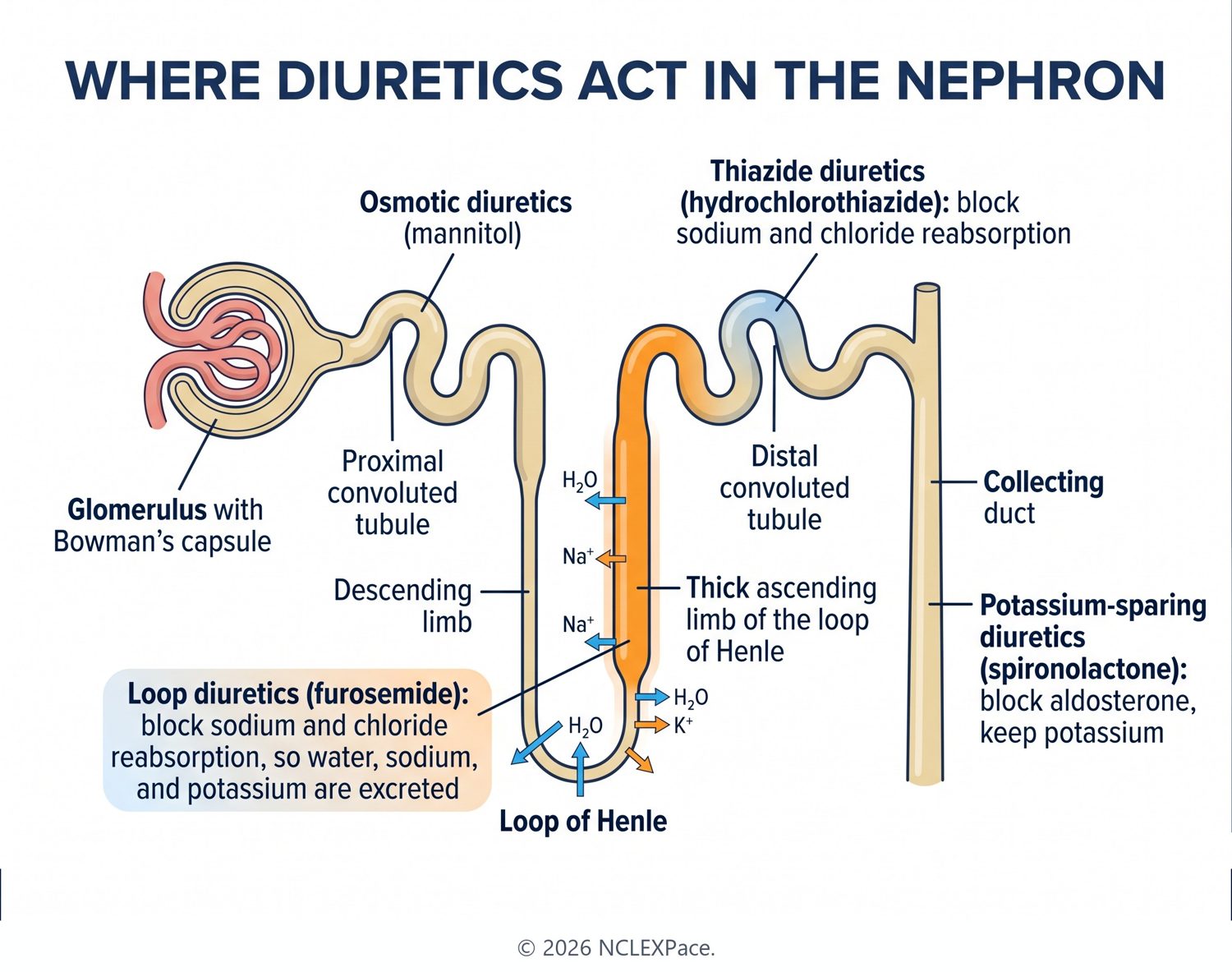
Diuretics are medications that increase renal excretion of sodium and water to reduce fluid retention or blood pressure. Loop diuretics, such as furosemide, act in the thick ascending limb of the loop of Henle and produce substantial diuresis. Thiazide diuretics, such as hydrochlorothiazide, act in the distal convoluted tubule. Potassium-sparing diuretics, such as spironolactone and amiloride, reduce potassium excretion.
What the NCLEX focuses on
- Loop diuretics increase urinary potassium loss and can cause hypokalemia.
- Thiazide diuretics increase potassium excretion and can also cause hyponatremia.
- Potassium-sparing diuretics can cause hyperkalemia, particularly with impaired kidney function.
- Furosemide is used to treat edema associated with heart failure and selected renal or hepatic conditions.
- Thiazide diuretics are commonly prescribed to manage hypertension.
- Rapid intravenous furosemide administration increases the risk of ototoxicity.
- Diuretic treatment requires monitoring of fluid balance, renal function, blood pressure, and electrolytes.
- Potassium supplements and potassium-containing salt substitutes increase hyperkalemia risk with spironolactone.
Priority nursing actions
- Assess blood pressure, pulse, respiratory status, lung sounds, and manifestations of fluid overload or dehydration before administration.
- Review serum potassium, sodium, creatinine, and other prescribed laboratory results, reporting clinically significant abnormalities before administering medication when indicated.
- Monitor daily weight under consistent conditions and accurately document intake and output to assess fluid balance.
- Administer intravenous furosemide according to the specific product instructions and prescribed rate, avoiding rapid administration that increases ototoxicity risk.
- Monitor for dizziness, muscle weakness, abnormal heart rhythm, reduced urine output, tinnitus, or hearing changes and report concerning findings promptly.
- Schedule oral doses according to the prescription, generally earlier in the day when appropriate, to reduce nighttime urination.
Numbers to know
| Value | Number | Why it matters |
|---|---|---|
| Normal serum potassium | 3.5 to 5.0 mEq/L | Potassium abnormalities can affect neuromuscular function and cardiac rhythm. |
| High-dose IV furosemide infusion | Not greater than 4 mg/minute | This adult controlled-infusion rate is described in U.S. labeling to limit ototoxicity risk; follow the specific product instructions. |
| Rapid daily weight gain | More than 3 pounds in a day | This weight increase warrants provider notification according to the referenced nursing guidance. |
Common exam traps
- Choosing potassium supplements routinely for a client taking spironolactone: wrong because potassium retention can cause hyperkalemia.
- Choosing to administer intravenous furosemide rapidly without checking the prescribed rate: wrong because rapid administration increases ototoxicity risk.
- Choosing to evaluate diuretic effectiveness using urine output alone: wrong because daily weight, clinical findings, and laboratory results also assess treatment response.
- Choosing to ignore muscle weakness during diuretic therapy: wrong because electrolyte abnormalities can impair muscle function and cardiac conduction.
- Choosing a bedtime dose when a morning schedule is appropriate: wrong because increased urination can interrupt sleep.
What to teach
- Weigh daily using the same scale and similar clothing, and report rapid changes according to the care plan.
- Take oral diuretics at prescribed times, usually in the morning when appropriate.
- Change positions slowly and report dizziness or fainting.
- Follow individualized fluid, sodium, and potassium recommendations rather than independently changing dietary intake.
- Avoid potassium supplements and potassium-containing salt substitutes while taking spironolactone unless specifically directed by the provider.
- Report muscle weakness, palpitations, ringing in the ears, hearing changes, or markedly decreased urine output.
2 NCLEX questions with rationales on this topic
From the NCLEXPace question bank. Choose your answer first, then open the correct answer and the full rationale under each question.
A client is prescribed intravenous furosemide 80 mg. Which action by the nurse is correct?
Select the best answer.
- A. Administer it slowly, per the rate limit
- B. Give it undiluted by IV push over 30 seconds
- C. Give it rapidly over 1 minute for faster relief
- D. Dilute it in dextrose solution before giving
Show the correct answer and rationale
Correct answer:
- A. Administer it slowly, per the rate limit
Rationale
Overview
- Definition: IV furosemide is a loop diuretic that inhibits sodium and chloride reabsorption in the ascending loop of Henle.
- Rate limit and ototoxicity: Rapid administration increases tinnitus and hearing loss risk. Product-specific administration limits apply.
- Monitoring: Diuresis lowers fluid volume and increases potassium loss.
Nursing key points
- Verify product labeling and institutional IV policy before administering 80 mg.
- Standard initial doses of 20 to 40 mg are administered over 1 to 2 minutes.
- For high-dose controlled infusion, do not exceed 4 mg/min; 80 mg requires at least 20 minutes at this limit.
- Report tinnitus or hearing changes immediately.
- Monitor blood pressure, potassium, and urine output; expected adult urine output is at least 0.5 mL/kg/hour.
Answer analysis
| Nursing action | Rationale |
|---|---|
| Administer it slowly, per the rate limit | Correct. Use the approved rate for the product, dose, and administration method. |
| Give it undiluted by IV push over 30 seconds | Not correct. Monitoring does not make rapid administration safe. |
| Give it rapidly over 1 minute for faster relief | Not correct. Symptom relief does not justify exceeding the applicable rate. |
| Dilute it in dextrose solution before giving | Not correct. Dextrose compatibility requires appropriate pH and product-specific instructions. |
- A. Serum potassium
- B. Apical pulse for one full minute
- C. Blood pressure
- D. Blood glucose
- E. Daily weight and urine output
- F. Blood urea nitrogen and creatinine
Show the correct answer and rationale
Correct answers:
- A. Serum potassium
- C. Blood pressure
- E. Daily weight and urine output
- F. Blood urea nitrogen and creatinine
Rationale
Overview
- Definition: Furosemide is a loop diuretic that blocks sodium and chloride reabsorption in the ascending loop of Henle, increasing water, sodium, and potassium excretion.
- Safety assessment: Review blood pressure because volume loss lowers pressure and potassium because hypokalemia causes dysrhythmias.
- Kidney function: Blood urea nitrogen and creatinine guide dosing and identify kidney-related safety concerns.
- Fluid status: Daily weight and urine output establish baseline volume status and indicate treatment response.
Nursing key points
- Review blood pressure, potassium, kidney function, daily weight, and urine output before administration.
- Follow prescribed hold parameters; report systolic pressure below 100 mm Hg when specified.
- Know the reference value: potassium below 3.5 mEq/L indicates hypokalemia requiring follow-up.
- Administer intravenously at the prescribed slow rate; rapid injection causes ototoxicity.
- After administration, monitor urine output, blood pressure, dizziness, and potassium; assist with toileting.
Answer analysis
| Data to review | Rationale |
|---|---|
| Serum potassium | Correct. Potassium loss increases the risk of dysrhythmias. |
| Blood pressure | Correct. A baseline blood pressure identifies hypotension before further fluid loss. |
| Daily weight and urine output | Correct. Weight and urine output establish baseline volume status and allow evaluation of diuresis. |
| Blood urea nitrogen and creatinine | Correct. These values show kidney function and guide safe dosing. |
| Apical pulse for one full minute | Not correct. A full-minute apical pulse is the digoxin check, not a furosemide requirement. |
| Blood glucose | Not correct. Blood glucose is not a pre-dose check for a loop diuretic. |
The NCLEXPace bank has 3,200+ NCLEX questions with full rationales, sorted by topic, with your progress tracked as you practice. Create your account to start.
Create Account →More topics in Pharmacology
Proton Pump Inhibitors and Antacids NCLEX Questions With RationalesReviews acid-suppressing medications, administration, adverse effects, drug interactions, and nursing priorities for gastrointestinal bleeding.Calcium Channel Blockers NCLEX Questions With RationalesReviews calcium channel blocker classes, cardiovascular uses, adverse effects, nursing assessments, medication safety, and client teaching.Statins NCLEX Questions With RationalesReviews statin medications, LDL reduction, adverse effects, drug interactions, laboratory monitoring, and client education.Sources
- National Library of Medicine, NCBI Bookshelf. Chapter 6 Cardiovascular and Renal Systems. 2023.
- National Library of Medicine, NCBI Bookshelf. Chapter 15 Fluids and Electrolytes. 2023.
- National Library of Medicine, DailyMed. Furosemide Injection, Solution. 2026.
- National Library of Medicine, MedlinePlus. Spironolactone: Drug Information. 2017.
3,200+ NCLEX questions with think-like-a-nurse rationales, unfolding case studies and adaptive readiness exams. Start with free practice questions, then choose a plan when you are ready.
Create Account →