Deep Vein Thrombosis NCLEX Questions With Rationales
What it is
Deep vein thrombosis (DVT) is the formation of a blood clot within a deep vein, most commonly in the lower extremity. Clot formation is promoted by venous stasis, vessel injury, and increased blood clotting tendency. A clot can travel to the pulmonary arteries and cause a potentially fatal pulmonary embolism (PE). Anticoagulation is the main treatment for most confirmed DVT cases.
What the NCLEX focuses on
- Major risk factors include recent surgery, trauma, immobility, active cancer, pregnancy, estrogen exposure, and previous venous thromboembolism.
- DVT commonly produces unilateral leg swelling, pain, tenderness, warmth, or skin discoloration.
- Some clients with DVT have no noticeable symptoms.
- Compression ultrasonography is the standard initial imaging test for suspected lower-extremity DVT.
- Hospital prevention includes early mobilization, prescribed anticoagulant prophylaxis, and intermittent pneumatic compression when appropriate.
- Anticoagulants prevent clot extension and new clot formation rather than directly dissolving existing clots.
- Direct oral anticoagulants, including apixaban and rivaroxaban, are commonly preferred for eligible clients.
- Warfarin therapy requires international normalized ratio monitoring, unlike routine direct oral anticoagulant therapy.
- Sudden unexplained shortness of breath, pleuritic chest pain, tachycardia, or syncope may indicate pulmonary embolism.
Priority nursing actions
- Assess airway, breathing, circulation, oxygen saturation, and vital signs immediately when pulmonary embolism is suspected.
- Activate emergency assistance for suspected pulmonary embolism, administer prescribed oxygen, and prepare for urgent evaluation.
- Assess the affected extremity for swelling, tenderness, warmth, and skin changes, and promptly report suspected DVT.
- Administer prescribed anticoagulation and monitor for hematuria, gastrointestinal bleeding, bruising, or other bleeding complications.
- Monitor prescribed laboratory tests, including platelet counts with heparin therapy and INR with warfarin therapy.
- Avoid massaging the affected leg, and assist with mobilization as tolerated after appropriate treatment is established.
Numbers to know
| Value | Number | Why it matters |
|---|---|---|
| Initial anticoagulation duration | 3 to 6 months | Duration depends on clot circumstances and recurrence risk. |
| Warfarin target INR | 2.0 to 3.0 | Usual therapeutic range for DVT treatment. |
| Heparin overlap with warfarin | At least 5 days | Warfarin requires time to become fully effective. |
| Prolonged travel | More than 4 hours | Extended immobility increases thrombosis risk. |
| Walking during prolonged travel | Every 1 to 2 hours | Movement helps reduce venous stasis. |
Common exam traps
- Choosing vigorous massage of the swollen leg: wrong because deep massage may contribute to clot dislodgment.
- Choosing strict bed rest for every treated DVT: wrong because early activity is generally safe when tolerated and appropriately treated.
- Choosing a normal oxygen saturation to exclude pulmonary embolism: wrong because PE cannot be ruled out by pulse oximetry alone.
- Choosing aspirin as the standard treatment for confirmed DVT: wrong because therapeutic anticoagulation is generally required.
- Choosing routine INR testing for apixaban: wrong because INR does not measure its anticoagulant effect reliably.
What to teach
- Take anticoagulants exactly as prescribed and do not independently stop treatment.
- Report black stools, blood in urine, persistent bleeding, or unusual bruising promptly.
- Seek emergency care for sudden shortness of breath, chest pain, fainting, or coughing blood.
- Avoid deep massage of the affected leg, especially during early DVT treatment.
- Walk regularly and perform ankle and calf movements during prolonged sitting.
- Tell healthcare professionals about anticoagulant use before procedures or starting new medications.
2 NCLEX questions with rationales on this topic
From the NCLEXPace question bank. Choose your answer first, then open the correct answer and the full rationale under each question.
Select the best answer.
- A. An 84-year-old client on postoperative day 3 after hip replacement who has not walked
- B. A 31-year-old client who smokes and uses an estrogen-containing contraceptive but walks independently
- C. A 58-year-old client with pneumonia who spends most of the day in bed but walks with assistance
- D. A 70-year-old client with active cancer who walks independently on the unit
Show the correct answer and rationale
Correct answer:
- A. An 84-year-old client on postoperative day 3 after hip replacement who has not walked
Rationale
Overview
- Definition: Deep vein thrombosis (DVT) is a blood clot that forms in a deep vein, most often in the leg or pelvis. The main complication of DVT is pulmonary embolism: part of the clot breaks off and travels to the arteries of the lungs.
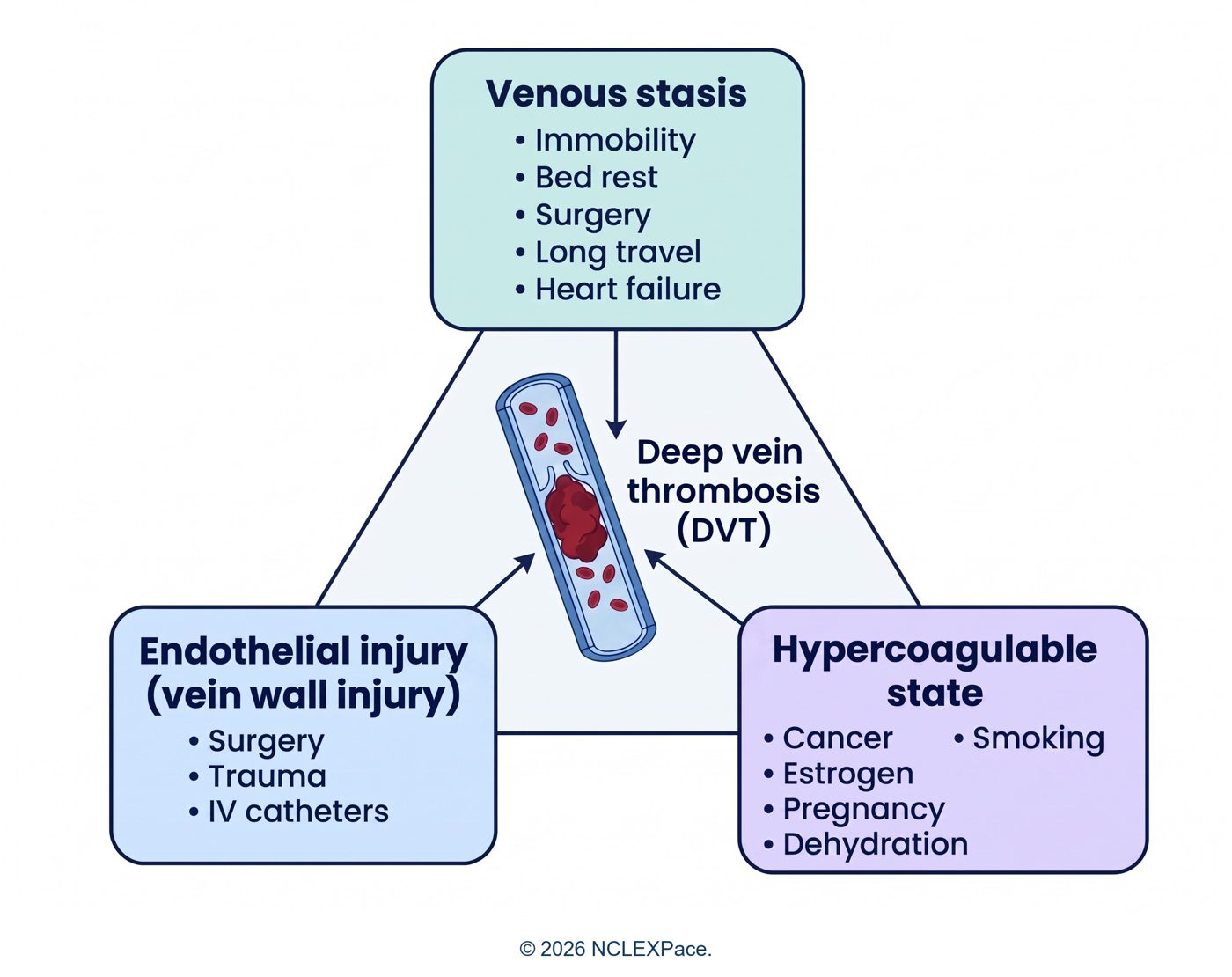
- Risk factors (Virchow triad):
- Venous stasis: immobility, bed rest, surgery, long travel, heart failure.
- Endothelial injury: surgery, trauma, intravenous catheters.
- Hypercoagulable state: cancer, estrogen, pregnancy, smoking, dehydration.
- Prevention: early walking, leg exercises, compression devices, and prescribed prophylactic anticoagulants reduce the risk.
Nursing key points
- Assess clotting and bleeding risks on admission and after surgery.
- Help clients walk early and often; teach ankle pumps and leg exercises.
- Apply prescribed compression devices in bed; remove them briefly for skin checks.
- Give prescribed prophylactic anticoagulants.
- Maintain hydration within ordered fluid limits.
- Report calf pain, swelling, warmth, or redness promptly.
Answer analysis
| Client | Rationale |
|---|---|
| An 84-year-old client on postoperative day 3 after hip replacement who has not walked | Correct. Major orthopedic surgery, age over 60, and immobility combine three strong risk factors. |
| A 31-year-old client who smokes and uses an estrogen-containing contraceptive but walks independently | Not correct. Smoking and estrogen increase risk, but this client remains mobile without recent surgery. |
| A 58-year-old client with pneumonia who spends most of the day in bed but walks with assistance | Not correct. Infection and reduced mobility increase risk, but this client walks with assistance. |
| A 70-year-old client with active cancer who walks independently on the unit | Not correct. Cancer and older age increase risk, but recent major surgery and prolonged immobility are absent. |
- A. Right calf circumference 3 cm larger than the left
- B. Warmth and redness over the right calf
- C. Right calf pain and tenderness
- D. Cool, pale right foot with an absent pedal pulse
- E. Swelling of both ankles that goes away overnight
Show the correct answer and rationale
Correct answers:
- A. Right calf circumference 3 cm larger than the left
- B. Warmth and redness over the right calf
- C. Right calf pain and tenderness
Rationale
Overview
- Definition: Deep vein thrombosis (DVT) is a blood clot that forms in a deep vein, most often in the leg or pelvis. The main complication of DVT is pulmonary embolism: part of the clot breaks off and travels to the arteries of the lungs.
- Signs and symptoms: one leg or calf is swollen, with a larger calf circumference, warmth, redness, pain, and tenderness. Some clients have no signs.
- Diagnosis: Venous duplex ultrasound confirms DVT. A negative D-dimer helps rule out DVT when the probability is low.
Nursing key points
- Measure both calves at the same marked point; compare and document the measurements.
- Do not massage the affected leg. Report swelling, warmth, redness, and tenderness promptly.
- Call the rapid response team for sudden shortness of breath, chest pain, or a fast heart rate (signs of pulmonary embolism). A normal resting heart rate is 60 to 100/min.
- Give the prescribed anticoagulant and monitor for bleeding.
Answer analysis
| Finding | Rationale |
|---|---|
| Right calf circumference 3 cm larger than the left | Correct. A difference of 3 cm or more supports DVT when both calves are measured at the same level. |
| Warmth and redness over the right calf | Correct. Inflammation around the vein causes warmth and redness. |
| Right calf pain and tenderness | Correct. Inflammation around the affected vein causes pain and tenderness. |
| Cool, pale right foot with an absent pedal pulse | Not correct. These are signs of blocked arterial flow and need an immediate report. |
| Swelling of both ankles that goes away overnight | Not correct. This is dependent edema from chronic venous disease or fluid overload, not a clot in one leg. |
The NCLEXPace bank has 3,200+ NCLEX questions with full rationales, sorted by topic, with your progress tracked as you practice. Create your account to start.
Create Account →More topics in Medical-Surgical
Lyme Disease NCLEX Questions With RationalesCovers Lyme disease stages, clinical manifestations, doxycycline treatment, tick removal, nursing priorities, and prevention.Influenza NCLEX Questions With RationalesReviews seasonal influenza symptoms, high-risk groups, antiviral treatment, isolation, vaccination, complications, and nursing care.Atopic Dermatitis (Eczema) NCLEX Questions With RationalesReviews childhood eczema manifestations, age-related distribution, triggers, skin care, topical medications, infection prevention, and parent education.Sources
- Centers for Disease Control and Prevention. About Venous Thromboembolism (Blood Clots). 2025.
- Merck Manual Professional Edition. Deep Venous Thrombosis (DVT). 2026.
- Merck Manual Professional Edition. Medications for Deep Venous Thrombosis. 2026.
- National Library of Medicine. Vascular Disease Patient Information Page: A Guide for Patients With Newly Diagnosed Deep Vein Thrombosis or Pulmonary Embolism. 2023.
3,200+ NCLEX questions with think-like-a-nurse rationales, unfolding case studies and adaptive readiness exams. Start with free practice questions, then choose a plan when you are ready.
Create Account →