Cushing Syndrome NCLEX Questions With Rationales
What it is
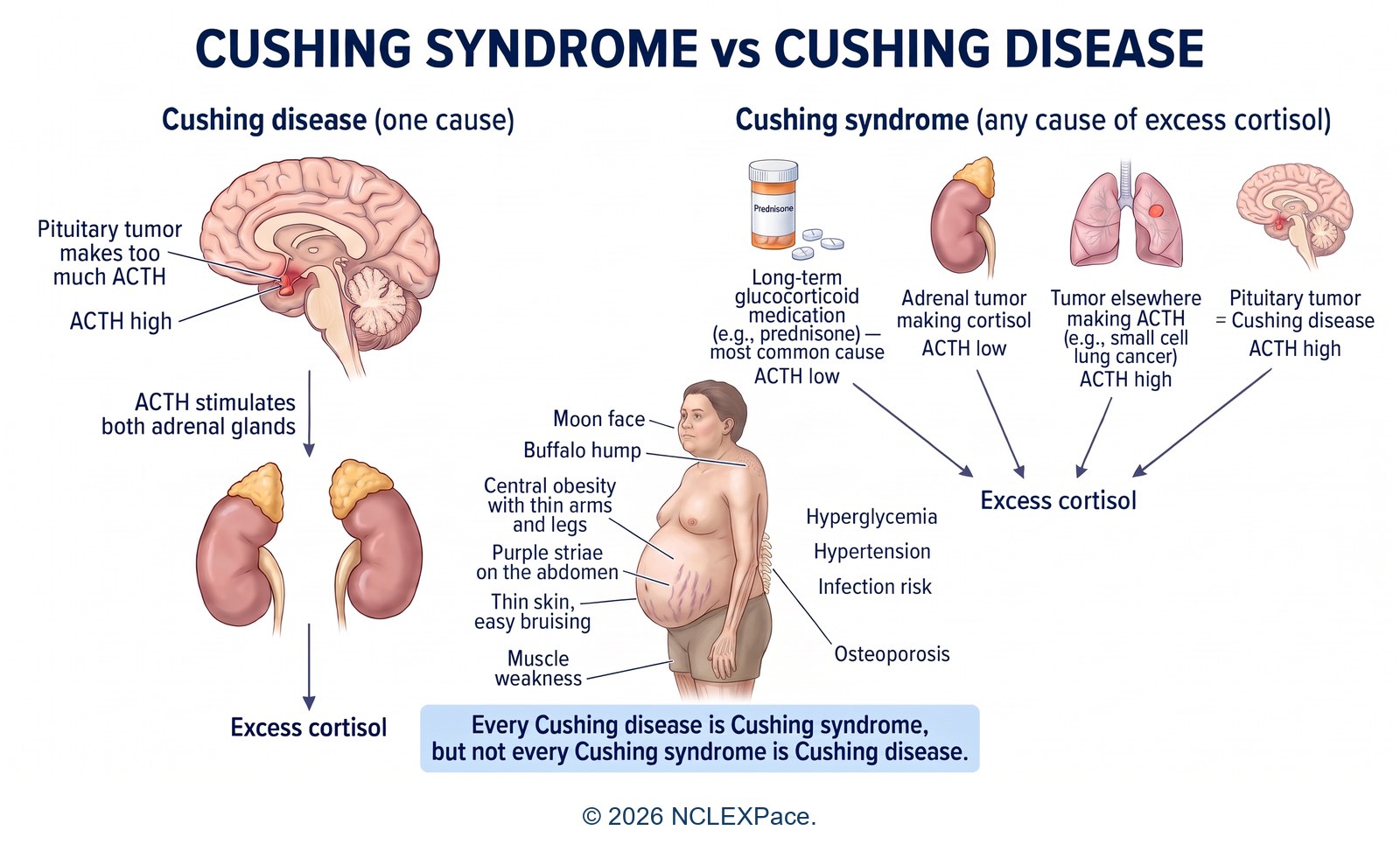
Cushing syndrome is the set of signs and symptoms caused by prolonged exposure to excess cortisol or other glucocorticoids. The most common cause is long-term, high-dose corticosteroid therapy. The most common endogenous cause is an ACTH-secreting pituitary adenoma, which is called Cushing disease; adrenal tumors and ectopic ACTH-secreting tumors are less common.
What the NCLEX focuses on
- Fat redistribution: truncal obesity, a rounded moon face and a fat pad between the shoulders (buffalo hump), with thin arms and legs.
- Skin: thin, fragile skin, easy bruising, purple striae and poor wound healing.
- Muscle and bone: weakness of the hip and shoulder muscles, and osteoporosis with rib and spine fractures.
- Metabolic and cardiovascular effects: hyperglycemia, hypertension and hypokalemia.
- Resistance to infection is reduced.
- Dexamethasone suppression test: the client takes a low dose of dexamethasone late in the evening and serum cortisol is drawn the next morning; a cortisol level that does not fall suggests Cushing syndrome.
- Treatment is a prescribed gradual taper when a corticosteroid medicine is the cause, or surgery: transsphenoidal removal of a pituitary tumor or adrenalectomy for an adrenal tumor.
Priority nursing actions
- Prevent infection: perform hand hygiene, assess temperature and wounds, and report signs of infection promptly.
- Prevent injury: use fall precautions and assist with ambulation, because muscle weakness and osteoporosis raise the risk of fracture.
- Protect the skin: handle the client gently and inspect the skin often, because it bruises easily and heals poorly.
- Monitor blood glucose, blood pressure and serum potassium, and report abnormal results.
- After transsphenoidal surgery, monitor urine output for diabetes insipidus, report clear nasal drainage (possible cerebrospinal fluid leak), and remind the client to avoid coughing and bending.
- After adrenalectomy or pituitary surgery, give the prescribed glucocorticoid replacement on time and report fatigue, muscle weakness, loss of appetite or abdominal pain, which suggest adrenal insufficiency.
Numbers to know
| Value | Number | Why it matters |
|---|---|---|
| Overnight dexamethasone dose | 1 mg by mouth at 11 PM to midnight | Suppresses cortisol in a healthy person |
| Serum cortisol the next morning | Drawn at 8 to 9 AM; normal after dexamethasone is below 1.8 mcg/dL | A higher value means cortisol was not suppressed |
| Cortisol replacement after pituitary surgery | Often needed for 6 to 18 months | The adrenal glands recover slowly |
| Replacement after removal of both adrenal glands | Lifelong | No adrenal tissue remains to make cortisol |
Common exam traps
- Choosing to stop the corticosteroid at once when cushingoid features appear: wrong because sudden withdrawal can cause adrenal crisis, so the dose is tapered.
- Choosing hyperkalemia or hypoglycemia as expected findings: wrong because excess cortisol causes hypokalemia and hyperglycemia.
- Choosing generalized weight gain as the typical pattern: wrong because fat collects in the trunk and face while the arms and legs stay thin.
- Choosing Cushing disease as another name for every case: wrong because Cushing disease means only the pituitary ACTH cause.
- Choosing to omit steroid replacement after removal of both adrenal glands: wrong because replacement is lifelong.
What to teach
- Never stop a corticosteroid suddenly; the provider lowers the dose gradually.
- Take glucocorticoid replacement exactly as prescribed after surgery.
- Watch for infection and report fever or a wound that is slow to heal.
- Prevent falls at home and follow the prescribed plan to protect the bones.
2 NCLEX questions with rationales on this topic
From the NCLEXPace question bank. Choose your answer first, then open the correct answer and the full rationale under each question.
The nurse reviews the laboratory report of a client who completed an overnight low-dose dexamethasone suppression test for suspected Cushing syndrome. The morning serum cortisol is 18 mcg/dL (reference: suppression to <1.8 mcg/dL). Which interpretation by the nurse is correct?
Select the best answer.
- A. Cortisol failed to suppress, which supports excess cortisol production
- B. The hypothalamic-pituitary-adrenal axis suppressed appropriately because the morning cortisol remains within the laboratory reference range
- C. The test should be repeated after a 12-hour fast because recent food intake can prevent adequate dexamethasone suppression
- D. The result cannot be interpreted because normal circadian cortisol variation makes a single morning value unreliable after dexamethasone
Show the correct answer and rationale
Correct answer:
- A. Cortisol failed to suppress, which supports excess cortisol production
Rationale
Overview
- Definition: Cushing syndrome is prolonged exposure to excess cortisol. Excess cortisol causes central obesity, muscle weakness, hyperglycemia, hypertension, and skin changes.
- Tests: The overnight dexamethasone suppression test assesses cortisol suppression after 1 mg of dexamethasone at 2300. Serum cortisol is measured at approximately 0800.
- Results: Normal suppression produces cortisol below 1.8 mcg/dL. A result of 18 mcg/dL indicates failure of suppression and requires further endocrine evaluation.
| Test | Normal | Cushing |
|---|---|---|
| 1-mg overnight dexamethasone suppression | Morning cortisol <1.8 mcg/dL | Cortisol fails to suppress below 1.8 mcg/dL |
| Late-night salivary cortisol | Low late-night cortisol | Elevated late-night cortisol |
| 24-hour urinary free cortisol | Within laboratory reference range | Elevated urinary free cortisol |
Nursing key points
- Verify administration of 1 mg dexamethasone at 2300 and cortisol sampling at approximately 0800.
- Compare the morning cortisol with the suppression cutoff of 1.8 mcg/dL.
- Report cortisol of 18 mcg/dL as an abnormal suppression-test result.
- Review glucocorticoids, estrogen therapy, medications affecting dexamethasone metabolism, and acute illness.
- Prepare for prescribed additional screening with late-night salivary cortisol or 24-hour urinary free cortisol.
Answer analysis
| Interpretation | Rationale |
|---|---|
| Cortisol failed to suppress, which supports excess cortisol production | Correct. Cortisol of 18 mcg/dL exceeds the suppression cutoff of 1.8 mcg/dL and indicates an abnormal screening result. |
| The hypothalamic-pituitary-adrenal axis suppressed appropriately because the morning cortisol remains within the laboratory reference range | Not correct. The dexamethasone suppression cutoff, not the routine morning cortisol range, determines the result. |
| The test should be repeated after a 12-hour fast because recent food intake can prevent adequate dexamethasone suppression | Not correct. Fasting does not explain this result; medication administration and test interference require review. |
| The result cannot be interpreted because normal circadian cortisol variation makes a single morning value unreliable after dexamethasone | Not correct. Standardized dexamethasone administration and morning cortisol measurement permit assessment of suppression. |
The nurse plans care for a hospitalized client with Cushing syndrome. Which interventions should the nurse include to address this client's specific risks? Select all that apply.
- A. Institute meticulous hand hygiene and monitor subtle signs of infection
- B. Encourage a diet high in sodium to replace renal losses
- C. Monitor capillary blood glucose per protocol
- D. Implement fall precautions and assist with transfers
- E. Massage the legs twice daily to promote venous return
- F. Handle skin gently and pad bony prominences
Show the correct answer and rationale
Correct answers:
- A. Institute meticulous hand hygiene and monitor subtle signs of infection
- C. Monitor capillary blood glucose per protocol
- D. Implement fall precautions and assist with transfers
- F. Handle skin gently and pad bony prominences
Rationale
Overview
- Definition: Cushing syndrome is chronic exposure to excessive glucocorticoids, resulting from endogenous cortisol excess or prolonged exogenous glucocorticoid therapy.
- Risks: Excess cortisol causes immunosuppression, hyperglycemia, proximal muscle weakness, osteoporosis, thin skin, hypertension, and sodium retention. Infection signs are less pronounced because the inflammatory response is suppressed.
- Care: Priorities include infection prevention, glucose monitoring, fall precautions, skin protection, and assessment of fluid balance and thromboembolic risk.
Nursing key points
- Perform meticulous hand hygiene and assess for subtle infection findings.
- Monitor capillary glucose and administer prescribed glucose-lowering therapy.
- Assist with transfers and institute fall precautions to prevent fractures.
- Protect fragile skin from friction, shear, and pressure injuries.
- Monitor blood pressure, edema, daily weight, and fluid balance.
- Implement prescribed anticoagulant prophylaxis and avoid leg massage.
Answer analysis
| Nursing intervention | Rationale |
|---|---|
| Institute meticulous hand hygiene and monitor subtle signs of infection | Include. Cortisol excess suppresses immunity and inflammatory responses, increasing infection risk. |
| Encourage a diet high in sodium to replace renal losses | Do not include. Cortisol excess promotes sodium retention, hypertension, and edema. |
| Monitor capillary blood glucose per protocol | Include. Cortisol increases gluconeogenesis and insulin resistance, causing hyperglycemia. |
| Implement fall precautions and assist with transfers | Include. Proximal muscle weakness and osteoporosis increase falls and fracture risk. |
| Massage the legs twice daily to promote venous return | Do not include. Leg massage is not thrombosis prophylaxis and risks embolization when a thrombus is present. |
| Handle skin gently and pad bony prominences | Include. Skin thinning and impaired collagen synthesis increase tissue injury and delayed healing. |
The NCLEXPace bank has 3,200+ NCLEX questions with full rationales, sorted by topic, with your progress tracked as you practice. Create your account to start.
Create Account →More topics in Medical-Surgical
Lyme Disease NCLEX Questions With RationalesCovers Lyme disease stages, clinical manifestations, doxycycline treatment, tick removal, nursing priorities, and prevention.Influenza NCLEX Questions With RationalesReviews seasonal influenza symptoms, high-risk groups, antiviral treatment, isolation, vaccination, complications, and nursing care.Atopic Dermatitis (Eczema) NCLEX Questions With RationalesReviews childhood eczema manifestations, age-related distribution, triggers, skin care, topical medications, infection prevention, and parent education.Sources
- National Institute of Diabetes and Digestive and Kidney Diseases (NIH). Cushing's Syndrome.
- MedlinePlus, National Library of Medicine (NIH). Cushing syndrome.
- Merck Manual Professional Edition. Cushing Syndrome.
- StatPearls, NCBI Bookshelf (NIH). Transsphenoidal Hypophysectomy. 2025.
3,200+ NCLEX questions with think-like-a-nurse rationales, unfolding case studies and adaptive readiness exams. Start with free practice questions, then choose a plan when you are ready.
Create Account →