Crutches, Canes and Walkers NCLEX Questions With Rationales
What it is
Crutches, canes, and walkers are assistive devices that improve mobility, balance, and stability when walking is impaired. They support clients with weakness, pain, injury, or restricted weight bearing. Proper fitting, correct gait technique, and adherence to prescribed weight-bearing restrictions help prevent falls and nerve injuries.
What the NCLEX focuses on
- A cane is normally held in the hand opposite the weaker or affected leg, and the cane advances with that leg.
- A correctly fitted cane has its handle at wrist level with the elbow slightly flexed.
- Underarm crutches must support body weight through the hands rather than the armpits to prevent nerve compression.
- A two-point crutch gait advances the left crutch with the right leg, followed by the right crutch with the left leg.
- A three-point crutch gait advances both crutches with the affected leg, followed by the stronger leg, while following prescribed weight-bearing restrictions.
- A four-point crutch gait advances the left crutch, right leg, right crutch, and left leg in sequence.
- A swing-to crutch gait advances both crutches first, followed by both legs moving toward the crutches.
- On stairs, the stronger leg leads upward, while the crutches or cane and affected leg lead downward.
- A standard walker advances first, followed by the weaker leg and then the stronger leg.
Priority nursing actions
- Assess lower-extremity strength, balance, coordination, dizziness, and ability to follow instructions before assisting with ambulation.
- Verify prescribed weight-bearing restrictions and provide assistance until the client demonstrates safe mobility.
- Check device height, handle position, stability, and rubber tips before walking.
- Observe gait technique, ensure proper positioning, and correct unsafe movements immediately.
- Evaluate stair negotiation and transfers, arranging physical therapy instruction when needed.
Numbers to know
| Value | Number | Why it matters |
|---|---|---|
| Underarm crutch clearance | 1 to 1 1/2 inches below the armpit | Allows clearance to reduce pressure on nerves and blood vessels. |
| Cane elbow flexion | 20 to 30 degrees | Provides appropriate arm positioning and support. |
| Initial crutch placement | About 1 foot in front | Establishes the starting position for crutch walking. |
| Walker ground contact | All 4 tips or wheels | Provides a stable base before transferring weight. |
Common exam traps
- Choosing to hold the cane on the weaker side: wrong because the cane normally supports the affected leg from the opposite side.
- Choosing to rest body weight on the crutch pads: wrong because pressure in the armpits can injure nerves.
- Choosing the weaker leg first when ascending stairs: wrong because the stronger leg should lead upward.
- Choosing to pull on a walker when standing: wrong because the walker can tilt and cause a fall.
What to teach
- Look forward while walking and move slowly until balance and coordination improve.
- Use handrails when available and practice stairs with assistance before attempting them independently.
- Remove loose rugs, clutter, and electrical cords from walking paths.
- Wear supportive shoes with nonskid soles and inspect device tips for wear.
- Avoid using a walker on stairs or escalators without specific professional training.
- Report new numbness, weakness, falls, or difficulty using the prescribed device.
2 NCLEX questions with rationales on this topic
From the NCLEXPace question bank. Choose your answer first, then open the correct answer and the full rationale under each question.
The nurse teaches an older adult with balance problems to use a standard walker. Which observation indicates correct use?
Select the best answer.
- A. The client advances the walker about two full steps ahead before moving forward so there is enough space to take several steps inside it
- B. The client carries the walker beside the stronger leg and places it in front only when balance begins to feel unsteady
- C. The client leans the upper body over the walker with the elbows fully extended so body weight can be transferred directly through the arms
- D. The client lifts the walker, sets it down a step ahead, then steps into it with the weaker leg
Show the correct answer and rationale
Correct answer:
- D. The client lifts the walker, sets it down a step ahead, then steps into it with the weaker leg
Rationale
Overview
- Definition: A standard walker is a four-legged mobility device that provides a broad base of support for impaired balance or lower-extremity weakness.
- Technique: Lift the walker a short distance forward, place all four legs firmly on the floor, and advance the weaker leg before the stronger leg.
- Fit: Adjust handgrips for approximately 15 to 30 degrees of elbow flexion. A standard walker is lifted; a rolling walker is pushed.
Nursing key points
- Fit the handgrips at wrist-crease height with elbows flexed 15 to 30 degrees.
- Lift a standard walker a short step forward without excessive reaching.
- Place all four walker legs securely on the floor before stepping.
- Advance the weaker leg first, followed by the stronger leg.
- Maintain an upright posture and remain within the walker's base of support.
- Inspect rubber tips and maintain prescribed weight-bearing restrictions.
Answer analysis
| Observation | Rationale |
|---|---|
| The client advances the walker about two full steps ahead before moving forward so there is enough space to take several steps inside it | Not correct. Excessive forward placement forces reaching and decreases stability. |
| The client carries the walker beside the stronger leg and places it in front only when balance begins to feel unsteady | Not correct. Carrying the walker removes continuous support and increases fall risk. |
| The client leans the upper body over the walker with the elbows fully extended so body weight can be transferred directly through the arms | Not correct. Forward leaning and locked elbows reduce balance and movement control. |
| The client lifts the walker, sets it down a step ahead, then steps into it with the weaker leg | Correct. The walker is positioned securely before the weaker leg advances. |
The nurse teaches a client how to use crutches safely at home. Which instructions should the nurse include? Select all that apply.
- A. Take short steps and look ahead rather than at your feet
- B. Rest your armpits on the crutch pads when you stand still for a while
- C. Support your weight on your hands, not your armpits
- D. Remove loose rugs and cords from walkways
- E. Wear slippers or soft sandals so the feet stay comfortable
- F. If you begin to fall, throw the crutches to the side and try to land relaxed
- G. Check that the rubber tips are intact and not worn before each use
Show the correct answer and rationale
Correct answers:
- A. Take short steps and look ahead rather than at your feet
- C. Support your weight on your hands, not your armpits
- D. Remove loose rugs and cords from walkways
- F. If you begin to fall, throw the crutches to the side and try to land relaxed
- G. Check that the rubber tips are intact and not worn before each use
Rationale
Overview
- Definition: Crutch safety is the correct use of ambulatory assistive devices to maintain balance, follow prescribed weight-bearing restrictions, and prevent falls and neurovascular injury.
- Complications: Excessive axillary pressure compresses the brachial plexus, including fibers supplying the radial nerve, and produces crutch palsy with upper-extremity weakness.
- Home teaching: Proper crutch fitting, intact rubber tips, nonslip footwear, and clear walking surfaces reduce injury risk.
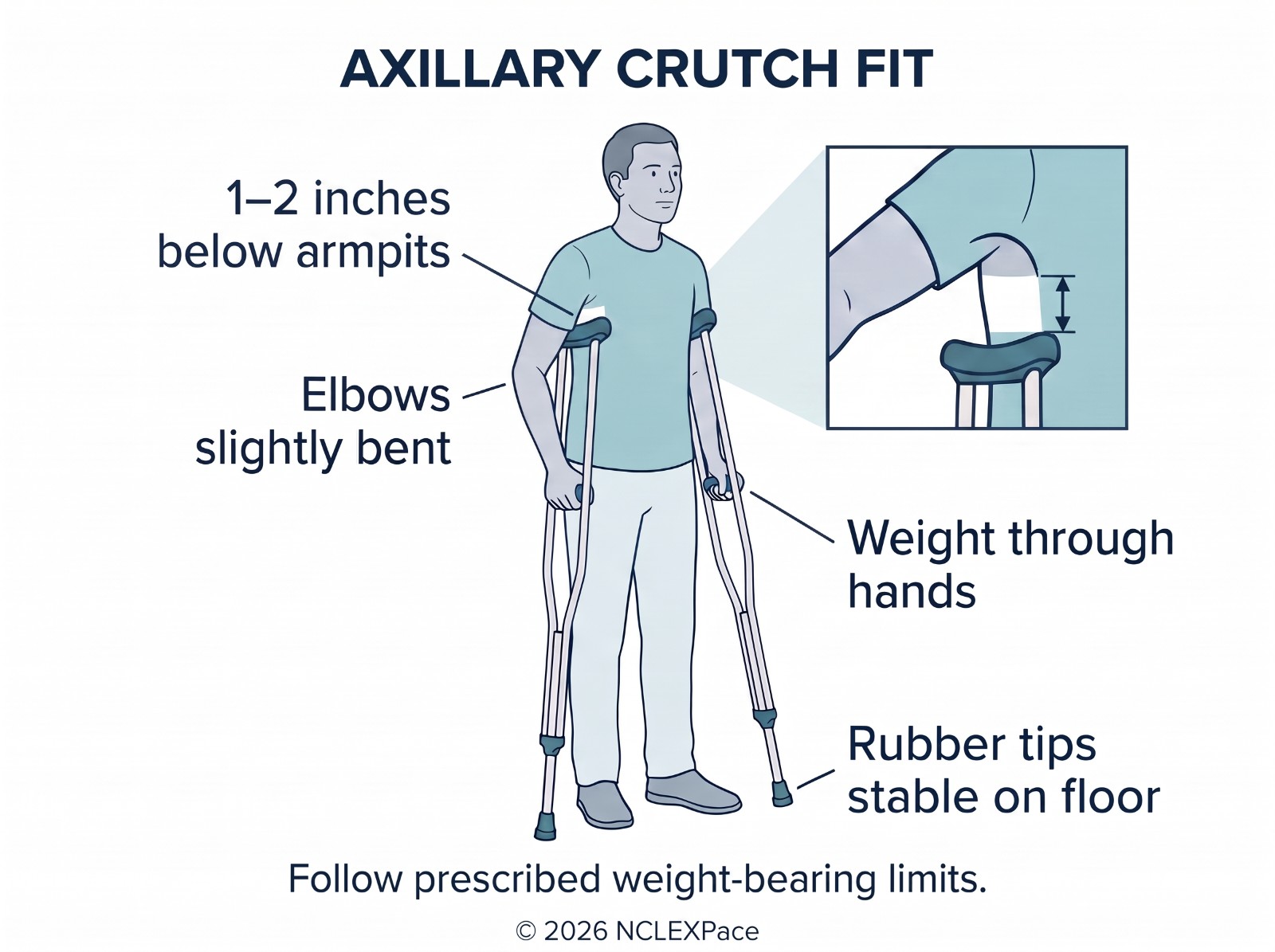
Nursing key points
- Keep 2 to 3 finger widths between each axilla and crutch pad while standing.
- Support body weight through the handgrips with elbows slightly flexed.
- Wear flat, closed, well-fitting shoes with nonslip soles.
- Remove loose rugs, cords, and clutter from walking routes.
- Inspect rubber tips and other crutch components before each use.
- Practice controlled gait and therapist-taught fall responses while following weight-bearing restrictions.
Answer analysis
| Client instruction | Rationale |
|---|---|
| Take short steps and look ahead rather than at your feet | Include. Short, controlled steps and forward visual scanning improve balance. |
| Rest your armpits on the crutch pads when you stand still for a while | Do not include. Axillary weight bearing compresses nerves and causes crutch palsy. |
| Support your weight on your hands, not your armpits | Include. Handgrip support protects the axillary neurovascular structures. |
| Remove loose rugs and cords from walkways | Include. Clearing obstacles reduces falls from tripping and slipping crutch tips. |
| Wear slippers or soft sandals so the feet stay comfortable | Do not include. Loose footwear reduces traction and increases fall risk. |
| If you begin to fall, throw the crutches to the side and try to land relaxed | Include. Releasing the crutches during an unavoidable fall reduces the risk of landing on them; practice the response with a therapist. |
| Check that the rubber tips are intact and not worn before each use | Include. Intact rubber tips provide traction and prevent slipping. |
The NCLEXPace bank has 3,200+ NCLEX questions with full rationales, sorted by topic, with your progress tracked as you practice. Create your account to start.
Create Account →More topics in Medical-Surgical
Lyme Disease NCLEX Questions With RationalesCovers Lyme disease stages, clinical manifestations, doxycycline treatment, tick removal, nursing priorities, and prevention.Influenza NCLEX Questions With RationalesReviews seasonal influenza symptoms, high-risk groups, antiviral treatment, isolation, vaccination, complications, and nursing care.Atopic Dermatitis (Eczema) NCLEX Questions With RationalesReviews childhood eczema manifestations, age-related distribution, triggers, skin care, topical medications, infection prevention, and parent education.Sources
3,200+ NCLEX questions with think-like-a-nurse rationales, unfolding case studies and adaptive readiness exams. Start with free practice questions, then choose a plan when you are ready.
Create Account →