Crohn Disease and Ulcerative Colitis NCLEX Questions With Rationales
What it is
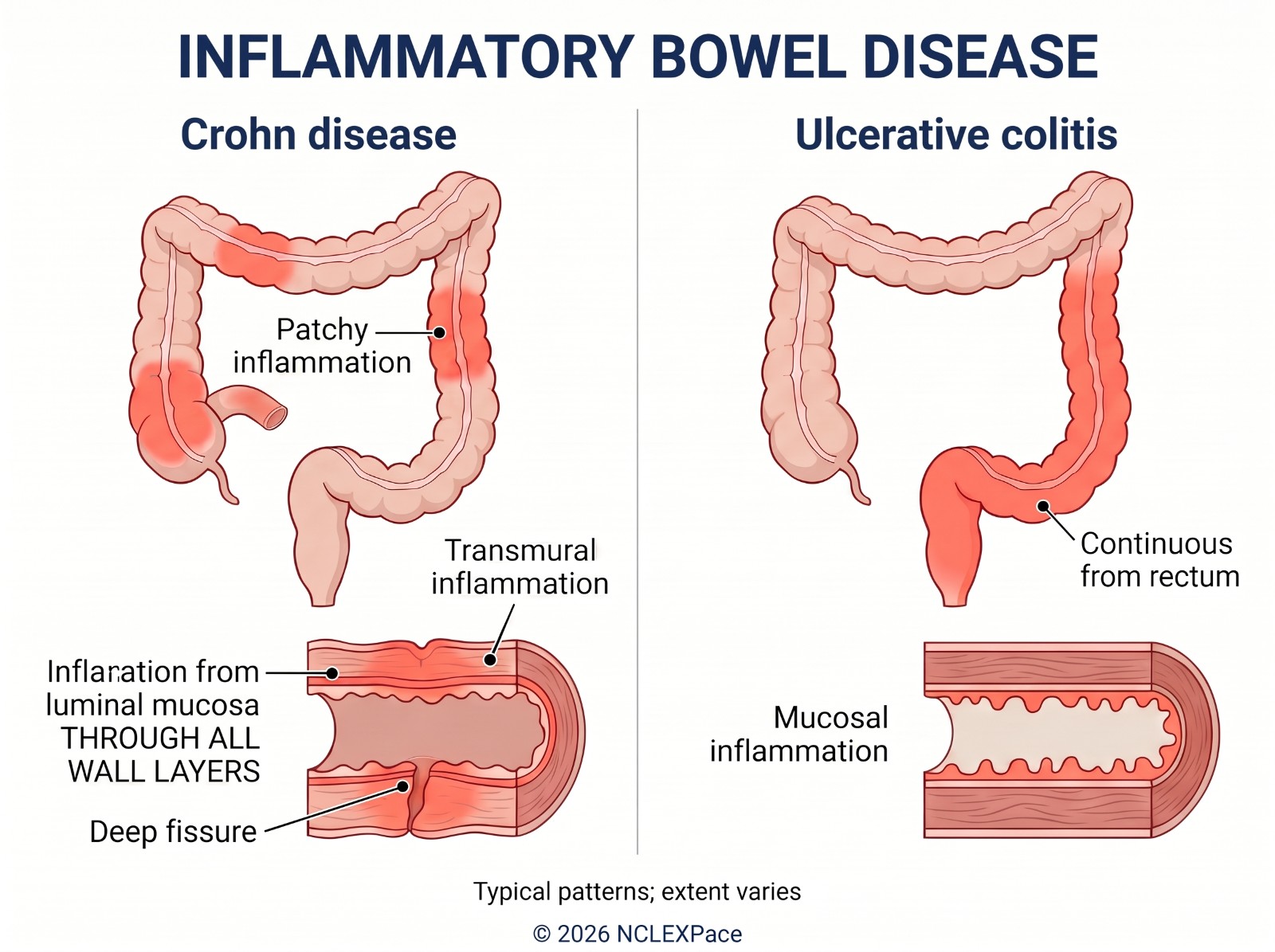
Crohn disease and ulcerative colitis are chronic inflammatory bowel diseases that cause intestinal inflammation, recurring flares, and periods of remission. Crohn disease can affect any part of the digestive tract, commonly the terminal ileum and colon, with inflammation extending through the bowel wall. Ulcerative colitis affects the colon and rectum, usually beginning in the rectum and extending continuously through the inner intestinal lining.
What the NCLEX focuses on
- Crohn disease produces discontinuous areas of inflammation called skip lesions.
- Ulcerative colitis produces continuous inflammation involving the rectum and potentially extending proximally through the colon.
- Crohn disease commonly causes abdominal pain, diarrhea, weight loss, and nutritional deficiencies.
- Ulcerative colitis commonly causes bloody diarrhea, urgency, abdominal cramping, and rectal bleeding.
- Transmural Crohn inflammation can produce strictures, intestinal obstruction, fistulas, and abscesses.
- Severe ulcerative colitis can cause major bleeding, perforation, and toxic megacolon.
- Both disorders increase colorectal cancer risk when chronic inflammation involves the colon.
- Aminosalicylates such as mesalamine are commonly used for mild to moderate ulcerative colitis.
- Corticosteroids treat active inflammation, while selected immunosuppressants and biologic therapies help control disease according to severity.
Priority nursing actions
- Assess immediately for severe abdominal pain, distention, fever, tachycardia, hypotension, or sudden deterioration, and report possible toxic megacolon, perforation, or obstruction.
- Monitor stool frequency, blood loss, abdominal findings, vital signs, intake, output, and signs of dehydration.
- Review prescribed laboratory results, including hemoglobin and electrolytes, and report significant abnormalities.
- Administer prescribed intravenous fluids, electrolyte replacement, corticosteroids, and other indicated medications while monitoring the response.
- Support prescribed nutrition plans, assess weight changes and food tolerance, and provide skin care for frequent diarrhea.
- Monitor for infection and medication adverse effects, particularly when the client receives immunosuppressive treatment.
Numbers to know
| Value | Number | Why it matters |
|---|---|---|
| Fulminant ulcerative colitis | More than 10 bloody stools daily | This severe presentation can occur with fever, tachycardia, and anemia. |
| Crohn colorectal cancer screening | Often 8 to 10 years after diagnosis | Screening is commonly recommended for Crohn disease involving the colon, with timing individualized. |
| Common Crohn colorectal surveillance interval | Every 1 to 5 years | Follow-up depends on individual cancer risk and provider recommendations. |
Common exam traps
- Choosing bloody diarrhea as the defining feature of Crohn disease: wrong because bloody diarrhea is more characteristic of ulcerative colitis, although Crohn disease can also cause bleeding.
- Choosing routine antidiarrheal medication during suspected toxic megacolon: wrong because severe colonic dilation requires emergency assessment and treatment.
- Choosing long-term corticosteroids to maintain remission: wrong because these drugs are generally intended for short-term control of active inflammation.
- Choosing bowel resection as a cure for Crohn disease: wrong because inflammation can recur elsewhere in the digestive tract.
What to teach
- Continue prescribed maintenance medications during remission unless the provider changes treatment.
- Maintain hydration and follow an individualized nutrition plan, since food tolerance varies during flares.
- Discuss nutritional deficiencies and the possible need for iron, vitamin B12, or other supplements with the provider.
- Avoid smoking, and discuss nonsteroidal anti-inflammatory drug use with the provider because these medications can worsen symptoms.
- Seek urgent care for severe pain, abdominal swelling, high fever, heavy bleeding, or inability to pass stool or gas.
- Attend recommended colorectal cancer surveillance and follow-up visits.
2 NCLEX questions with rationales on this topic
From the NCLEXPace question bank. Choose your answer first, then open the correct answer and the full rationale under each question.
A client with inflammatory bowel disease asks what to eat during an acute flare with frequent diarrhea. Which teaching is most appropriate?
Select the best answer.
- A. Increase insoluble fiber from raw vegetables and whole grains to restore normal stool formation.
- B. Eat three large high-calorie meals each day to replace nutrients lost through diarrhea.
- C. Limit oral fluids during meals to reduce intestinal motility and stool frequency.
- D. Choose small, frequent meals and follow the prescribed low-residue plan during the flare.
Show the correct answer and rationale
Correct answer:
- D. Choose small, frequent meals and follow the prescribed low-residue plan during the flare.
Rationale
Overview
- Definition: An inflammatory bowel disease flare is a period of increased intestinal inflammation causing diarrhea, abdominal pain, and impaired nutritional intake.
- Flare diet: Small, frequent meals with adequate protein and calories support nutrition. A prescribed temporary low-residue diet reduces poorly tolerated insoluble fiber. Fluids replace diarrheal losses.
- Remission diet: A varied, balanced diet supports long-term nutrition. Fiber intake is gradually individualized according to symptoms and intestinal complications.
Nursing key points
- Encourage 5 to 6 small meals daily during the flare.
- Follow the prescribed low-residue plan and provide adequate protein and calories.
- Maintain fluids and electrolyte replacement to compensate for diarrhea.
- Limit raw vegetables, nuts, caffeine, and alcohol when they aggravate symptoms.
- Monitor weight and prescribed iron, vitamin B12, folate, and vitamin D supplementation.
- Reintroduce tolerated foods and fiber gradually during remission.
Answer analysis
| Dietary teaching | Rationale |
|---|---|
| Increase insoluble fiber from raw vegetables and whole grains to restore normal stool formation. | Not correct. Excess insoluble fiber increases stool bulk and worsens cramping during active symptoms. |
| Eat three large high-calorie meals each day to replace nutrients lost through diarrhea. | Not correct. Large meals increase gastrointestinal discomfort and are less tolerated during an acute flare. |
| Limit oral fluids during meals to reduce intestinal motility and stool frequency. | Not correct. Inadequate fluid intake worsens dehydration and electrolyte depletion. |
| Choose small, frequent meals and follow the prescribed low-residue plan during the flare. | Correct. Smaller meals and prescribed temporary residue restriction improve dietary tolerance and maintain nutrition. |
The nurse evaluates complications in clients with inflammatory bowel disease.
For each finding, identify the most likely association.
| More consistent with Crohn disease | More consistent with ulcerative colitis | Can occur with either | |
|---|---|---|---|
| A: Stricture causing partial bowel obstruction | |||
| B: Toxic megacolon during severe flare | |||
| C: Perianal fistula and abscess | |||
| D: Fluid and electrolyte imbalance from frequent diarrhea | |||
| E: Anemia from chronic intestinal blood loss |
Show the correct answer and rationale
Correct answers:
- A: Stricture causing partial bowel obstruction: More consistent with Crohn disease
- B: Toxic megacolon during severe flare: More consistent with ulcerative colitis
- C: Perianal fistula and abscess: More consistent with Crohn disease
- D: Fluid and electrolyte imbalance from frequent diarrhea: Can occur with either
- E: Anemia from chronic intestinal blood loss: Can occur with either
Rationale
Overview
- Definition: Inflammatory bowel disease includes Crohn disease and ulcerative colitis, both chronic inflammatory conditions of the gastrointestinal tract.
- Comparison: Crohn disease produces discontinuous, transmural inflammation throughout the gastrointestinal tract. Ulcerative colitis produces continuous mucosal inflammation beginning in the rectum and involving the colon.
- Complications: Crohn disease causes fistulas, abscesses, and strictures. Severe ulcerative colitis is classically associated with toxic megacolon and increased colorectal cancer risk. Both disorders cause anemia, dehydration, and electrolyte loss.
Nursing key points
- Assess Crohn disease for fistula drainage, perianal infection, and obstructive symptoms.
- Report severe abdominal distention, fever, and tachycardia immediately during active colitis.
- Monitor hemoglobin, hematocrit, and iron studies for chronic intestinal blood loss.
- Monitor potassium, sodium, hydration, and urine output during frequent diarrhea.
- Reinforce prescribed colorectal cancer surveillance for longstanding colonic inflammation.
Answer analysis
| Complication | Which disorder? | Why |
|---|---|---|
| A: Stricture causing partial bowel obstruction | More consistent with Crohn disease. | Transmural inflammation and fibrosis narrow the intestinal lumen. |
| B: Toxic megacolon during severe flare | More consistent with ulcerative colitis. | Severe ulcerative colitis is classically associated with acute colonic dilation and systemic toxicity. |
| C: Perianal fistula and abscess | More consistent with Crohn disease. | Transmural inflammation creates fistulous tracts and abscesses. |
| D: Fluid and electrolyte imbalance from frequent diarrhea | Can occur with either. | Both disorders produce diarrheal fluid loss and hypokalemia. |
| E: Anemia from chronic intestinal blood loss | Can occur with either. | Chronic intestinal bleeding produces iron-deficiency anemia in both disorders. |
The NCLEXPace bank has 3,200+ NCLEX questions with full rationales, sorted by topic, with your progress tracked as you practice. Create your account to start.
Create Account →More topics in Medical-Surgical
Lyme Disease NCLEX Questions With RationalesCovers Lyme disease stages, clinical manifestations, doxycycline treatment, tick removal, nursing priorities, and prevention.Influenza NCLEX Questions With RationalesReviews seasonal influenza symptoms, high-risk groups, antiviral treatment, isolation, vaccination, complications, and nursing care.Atopic Dermatitis (Eczema) NCLEX Questions With RationalesReviews childhood eczema manifestations, age-related distribution, triggers, skin care, topical medications, infection prevention, and parent education.Sources
- National Institute of Diabetes and Digestive and Kidney Diseases. Definition and Facts for Crohn's Disease. 2024.
- National Institute of Diabetes and Digestive and Kidney Diseases. Definition and Facts of Ulcerative Colitis. 2020.
- National Institute of Diabetes and Digestive and Kidney Diseases. Treatment for Crohn's Disease. 2024.
- National Institute of Diabetes and Digestive and Kidney Diseases. Treatment for Ulcerative Colitis. 2020.
3,200+ NCLEX questions with think-like-a-nurse rationales, unfolding case studies and adaptive readiness exams. Start with free practice questions, then choose a plan when you are ready.
Create Account →