Colostomy and Ileostomy Care NCLEX Questions With Rationales
What it is
A colostomy brings part of the colon, and an ileostomy brings the ileum (the end of the small intestine), through the abdominal wall to form a stoma that drains stool into a pouch. A stoma has no muscle, so the client cannot control when stool passes. Because the colon absorbs water, an ileostomy carries the highest risk of dehydration.
What the NCLEX focuses on
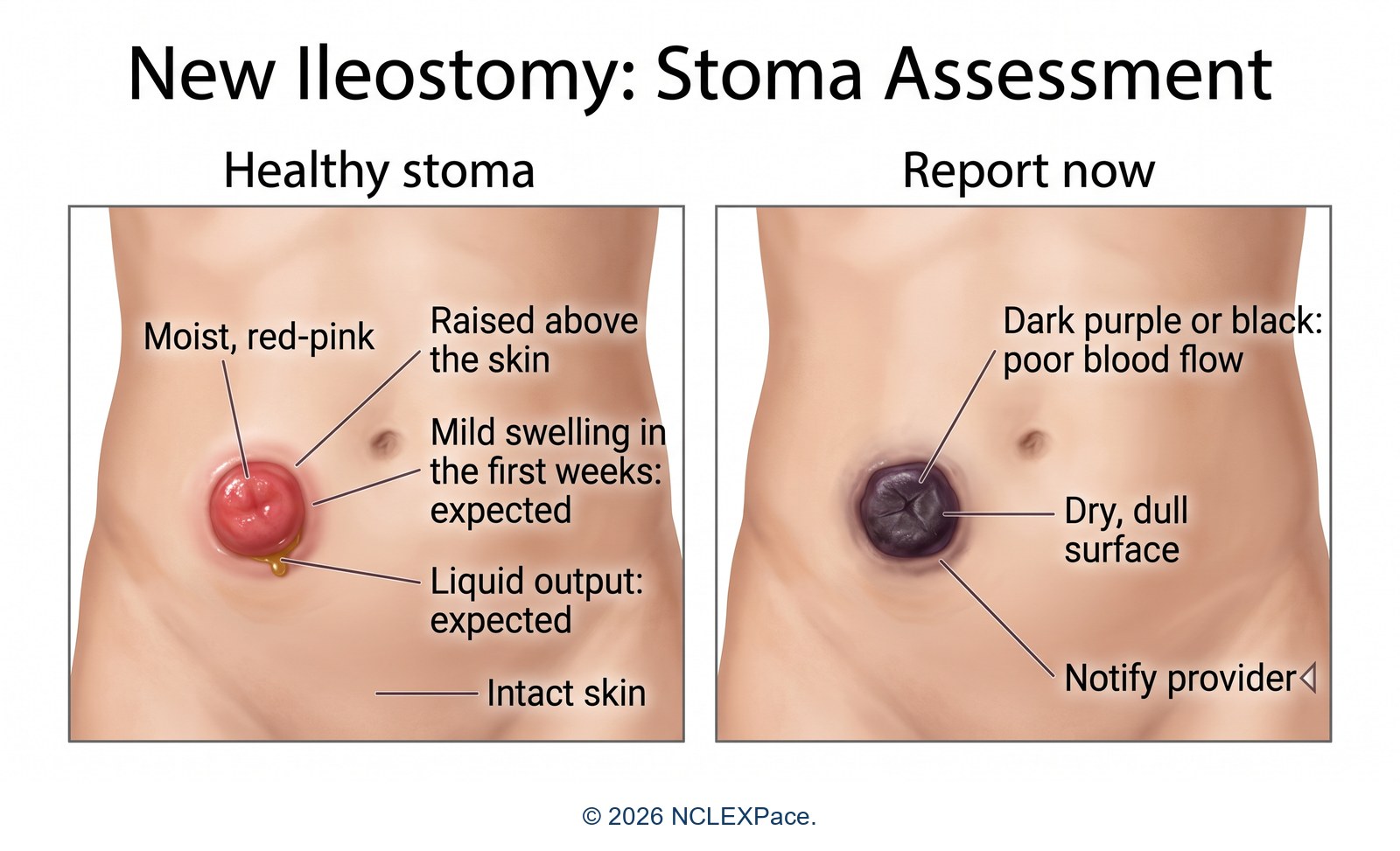
- A healthy stoma is pink or red, moist and shiny; it is swollen after surgery and shrinks over several weeks.
- A purple, blue, black or white stoma signals impaired blood supply and is reported immediately.
- Expected output: ileostomy stool is liquid to pasty; ascending and transverse colostomy stool is soft and loose; descending colostomy stool is firmer and paste-like; sigmoid colostomy stool resembles normal stool.
- The skin barrier opening fits close to the stoma, no more than 1/8 inch larger, so stool does not touch the skin.
- Ileostomy food blockage causes sudden cramping, a swollen stoma, nausea and little or no output.
- Enteric-coated and extended-release drugs may pass through an ileostomy unabsorbed; liquid or immediate-release forms are preferred.
- Irrigation is an option only for selected clients with a descending or sigmoid colostomy.
Priority nursing actions
- Assess stoma color, moisture and height, and the surrounding skin, at every pouch change; report any color change at once.
- Measure output and monitor for dehydration, especially with an ileostomy.
- Empty the pouch when it is one third to one half full.
- Change the pouching system on schedule, and right away if it leaks.
- For suspected blockage, notify the provider and do not give a laxative.
Numbers to know
| Value | Normal or target | Why it matters |
|---|---|---|
| Ileostomy output | About 500 to 700 mL per day | Above 1.5 L per day is excessive and risks dehydration |
| Pouch emptying | One third to one half full | An ileostomy pouch is emptied about 5 to 8 times a day |
| Barrier opening | No more than 1/16 to 1/8 inch larger than the stoma | Protects the skin from stool |
| Wafer change | About every 3 to 7 days, depending on the system | Sooner for leakage or itching |
| No ileostomy output | 4 to 6 hours | Possible blockage; contact the provider right away |
Common exam traps
- Choosing to document a purple or black stoma as expected postoperative swelling: wrong because a color change is reported immediately.
- Choosing to irrigate an ileostomy: wrong because irrigation is only for selected descending or sigmoid colostomies.
- Choosing a laxative for an ileostomy with cramping and no output: wrong because this suggests blockage and the provider must be contacted.
- Choosing to limit fluids to thicken ileostomy output: wrong because dehydration is the main risk.
What to teach
- Chew food well; with an ileostomy, raw pineapple, nuts, seeds, celery, popcorn, corn, dried fruit, mushrooms and coconut can block the stoma.
- Drink 8 to 10 glasses of fluid a day with an ileostomy, and report dry mouth, less urine, lightheadedness or weakness.
- Wash the skin with warm water, pat it dry, and avoid products that contain alcohol or oil.
- Tell every provider and pharmacist about the ileostomy before starting a new medicine.
- Call the provider for a stoma that changes color, pulls in below skin level or bleeds more than usual.
2 NCLEX questions with rationales on this topic
From the NCLEXPace question bank. Choose your answer first, then open the correct answer and the full rationale under each question.
A client with a new ileostomy asks which symptom should be reported promptly after discharge. Which response by the nurse is best?
Select the best answer.
- A. Report dizziness, very low urine output, or a sudden large increase in watery output.
- B. Report liquid ileostomy output because normal output should become formed after recovery.
- C. Reduce oral fluid intake when ileostomy output becomes very watery to decrease losses.
- D. Manage repeated pouch leakage with extra barrier paste until the next scheduled clinic visit.
Show the correct answer and rationale
Correct answer:
- A. Report dizziness, very low urine output, or a sudden large increase in watery output.
Rationale
Overview
- Definition: An ileostomy diverts small-intestinal contents through an abdominal stoma. Output remains liquid to pasty because colonic water absorption is bypassed.
- Hydration: Ileostomy effluent contains water and electrolytes. High output increases dehydration risk. Many adults require approximately 2 to 3 L of daily fluid intake unless restricted.
- When to call: Dizziness, markedly reduced urine output, or a sudden large increase in watery effluent requires prompt assessment.
Nursing key points
- Measure daily ileostomy output. Report output above 1,500 mL/24 hr.
- Drink approximately 2 to 3 L/day as directed, unless fluid restriction is prescribed.
- Use the prescribed oral rehydration solution to replace sodium and water during high-output episodes.
- Report dizziness, reduced urine output, or inability to maintain oral intake promptly.
- Contact the ostomy nurse for repeated pouch leakage and barrier refitting.
Answer analysis
| Nurse's response | Rationale |
|---|---|
| Report dizziness, very low urine output, or a sudden large increase in watery output. | Correct. These findings indicate dehydration risk from excessive intestinal fluid losses. |
| Report liquid ileostomy output because normal output should become formed after recovery. | Not correct. Ileostomy output normally remains liquid to pasty. |
| Reduce oral fluid intake when ileostomy output becomes very watery to decrease losses. | Not correct. Fluid restriction without clinical direction worsens dehydration. |
| Manage repeated pouch leakage with extra barrier paste until the next scheduled clinic visit. | Not correct. Recurrent leakage requires prompt evaluation of the pouching system and barrier fit. |
Select all that apply.
| Requires follow-up | Expected finding | |
|---|---|---|
| The stoma is dark purple and dry. | ||
| The client states, 'I should report dizziness or very low urine output.' | ||
| The stoma is moist and pink-red. | ||
| The pouching system is leaking liquid stool onto peristomal skin. | ||
| The client states, 'I can cut the skin barrier opening much larger than the stoma so it does not touch.' |
Show the correct answer and rationale
Correct answers:
- The stoma is dark purple and dry.: Requires follow-up
- The client states, 'I should report dizziness or very low urine output.': Expected finding
- The stoma is moist and pink-red.: Expected finding
- The pouching system is leaking liquid stool onto peristomal skin.: Requires follow-up
- The client states, 'I can cut the skin barrier opening much larger than the stoma so it does not touch.': Requires follow-up
Rationale
Overview
- Definition: An ileostomy is a surgically created opening of the ileum through the abdominal wall that diverts intestinal contents into an external pouch.
- Stoma assessment: A healthy stoma is moist and pink to red. Dark purple, black, or dry tissue indicates concern for impaired perfusion or ischemia.
- Pouch care and hydration: Liquid enzyme-rich effluent requires a secure pouch seal and close skin barrier fit. High ileostomy output increases dehydration and electrolyte loss risk.
Nursing key points
- Assess stoma color, moisture, edema, and perfusion regularly during the immediate postoperative period.
- Report a dark purple, black, dusky, or dry stoma immediately.
- Measure the stoma and cut the skin barrier opening no more than 1/8 inch (3 mm) larger than the stoma.
- Replace leaking pouching systems promptly and protect peristomal skin from liquid effluent.
- Monitor ileostomy output, urine output, hydration, and serum electrolytes, including potassium.
- Teach the client to report dizziness, decreased urine output, or a marked increase in ileostomy output.
Answer analysis
| Finding or teaching point | Requires follow-up or expected? | Why |
|---|---|---|
| The stoma is dark purple and dry. | Requires follow-up. | Discoloration and dryness indicate concern for impaired perfusion and tissue ischemia. |
| The client states, 'I should report dizziness or very low urine output.' | Expected finding. | This statement demonstrates correct recognition of dehydration warning signs. |
| The stoma is moist and pink-red. | Expected finding. | Moist pink-red tissue indicates adequate stoma perfusion. |
| The pouching system is leaking liquid stool onto peristomal skin. | Requires follow-up. | Ileostomy effluent damages exposed skin and requires immediate pouch correction. |
| The client states, 'I can cut the skin barrier opening much larger than the stoma so it does not touch.' | Requires follow-up. | An oversized opening exposes peristomal skin to damaging effluent. |
The NCLEXPace bank has 3,200+ NCLEX questions with full rationales, sorted by topic, with your progress tracked as you practice. Create your account to start.
Create Account →More topics in Medical-Surgical
Lyme Disease NCLEX Questions With RationalesCovers Lyme disease stages, clinical manifestations, doxycycline treatment, tick removal, nursing priorities, and prevention.Influenza NCLEX Questions With RationalesReviews seasonal influenza symptoms, high-risk groups, antiviral treatment, isolation, vaccination, complications, and nursing care.Atopic Dermatitis (Eczema) NCLEX Questions With RationalesReviews childhood eczema manifestations, age-related distribution, triggers, skin care, topical medications, infection prevention, and parent education.Sources
- MedlinePlus (NIH). Ileostomy - caring for your stoma. Reviewed 2026.
- MedlinePlus (NIH). Ileostomy - discharge. Reviewed 2026.
- StatPearls, NCBI Bookshelf (NIH). Colostomy Care. Last update 2023.
- National Institute of Diabetes and Digestive and Kidney Diseases (NIH). Ostomy Surgery of the Bowel. Last reviewed 2021.
3,200+ NCLEX questions with think-like-a-nurse rationales, unfolding case studies and adaptive readiness exams. Start with free practice questions, then choose a plan when you are ready.
Create Account →