Chronic Kidney Disease NCLEX Questions With Rationales
What it is
Chronic kidney disease (CKD) is an abnormality of kidney structure or function that is present for at least 3 months and affects health. It is identified by a glomerular filtration rate (GFR) below 60 mL/min/1.73 m² or by markers of kidney damage, such as albuminuria (urine albumin-to-creatinine ratio of 30 mg/g or higher). Diabetes and hypertension are the most common causes in adults.
What the NCLEX focuses on
- CKD is classified by GFR category (G1 to G5) and albuminuria category (A1 to A3).
- Sodium and water retention cause edema, hypertension and, in fluid overload, heart failure.
- Hyperkalemia and metabolic acidosis develop as the kidneys lose the ability to excrete potassium and acid.
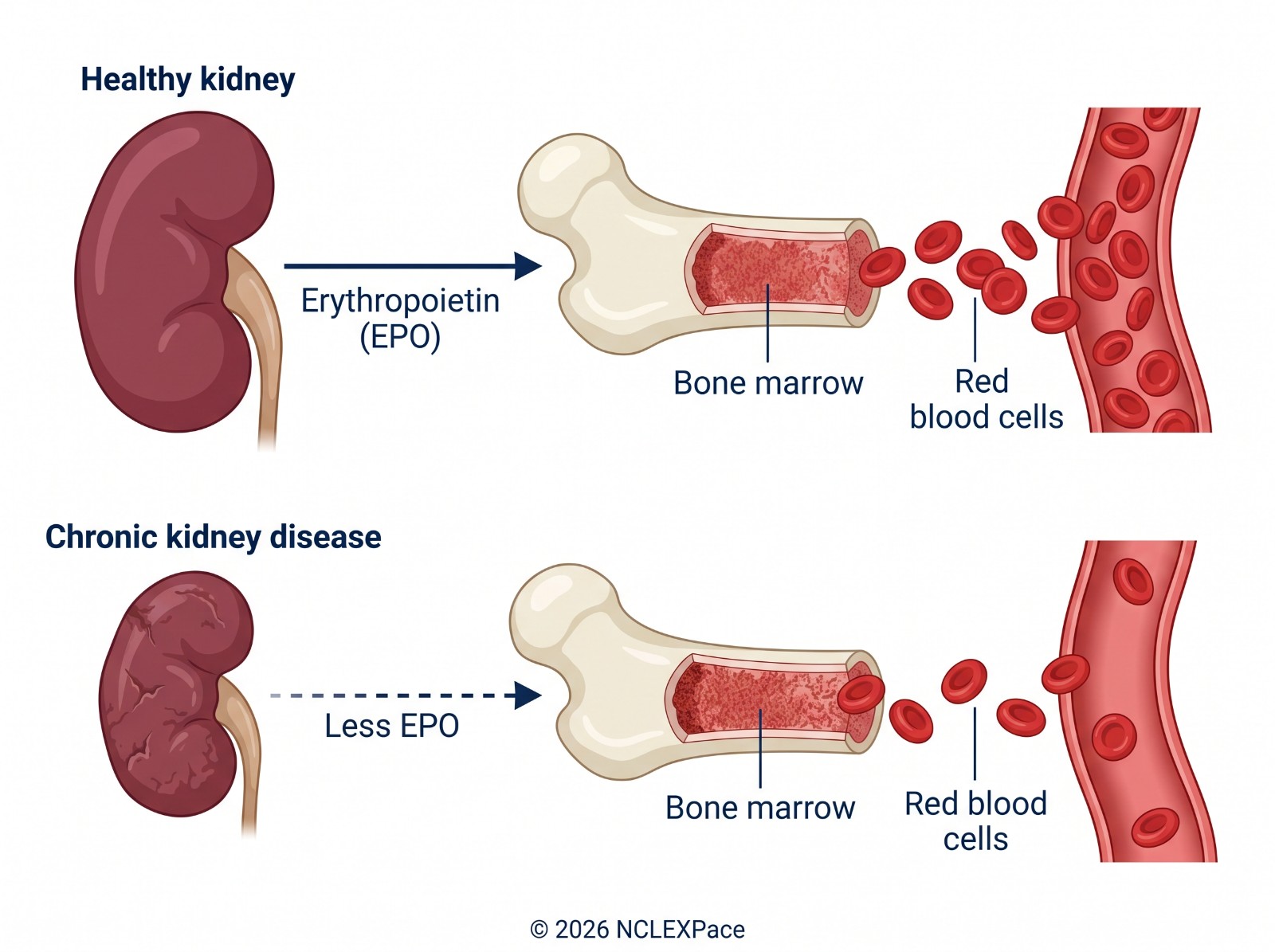
- Anemia results from reduced erythropoietin production by the damaged kidneys.
- Phosphorus rises and vitamin D is no longer activated, so calcium falls and parathyroid hormone pulls calcium from the bones (mineral and bone disorder).
- Phosphate binders are taken with each meal so they bind the phosphorus in food.
- NSAIDs such as ibuprofen and naproxen are avoided because they can damage the kidneys.
- Magnesium-containing antacids and laxatives and aluminum-containing antacids are avoided because failing kidneys cannot excrete the magnesium or aluminum.
- Arm veins are protected for future dialysis access: blood draws and IV lines go below the wrist, such as the back of the hand.
Priority nursing actions
- Assess fluid status: daily weight, intake and output, blood pressure, edema and lung sounds.
- Review potassium, bicarbonate, phosphorus, calcium and hemoglobin results, and report a potassium above 6 mEq/L immediately.
- Give phosphate binders with meals and other prescribed medications on schedule.
- Check the medication list for NSAIDs, magnesium or aluminum products and salt substitutes, and clarify them with the provider.
Numbers to know
| GFR category | GFR (mL/min/1.73 m²) | Description |
|---|---|---|
| G1 | 90 or higher | Normal or high; CKD only if kidney damage is present |
| G2 | 60 to 89 | Mildly decreased; CKD only if kidney damage is present |
| G3a | 45 to 59 | Mildly to moderately decreased |
| G3b | 30 to 44 | Moderately to severely decreased |
| G4 | 15 to 29 | Severely decreased |
| G5 | Below 15 | Kidney failure |
Other numbers: the suggested sodium intake is below 2 g per day, and the suggested protein intake is 0.8 g/kg per day for adults with CKD G3 to G5.
Common exam traps
- Choosing to rule out CKD because the GFR is 75: wrong because albuminuria that persists for 3 months meets the definition by itself.
- Choosing a salt substitute to lower sodium intake: wrong because salt substitutes can be high in potassium.
- Choosing to give the phosphate binder between meals: wrong because it must be present with food to bind phosphorus.
- Choosing magnesium hydroxide for constipation: wrong because hypermagnesemia occurs most often in kidney failure after magnesium-containing medications.
- Choosing a forearm vein for a routine IV: wrong because a damaged arm vein may not be usable for dialysis.
What to teach
- Follow the prescribed limits for sodium, potassium, phosphorus, protein and fluid; the amounts depend on kidney function.
- Limit packaged and processed foods with added phosphorus, and drain canned fruits and vegetables.
- Season food with herbs and spices instead of salt or salt substitutes.
- Ask the provider or pharmacist before taking any over-the-counter medicine, antacid, laxative or supplement.
2 NCLEX questions with rationales on this topic
From the NCLEXPace question bank. Choose your answer first, then open the correct answer and the full rationale under each question.
Select the best answer.
- A. The kidneys no longer produce enough erythropoietin
- B. Chronic microscopic urinary blood loss associated with progressive renal tissue damage
- C. Long-term dietary protein restriction reduces amino acid availability enough to suppress hemoglobin production
- D. Uremic toxins rapidly destroy circulating red blood cells within several days of entering the bloodstream
Show the correct answer and rationale
Correct answer:
- A. The kidneys no longer produce enough erythropoietin
Rationale
Overview
- Definition: Anemia of chronic kidney disease is a reduction in red blood cell production caused primarily by decreased renal erythropoietin synthesis. It is typically normocytic and normochromic.
- Mechanism: Erythropoietin stimulates red blood cell production in bone marrow. Advanced kidney damage decreases erythropoietin production. Iron deficiency, dialysis-related blood loss, and shortened red blood cell survival contribute.
- Treatment and monitoring: Correct iron deficiency and administer prescribed erythropoiesis-stimulating agents such as epoetin alfa. Monitor hemoglobin, iron status, and blood pressure. An individualized target around 10 to 11 g/dL is commonly used, with avoidance of unnecessarily high hemoglobin.
Nursing key points
- Assess fatigue, pallor, activity intolerance, and hemoglobin trends.
- Review ferritin and transferrin saturation before initiating or adjusting iron therapy.
- Administer prescribed iron replacement and epoetin alfa according to the treatment plan.
- Monitor hemoglobin and blood pressure during erythropoiesis-stimulating agent therapy.
- Follow the prescribed hemoglobin target and hold parameters; report uncontrolled hypertension or excessive hemoglobin elevation.
- Monitor for thromboembolic complications and other adverse effects of erythropoiesis-stimulating agents.
Answer analysis
| Proposed mechanism | Rationale |
|---|---|
| The kidneys no longer produce enough erythropoietin | Correct. Decreased erythropoietin reduces bone marrow stimulation and red blood cell production. |
| Chronic microscopic urinary blood loss associated with progressive renal tissue damage | Not correct. Chronic microscopic urinary blood loss is not the primary mechanism of anemia in advanced CKD. |
| Long-term dietary protein restriction reduces amino acid availability enough to suppress hemoglobin production | Not correct. Appropriate protein restriction does not explain the characteristic erythropoietin-deficiency anemia. |
| Uremic toxins rapidly destroy circulating red blood cells within several days of entering the bloodstream | Not correct. Shortened red blood cell survival contributes to anemia, but rapid destruction within days is not the primary mechanism. |
| Expected in CKD | Unexpected, investigate | |
|---|---|---|
| Potassium 5.9 mEq/L | ||
| Glucose 38 mg/dL | ||
| Phosphorus 6.8 mg/dL with calcium 7.6 mg/dL | ||
| Hemoglobin 9.4 g/dL | ||
| White blood cells 22,000/µL with fever | ||
| BUN 88 mg/dL with creatinine 8.2 mg/dL |
Show the correct answer and rationale
Correct answers:
- Potassium 5.9 mEq/L: Expected in CKD
- Glucose 38 mg/dL: Unexpected, investigate
- Phosphorus 6.8 mg/dL with calcium 7.6 mg/dL: Expected in CKD
- Hemoglobin 9.4 g/dL: Expected in CKD
- White blood cells 22,000/µL with fever: Unexpected, investigate
- BUN 88 mg/dL with creatinine 8.2 mg/dL: Expected in CKD
Rationale
Overview
- Definition: Stage 5 chronic kidney disease (CKD) is kidney failure with an estimated glomerular filtration rate (eGFR) below 15 mL/min/1.73 m². Reduced kidney function causes electrolyte disturbances, anemia, and accumulation of nitrogenous waste.
- Electrolyte changes: Reduced potassium and phosphorus excretion causes hyperkalemia and hyperphosphatemia. Reduced vitamin D activation decreases intestinal calcium absorption and contributes to hypocalcemia.
- Anemia and azotemia: Reduced erythropoietin production causes anemia. Reduced filtration increases blood urea nitrogen (BUN) and creatinine.
- Unexpected findings: Severe hypoglycemia requires immediate treatment and medication review. Leukocytosis with fever indicates an infectious process that requires prompt investigation.
Nursing key points
- Review potassium immediately. Obtain ECG monitoring and report potassium above 6.0 mEq/L or ECG changes as an emergency.
- Assess calcium, phosphorus, hemoglobin, BUN, and creatinine trends. Expected abnormalities still require treatment.
- Treat glucose of 38 mg/dL immediately using the hypoglycemia protocol. Recheck glucose after 15 minutes and review insulin dosing.
- Report WBC 22,000/µL with fever promptly. Obtain prescribed cultures and administer antibiotics without unnecessary delay.
- Assess for uremic symptoms, fluid overload, and indications for kidney replacement therapy.
Answer analysis
| Laboratory finding | Expected in CKD or unexpected | Why |
|---|---|---|
| Potassium 5.9 mEq/L | Expected in CKD. | Reduced renal potassium excretion causes hyperkalemia. This value requires prompt monitoring and treatment review. |
| Glucose 38 mg/dL | Unexpected, investigate. | Severe hypoglycemia requires immediate treatment. Reduced renal insulin clearance increases the risk during insulin therapy. |
| Phosphorus 6.8 mg/dL with calcium 7.6 mg/dL | Expected in CKD. | Phosphorus retention and reduced vitamin D activation cause hyperphosphatemia and hypocalcemia. |
| Hemoglobin 9.4 g/dL | Expected in CKD. | Reduced erythropoietin production decreases red blood cell production. |
| White blood cells 22,000/µL with fever | Unexpected, investigate. | Leukocytosis with fever indicates infection and requires prompt evaluation. |
| BUN 88 mg/dL with creatinine 8.2 mg/dL | Expected in CKD. | Severely reduced glomerular filtration causes accumulation of nitrogenous waste. |
The NCLEXPace bank has 3,200+ NCLEX questions with full rationales, sorted by topic, with your progress tracked as you practice. Create your account to start.
Create Account →More topics in Medical-Surgical
Lyme Disease NCLEX Questions With RationalesCovers Lyme disease stages, clinical manifestations, doxycycline treatment, tick removal, nursing priorities, and prevention.Influenza NCLEX Questions With RationalesReviews seasonal influenza symptoms, high-risk groups, antiviral treatment, isolation, vaccination, complications, and nursing care.Atopic Dermatitis (Eczema) NCLEX Questions With RationalesReviews childhood eczema manifestations, age-related distribution, triggers, skin care, topical medications, infection prevention, and parent education.Sources
- Kidney Disease: Improving Global Outcomes (KDIGO) CKD Work Group. KDIGO 2024 Clinical Practice Guideline for the Evaluation and Management of Chronic Kidney Disease. Kidney International; 2024.
- National Institute of Diabetes and Digestive and Kidney Diseases (NIH). Healthy Eating for Adults with Chronic Kidney Disease. 2025.
- StatPearls, NCBI Bookshelf (NIH). Chronic Kidney Disease. 2024.
- National Institute of Diabetes and Digestive and Kidney Diseases (NIH). Hemodialysis. 2018.
3,200+ NCLEX questions with think-like-a-nurse rationales, unfolding case studies and adaptive readiness exams. Start with free practice questions, then choose a plan when you are ready.
Create Account →