Cholecystitis NCLEX Questions With Rationales
What it is
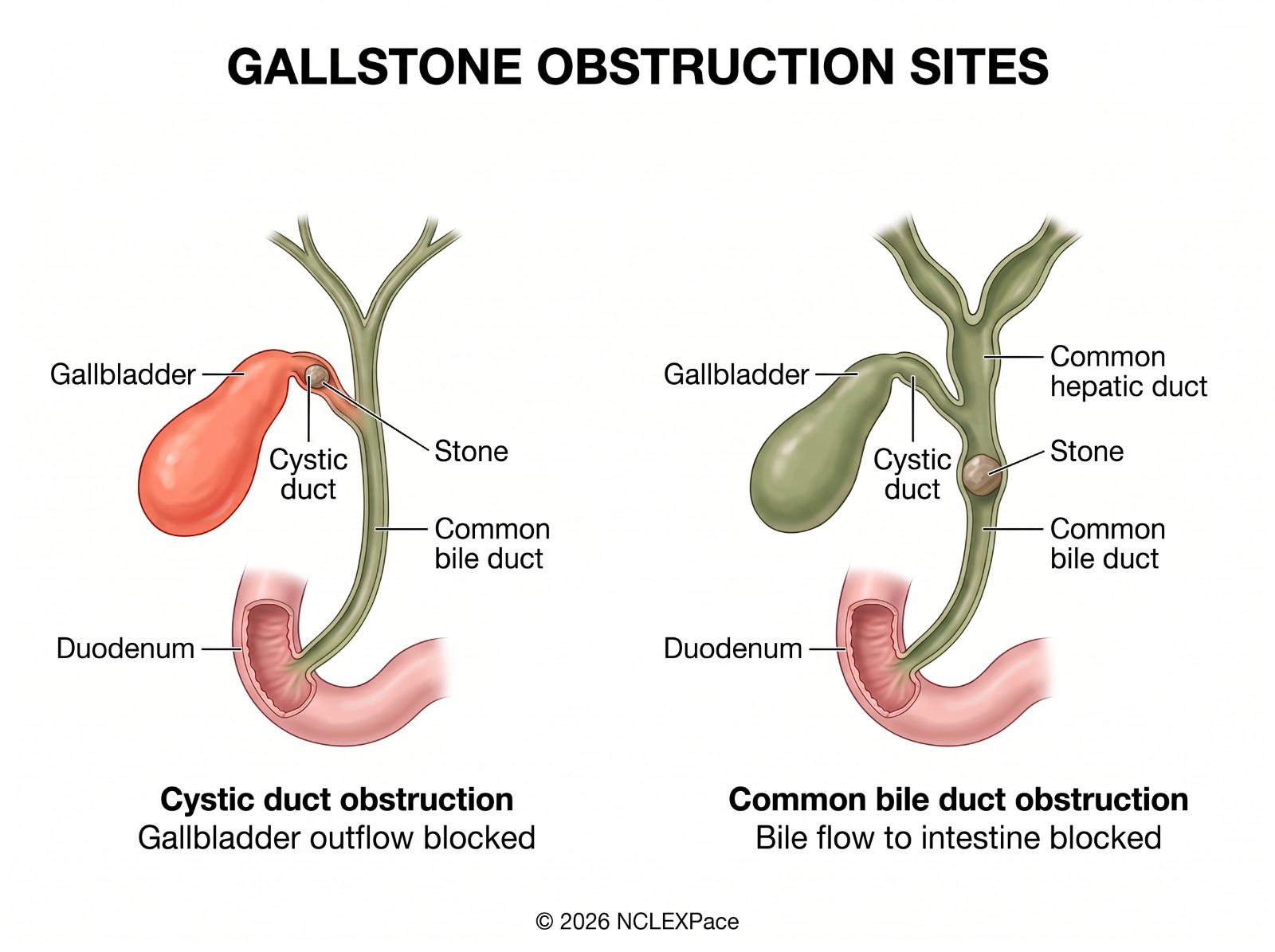
Acute cholecystitis is inflammation of the gallbladder, usually caused by a gallstone obstructing the cystic duct. Gallstones are solid deposits that form in the gallbladder and may obstruct bile flow. Acute ascending cholangitis is infection and inflammation of the bile ducts associated with biliary obstruction and requires emergency treatment.
What the NCLEX focuses on
- Acute cholecystitis commonly produces persistent right upper quadrant abdominal pain, nausea, vomiting, and fever.
- Pain may radiate to the right shoulder blade or upper back.
- A positive Murphy sign occurs when right upper quadrant palpation during inspiration causes pain and interrupts inspiration.
- Abdominal ultrasonography is a primary diagnostic test for suspected acute cholecystitis.
- Gallstones are present in at least 90% of clients with acute cholecystitis.
- Fever or chills, abdominal pain, and jaundice suggest acute ascending cholangitis and require emergency evaluation.
- Hypotension or altered mental status accompanying suspected cholangitis suggests severe systemic illness.
- Acute cholecystitis is commonly treated with supportive care and early cholecystectomy when appropriate.
- Shoulder discomfort after laparoscopic surgery can result from residual abdominal insufflation gas.
Priority nursing actions
- Assess vital signs, abdominal pain, hydration, and signs of sepsis or hemodynamic instability.
- Immediately report suspected cholangitis, particularly fever with jaundice, abdominal pain, hypotension, or confusion.
- Maintain prescribed fasting status and administer ordered intravenous fluids, analgesics, and antibiotics.
- Prepare the client for ordered imaging, surgical treatment, or urgent biliary drainage when indicated.
- After surgery, monitor breathing, circulation, abdominal findings, incision sites, pain, and tolerance of oral intake.
- Encourage prescribed early ambulation and monitor for postoperative complications.
Numbers to know
| Value | Number | Why it matters |
|---|---|---|
| Typical pain duration | Greater than 6 hours | Persistent pain supports acute cholecystitis rather than uncomplicated biliary colic. |
| Gallstone association | At least 90% | Most acute cases involve gallstones. |
| Expected shoulder pain improvement | 24 to 48 hours | Residual gas discomfort commonly improves during this period. |
| Postoperative fever requiring reporting | Above 101°F (38.3°C) | May indicate infection or another complication. |
Common exam traps
- Choosing routine outpatient observation for fever, jaundice, and right upper quadrant pain: wrong because this combination suggests emergency cholangitis.
- Choosing to ignore worsening abdominal pain after surgery: wrong because bleeding, bile leakage, or infection may be present.
- Choosing to classify every episode of postoperative shoulder pain as a surgical complication: wrong because residual insufflation gas commonly causes temporary shoulder discomfort.
- Choosing a high-fat meal during symptomatic gallbladder disease: wrong because fatty foods may provoke biliary symptoms.
What to teach
- Avoid greasy or high-fat foods that trigger symptoms, and follow the prescribed postoperative diet.
- Walk regularly after laparoscopic surgery and increase activity gradually as tolerated.
- Follow incision care instructions and avoid heavy lifting until cleared by the surgeon.
- Report fever, worsening abdominal pain, persistent vomiting, jaundice, gray stools, or abnormal wound drainage promptly.
- Explain that temporary shoulder discomfort may occur from surgical gas but should improve rather than worsen.
- Attend the scheduled postoperative follow-up appointment.
2 NCLEX questions with rationales on this topic
From the NCLEXPace question bank. Choose your answer first, then open the correct answer and the full rationale under each question.
A client with known gallstones reports right upper quadrant pain. The nurse notes fever, chills, jaundice, and dark urine. Which complication should the nurse suspect?
Select the best answer.
- A. Acute cholecystitis without common bile duct involvement
- B. Acute viral hepatitis causing hepatocellular inflammation
- C. Acute cholangitis from biliary obstruction
- D. Gallstone pancreatitis without biliary tract infection
Show the correct answer and rationale
Correct answer:
- C. Acute cholangitis from biliary obstruction
Rationale
Overview
- Definition: Acute cholangitis is a bacterial infection of the biliary ducts associated with biliary obstruction, commonly caused by gallstones. Untreated infection progresses to sepsis and septic shock.
- Signs and symptoms: Charcot triad consists of right upper quadrant pain, fever with chills, and jaundice. Dark urine results from increased urinary excretion of conjugated bilirubin. Reynolds pentad adds hypotension and altered mental status, indicating severe cholangitis with systemic deterioration.
- Treatment: Obtain blood cultures, administer prescribed IV antibiotics and fluids, and arrange urgent biliary drainage by endoscopic retrograde cholangiopancreatography (ERCP), generally within 24 to 48 hours and sooner in severe shock.
Nursing key points
- Recognize right upper quadrant pain, fever with chills, and jaundice as Charcot triad.
- Assess blood pressure and mental status for Reynolds pentad.
- Monitor temperature, heart rate, blood pressure, and urine output for sepsis.
- Obtain prescribed blood cultures before antibiotics without delaying treatment.
- Prepare for IV antibiotics, fluid resuscitation, and urgent ERCP drainage.
Answer analysis
| Suspected complication | Rationale |
|---|---|
| Acute cholecystitis without common bile duct involvement | Not correct. Isolated gallbladder inflammation does not explain the complete Charcot triad. |
| Acute viral hepatitis causing hepatocellular inflammation | Not correct. The combination of gallstones and Charcot triad identifies biliary infection. |
| Acute cholangitis from biliary obstruction | Correct. Right upper quadrant pain, fever with chills, and jaundice form Charcot triad. |
| Gallstone pancreatitis without biliary tract infection | Not correct. This presentation identifies infection of the obstructed biliary system. |
The nurse provides discharge teaching after laparoscopic cholecystectomy. Which instructions are appropriate?
Select all that apply.
- A. Report fever, worsening abdominal pain, jaundice, or persistent vomiting.
- B. Resume very high-fat meals immediately to test bile flow.
- C. Follow activity and incision-care instructions from the surgical team.
- D. Expect shoulder discomfort from retained gas to improve as recovery progresses.
- E. Ignore increasing redness or drainage at an incision if pain is mild.
Show the correct answer and rationale
Correct answers:
- A. Report fever, worsening abdominal pain, jaundice, or persistent vomiting.
- C. Follow activity and incision-care instructions from the surgical team.
- D. Expect shoulder discomfort from retained gas to improve as recovery progresses.
Rationale
Overview
- Definition: Laparoscopic cholecystectomy is minimally invasive surgical removal of the gallbladder through small abdominal incisions.
- Expected recovery: Residual carbon dioxide used during surgery irritates the diaphragm and causes referred shoulder discomfort, usually improving within 24 to 48 hours. Early ambulation promotes recovery.
- Warning signs: Fever, worsening abdominal pain, jaundice, persistent vomiting, and increasing incision redness or drainage indicate postoperative complications requiring assessment.
Nursing key points
- Explain that referred shoulder discomfort from residual carbon dioxide generally improves within 24 to 48 hours.
- Encourage short, frequent walks and gradual activity according to surgical instructions.
- Teach prescribed incision care and activity restrictions, including lifting and driving.
- Resume food as tolerated using smaller meals and temporarily limiting high-fat foods.
- Report fever, worsening abdominal pain, jaundice, persistent vomiting, or increasing incision redness or drainage.
Answer analysis
| Discharge instruction | Rationale |
|---|---|
| Report fever, worsening abdominal pain, jaundice, or persistent vomiting. | Include. These findings indicate possible infection, bile leakage, or biliary obstruction. |
| Resume very high-fat meals immediately to test bile flow. | Do not include. High-fat meals increase postoperative gastrointestinal discomfort and diarrhea. |
| Follow activity and incision-care instructions from the surgical team. | Include. Prescribed wound care and gradual activity promote safe recovery. |
| Expect shoulder discomfort from retained gas to improve as recovery progresses. | Include. Residual carbon dioxide irritates the diaphragm and causes temporary referred shoulder pain. |
| Ignore increasing redness or drainage at an incision if pain is mild. | Do not include. Increasing redness or drainage indicates possible wound infection and requires assessment. |
The NCLEXPace bank has 3,200+ NCLEX questions with full rationales, sorted by topic, with your progress tracked as you practice. Create your account to start.
Create Account →More topics in Medical-Surgical
Lyme Disease NCLEX Questions With RationalesCovers Lyme disease stages, clinical manifestations, doxycycline treatment, tick removal, nursing priorities, and prevention.Influenza NCLEX Questions With RationalesReviews seasonal influenza symptoms, high-risk groups, antiviral treatment, isolation, vaccination, complications, and nursing care.Atopic Dermatitis (Eczema) NCLEX Questions With RationalesReviews childhood eczema manifestations, age-related distribution, triggers, skin care, topical medications, infection prevention, and parent education.Sources
- Merck Manual Professional Edition. Acute Cholecystitis. 2025.
- Merck Manual Professional Edition. Choledocholithiasis and Cholangitis. 2025.
- NIH MedlinePlus. Gallbladder Removal, Laparoscopic, Discharge. 2026.
- Society of American Gastrointestinal and Endoscopic Surgeons. Gallbladder Removal Surgery (Cholecystectomy). 2026.
3,200+ NCLEX questions with think-like-a-nurse rationales, unfolding case studies and adaptive readiness exams. Start with free practice questions, then choose a plan when you are ready.
Create Account →