Addison Disease NCLEX Questions With Rationales
What it is
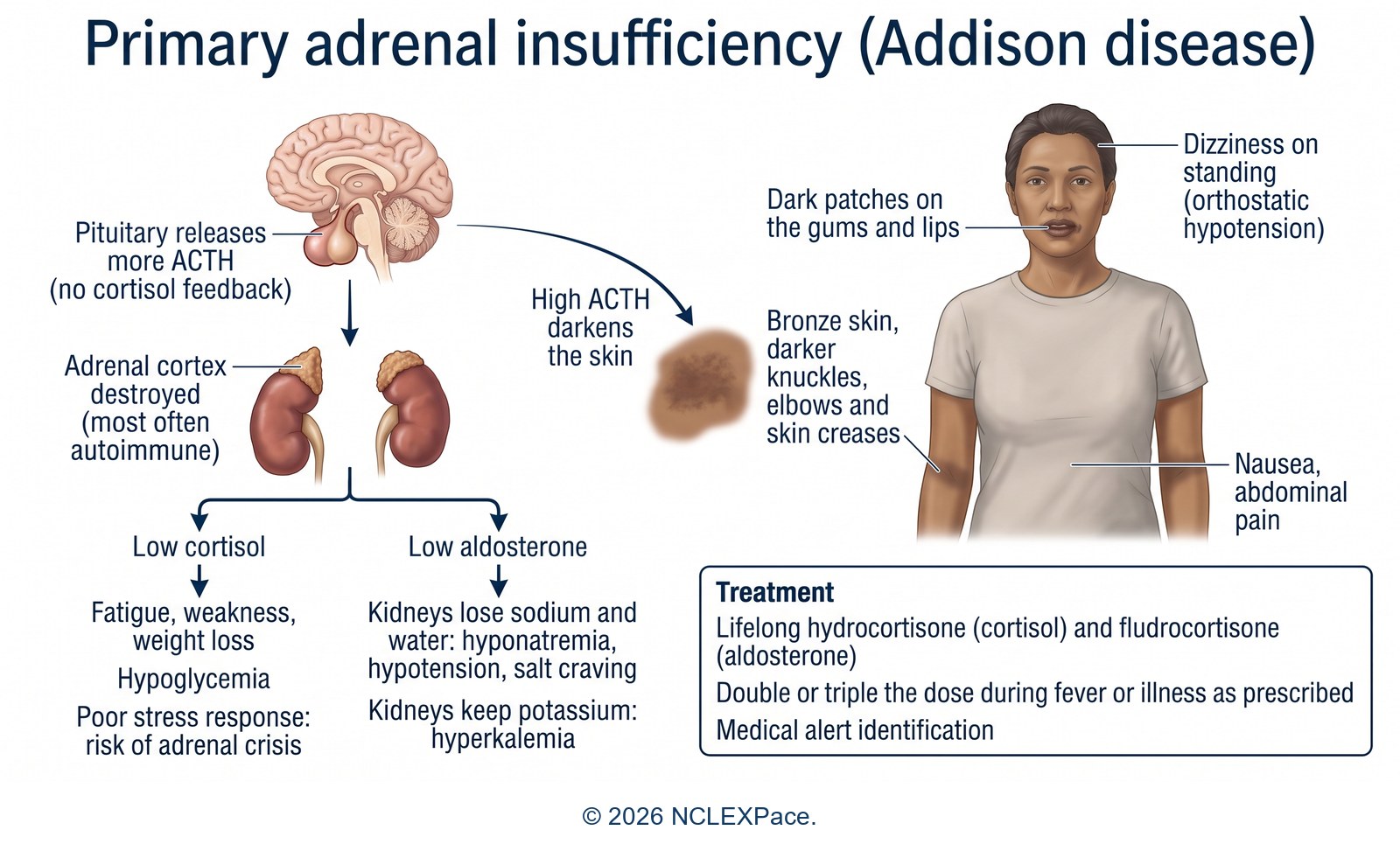
Addison disease is primary adrenal insufficiency: the adrenal cortex is damaged and cannot make enough cortisol and aldosterone. Autoimmune destruction is the most common cause. Adrenal crisis is the life-threatening form, with severe hypotension and shock, and it occurs when a physical stress such as infection, injury or surgery is not covered by extra glucocorticoid. Suddenly stopping long-term corticosteroid therapy also causes adrenal insufficiency.
What the NCLEX focuses on
- Findings: fatigue, weakness, weight loss, nausea, vomiting, abdominal pain, salt craving and orthostatic hypotension.
- Hyperpigmentation of sun-exposed skin, palmar creases and gums is a hallmark of primary adrenal insufficiency, caused by high ACTH; it is absent in secondary adrenal insufficiency.
- Laboratory findings: hyponatremia, hyperkalemia, hypoglycemia, and a low cortisol with a high ACTH.
- Hydrocortisone replaces cortisol and fludrocortisone replaces aldosterone, both for life.
- Adrenal crisis presents with hypotension or shock, severe pain in the abdomen, lower back or legs, vomiting and confusion.
- In crisis, IV hydrocortisone is given immediately and is never delayed for test results.
Priority nursing actions
- Assess blood pressure, heart rate, level of consciousness and blood glucose, and place the client on a cardiac monitor.
- Give hydrocortisone 100 mg IV as prescribed at once.
- Infuse 0.9% sodium chloride rapidly as prescribed, with dextrose to correct hypoglycemia.
- Monitor sodium, potassium and glucose, and watch the ECG for peaked T waves.
- Help identify and treat the trigger, such as infection.
- Before discharge, teach sick day rules and the emergency injection.
Numbers to know
| Value | Normal or target | Why it matters |
|---|---|---|
| Sodium in Addison disease | Below 135 mEq/L | Aldosterone and cortisol deficiency |
| Potassium in Addison disease | Above 5 mEq/L | Aldosterone deficiency; not seen in secondary adrenal insufficiency |
| Morning cortisol | Below 3 mcg/dL | Confirms adrenal insufficiency; above 18 mcg/dL is normal |
| Crisis dose | Hydrocortisone 100 mg IV | Then 200 mg over 24 hours, as a continuous infusion or 50 mg every 6 hours |
| Maintenance hydrocortisone | 15 to 25 mg per day | Given in 2 or 3 divided doses |
| Fludrocortisone | 0.05 to 0.2 mg once daily | Replaces aldosterone |
| Sick day rule | Double the dose for fever above 100.4°F (38°C); triple above 102.2°F (39°C) | Mimics the normal cortisol rise in illness |
Common exam traps
- Choosing hypernatremia and hypokalemia as expected results: wrong because aldosterone deficiency causes sodium loss and potassium retention.
- Choosing to hold hydrocortisone while the client is ill or vomiting: wrong because illness raises the need, and a client who cannot keep tablets down needs the dose by injection.
- Choosing to wait for cortisol results before giving hydrocortisone in suspected crisis: wrong because any delay can be fatal.
- Choosing to stop the steroid when the client feels well: wrong because abrupt withdrawal precipitates adrenal crisis.
- Choosing fludrocortisone as the first drug in crisis: wrong because high-dose hydrocortisone already has mineralocorticoid activity.
What to teach
- Take hydrocortisone and fludrocortisone every day for life; never skip doses or stop suddenly.
- Follow sick day rules: double or triple the oral glucocorticoid dose during fever or illness, as instructed.
- If vomiting prevents keeping tablets down, give the emergency hydrocortisone injection (100 mg IM) and get emergency care.
- Carry the injection at all times, and wear a medical alert tag or carry a card.
- Keep an adequate sodium intake; some clients are advised to follow a high-sodium diet.
- Monitor weight and blood pressure, because fludrocortisone can cause hypertension.
2 NCLEX questions with rationales on this topic
From the NCLEXPace question bank. Choose your answer first, then open the correct answer and the full rationale under each question.
A client with adrenal insufficiency is prescribed hydrocortisone in divided doses. Which administration schedule should the nurse reinforce?
Select the best answer.
- A. Take the full daily hydrocortisone dose at bedtime so the medication can prevent early-morning symptoms and provide overnight coverage
- B. Divide the daily dose equally every 8 hours to maintain a constant cortisol concentration throughout the full 24-hour period
- C. The larger dose on awakening and the smaller dose in the early afternoon, with food, as prescribed
- D. Take the full prescribed dose whenever fatigue or dizziness develops so replacement can be matched to the client's symptoms
Show the correct answer and rationale
Correct answer:
- C. The larger dose on awakening and the smaller dose in the early afternoon, with food, as prescribed
Rationale
Overview
- Definition: Adrenal insufficiency is inadequate production of cortisol by the adrenal cortex or inadequate stimulation of cortisol secretion.
- Replacement: Hydrocortisone replaces deficient cortisol. Daily maintenance therapy follows a scheduled regimen.
- Timing: Normal cortisol secretion peaks in the early morning and decreases throughout the day. A larger morning dose and smaller early-afternoon dose approximate this rhythm.
Nursing key points
- Give the larger prescribed hydrocortisone dose on awakening.
- Give the smaller prescribed dose in the early afternoon.
- Administer with food to reduce gastric irritation.
- Avoid routine evening dosing because it interferes with sleep.
- Follow the prescribed daily schedule, not symptom-triggered dosing.
- Follow the individualized stress-dose plan during illness.
Answer analysis
| Dosing schedule | Rationale |
|---|---|
| Take the full daily hydrocortisone dose at bedtime so the medication can prevent early-morning symptoms and provide overnight coverage | Not correct. Bedtime dosing disrupts the normal cortisol rhythm and interferes with sleep. |
| Divide the daily dose equally every 8 hours to maintain a constant cortisol concentration throughout the full 24-hour period | Not correct. Normal cortisol secretion is higher in the morning, not constant throughout 24 hours. |
| The larger dose on awakening and the smaller dose in the early afternoon, with food, as prescribed | Correct. This schedule approximates normal cortisol secretion and reduces gastric irritation. |
| Take the full prescribed dose whenever fatigue or dizziness develops so replacement can be matched to the client's symptoms | Not correct. Hydrocortisone maintenance replacement requires scheduled doses rather than administration only when symptoms occur. |
The nurse provides discharge teaching for a client newly prescribed lifelong hydrocortisone for primary adrenal insufficiency. Which instructions should the nurse include? Select all that apply.
- A. Wear medical alert identification at all times
- B. Stop the medication if stomach upset develops
- C. Contact the provider about increasing the dose during febrile illness
- D. Keep an injectable emergency dose available and teach a family member to give it
- E. Expect to taper off the medication within six months
- F. Report persistent vomiting or diarrhea promptly
Show the correct answer and rationale
Correct answers:
- A. Wear medical alert identification at all times
- C. Contact the provider about increasing the dose during febrile illness
- D. Keep an injectable emergency dose available and teach a family member to give it
- F. Report persistent vomiting or diarrhea promptly
Rationale
Overview
- Definition: Primary adrenal insufficiency is permanent deficiency of adrenal cortisol production, frequently accompanied by aldosterone deficiency.
- Daily therapy: Hydrocortisone replaces cortisol and requires lifelong scheduled administration. Abrupt discontinuation creates a risk of adrenal crisis.
- Sick-day rules: Fever and acute illness increase cortisol requirements. Written stress-dose plans commonly direct doubling or tripling oral glucocorticoid doses during illness. Persistent vomiting requires emergency parenteral replacement.
Nursing key points
- Take maintenance hydrocortisone daily at prescribed times.
- Follow the written sick-day plan, including prescribed dose increases during fever.
- Keep an emergency hydrocortisone injection kit available and check its expiration date.
- Teach a family member emergency injection administration.
- Give the emergency injection according to the plan and obtain urgent care when oral medication cannot be retained.
- Wear medical alert identification at all times.
Answer analysis
| Discharge instruction | Rationale |
|---|---|
| Wear medical alert identification at all times | Include. It alerts emergency personnel to glucocorticoid dependence. |
| Stop the medication if stomach upset develops | Do not include. Abrupt discontinuation increases the risk of adrenal crisis. |
| Contact the provider about increasing the dose during febrile illness | Include. Febrile illness increases cortisol requirements; follow prescribed stress-dose instructions promptly. |
| Keep an injectable emergency dose available and teach a family member to give it | Include. Emergency injection provides replacement when oral administration fails. |
| Expect to taper off the medication within six months | Do not include. Primary adrenal insufficiency requires lifelong hormone replacement. |
| Report persistent vomiting or diarrhea promptly | Include. Gastrointestinal losses impair oral replacement and increase dehydration risk; emergency treatment is required when medication cannot be retained. |
The NCLEXPace bank has 3,200+ NCLEX questions with full rationales, sorted by topic, with your progress tracked as you practice. Create your account to start.
Create Account →More topics in Medical-Surgical
Lyme Disease NCLEX Questions With RationalesCovers Lyme disease stages, clinical manifestations, doxycycline treatment, tick removal, nursing priorities, and prevention.Influenza NCLEX Questions With RationalesReviews seasonal influenza symptoms, high-risk groups, antiviral treatment, isolation, vaccination, complications, and nursing care.Atopic Dermatitis (Eczema) NCLEX Questions With RationalesReviews childhood eczema manifestations, age-related distribution, triggers, skin care, topical medications, infection prevention, and parent education.Sources
- National Institute of Diabetes and Digestive and Kidney Diseases (NIH). Adrenal Insufficiency and Addison's Disease. Last reviewed 2018.
- StatPearls, NCBI Bookshelf (NIH). Addison Disease. Last update 2024.
- StatPearls, NCBI Bookshelf (NIH). Adrenal Crisis. Last update 2025.
- Merck Manual Professional Edition. Primary Adrenal Insufficiency (Addison Disease). Reviewed 2026.
3,200+ NCLEX questions with think-like-a-nurse rationales, unfolding case studies and adaptive readiness exams. Start with free practice questions, then choose a plan when you are ready.
Create Account →